
During the process of unifying the country, Zhao Kuangyin successively sent troops to eliminate Jingnan (Nanping), Later Shu, and Southern Han, leaving only Southern Tang and Wuyue as the remaining separatist regimes in the south. Li Yu was the third ruler of Southern Tang and the sixth son of Li Jing, the second ruler of Southern Tang. Li Jing's second through fifth sons all died young, leaving only his eldest son Li Hongji and his sixth son Li Yu.
During Li Jing's reign, he appointed Li Hongji as the crown prince. Li Hongji was highly suspicious by nature, and Li Yu, fearing that his brother might suspect him of coveting the throne, adopted several pseudonyms such as "Lotus Peak Hermit" and "Zhongfeng Recluse" to prove his complete disinterest in politics and his longing for a reclusive life of wandering through mountains and rivers. Li Yu thus successfully avoided the threat from his elder brother Li Hongji, but his uncle Li Jingsui was not so fortunate. Because Li Jing had once indicated early in his reign that he would eventually pass the throne to his younger brother Li Jingsui, Li Jingsui became a major threat to Crown Prince Li Hongji, who ultimately had his own uncle assassinated. However, a few months later, Li Hongji suddenly died. He had gone to great lengths to secure the throne, only to see it fall into the hands of his politically indifferent younger brother Li Yu.
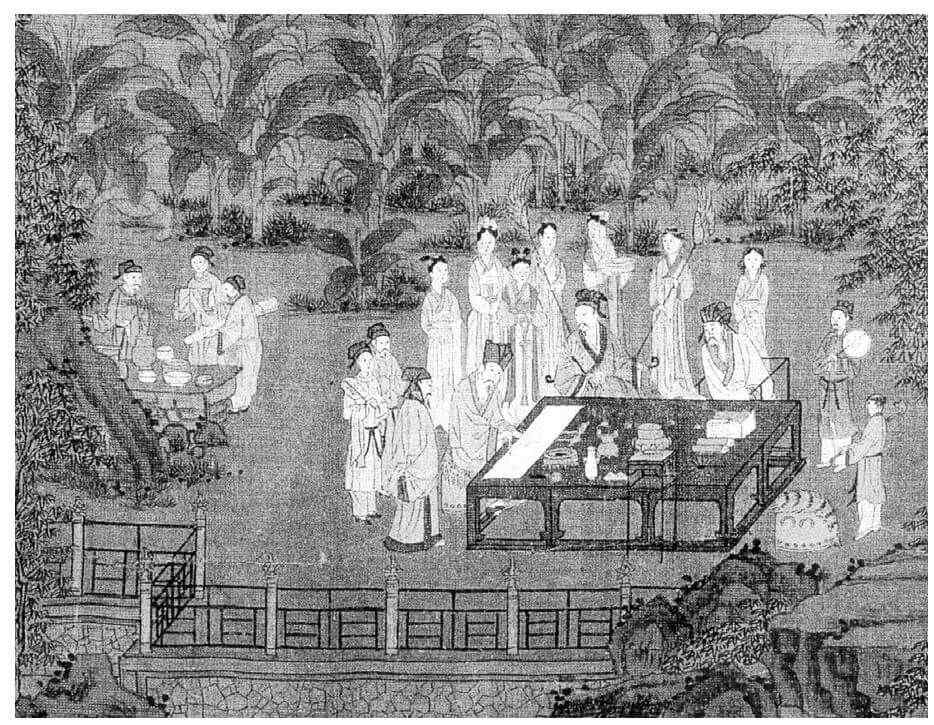
For ordinary people, becoming an emperor is truly a great fortune, but for Li Yu, the last ruler of the Southern Tang Dynasty, it was a great misfortune. Although born into a royal family, Li Yu never had the slightest interest in being an emperor. He was completely ignorant of politics and was a true incompetent ruler; however, he had profound artistic achievements, mastering poetry, painting, and music without exception. He is hailed by later generations as the "Emperor of Ci Poetry" because of his extremely high accomplishments in writing ci poetry, producing timeless works such as "The Beautiful Lady Yu," "Crying at Night," and "Waves Scouring the Sand." Li Yu's creative output can be roughly divided into two stages: the first stage was before the fall of his kingdom, during which his ci poems mainly focused on love and life in the imperial palace; the second stage was after the fall of his kingdom, during which his ci poems mainly focused on the sorrow of national subjugation, which was also his golden period of creation, with most of his masterpieces written during this time. Who doesn't know his immortal line from this period: "Ask me how much sorrow I can bear, it's like a river of spring water flowing eastward"?
Such a brilliant literary genius ended up becoming an emperor—this was both a helpless fate and a tragedy. In the early days of the Southern Tang Dynasty, the kingdom was once powerful and prosperous. However, during the reign of Li Yu's father, Li Jing, the kingdom's strength gradually declined, forcing it to submit to the Northern Zhou. By the time Li Yu ascended the throne, the Southern Tang was already in ruins. Compounding this, Li Yu was incompetent and foolish, making a series of grave mistakes in handling state affairs, which led to the rapid decline of the Southern Tang.
After Zhao Kuangyin established the Northern Song Dynasty, Li Yu first tried to bribe him with wealth and gifts, then directly wrote a letter expressing his willingness to submit as a vassal. However, these concessions did not save the Southern Tang Dynasty. Zhao Kuangyin dispatched an army of 100,000 troops to attack the Southern Tang, and by the time they reached the city walls, Li Yu was completely unaware. When he finally discovered the situation, he immediately sent Xu Xuan to negotiate for peace. Zhao Kuangyin replied, "How can I tolerate another snoring beside my bed?" With that, he dashed Li Yu's extravagant hope of preserving the Southern Tang.
Li Yu was ultimately defeated by the Song army, leading to the fall of the Southern Tang kingdom. He then became a captive of Zhao Kuangyin, was taken to Kaifeng, and was granted the title of the Marquis of Defiance. During his captivity, Li Yu wrote the timeless masterpiece "The Beautiful Lady Yu" to express his grief over the loss of his kingdom. Upon learning of this, Zhao Kuangyin flew into a rage, believing that Li Yu harbored intentions of restoration and should not be allowed to live, so he poisoned him with strychnine. Strychnine, gelsemium, and crane's bill are the three most notorious poisons in ancient Chinese history. In ancient China, when an emperor wanted to order the death of a consort or minister, strychnine was often used.
When Li Yu died, his head and feet were bent together, resembling a hand-operated loom in working condition, which is why the poison strychnine is also called "loom medicine." After Li Yu's death, to display his magnanimity, Zhao Kuangyin ordered former officials of the Southern Tang Dynasty to write Li Yu's epitaph, posthumously conferred upon him the title of Prince of Wu, and gave him a lavish burial. To express mourning, Zhao Kuangyin also refrained from holding court for three consecutive days.
During Li Yu's brief life, aside from his poetry, what he was most renowned for was his love story with Empress Zhou the Elder. Empress Zhou the Elder, whose given name was Ehuang, was one year older than Li Yu. She was beautiful, gentle, and exceptionally talented. Although the Southern Tang harem was filled with countless beauties, Empress Zhou the Elder alone captured all of Li Yu's affection. Many of Li Yu's poems depict his feelings for Empress Zhou the Elder; it can be said that she, with her beauty and talent, provided him with endless creative inspiration. Unfortunately, before she turned thirty, Empress Zhou the Elder fell ill and passed away. Overwhelmed with grief, Li Yu attempted to throw himself into a well to join her in death, but was fortunately rescued in time. Such deep devotion was truly rare among emperors, who were often known for their fickleness.