Pinyin: Chenxiang
Aliases
Mihiang, Chenshuixiang, Jiananxiang.
Source
Thymelaeaceae plant *Aquilaria sinensis* (Lour.) GilgAquilaria sinensis(Lour.) Gilg resinous wood.
Botanical Description
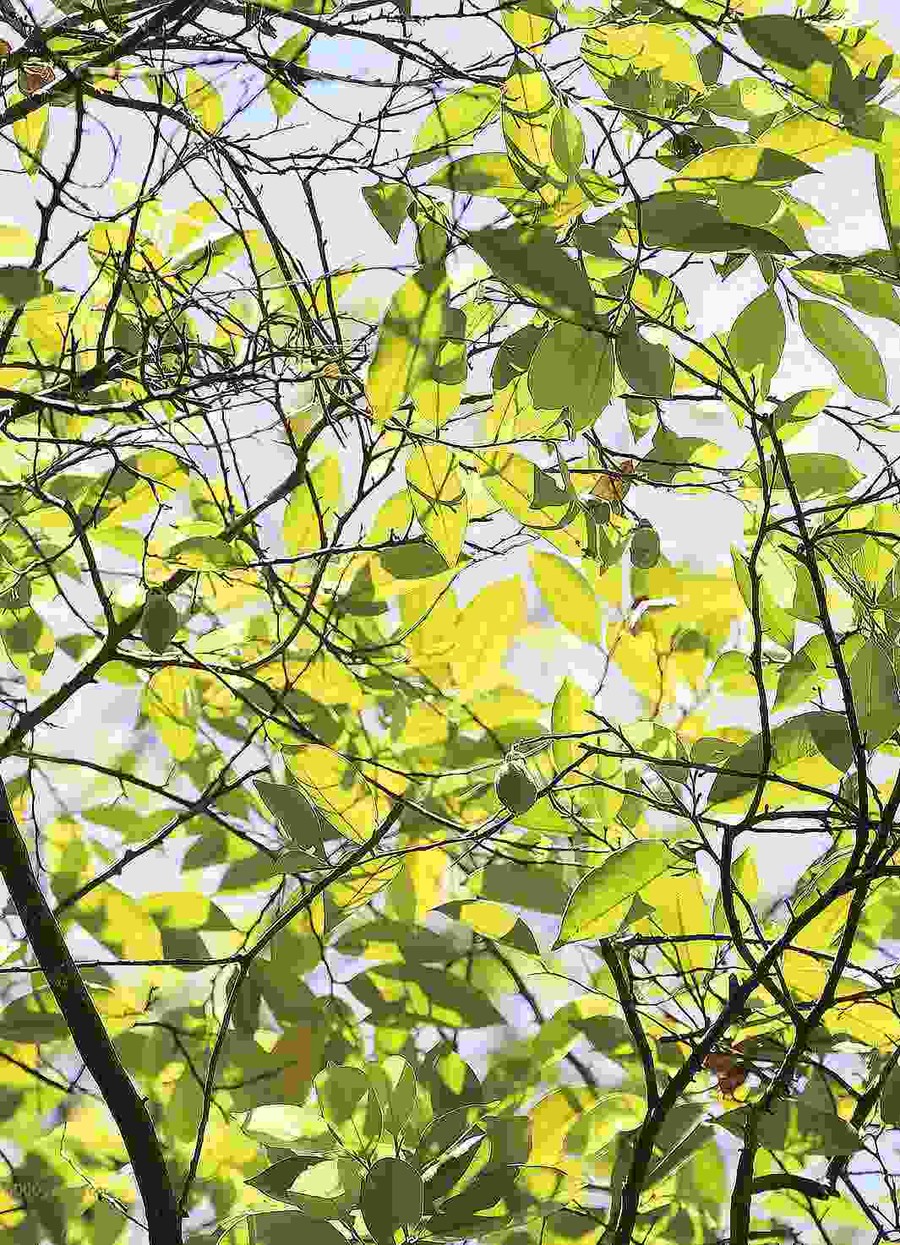
Evergreen tree, up to 15 m tall. Bark grayish-brown; young branches, petioles, and inflorescences covered with pubescence or white tomentose. Leaves alternate; petiole about 5 mm long; leaf blade leathery, long-ovate, obovate, or elliptic, 6-12 cm long, 2-4.5 cm wide, apex acuminate, base cuneate, margin entire, both surfaces sparsely hairy, becoming glabrous and glossy. Umbels terminal and axillary; pedicels 0.5-1.2 cm long; flowers yellowish-green, tomentose; perianth campanulate, 5-lobed, oblong, about 7 mm long, about 4 mm wide, apex obtuse and rounded, throat of perianth tube with 10 scales, densely white-tomentose, about 5 mm long, base united into a ring; stamens 10, filaments stout; ovary ovoid, densely tomentose. Capsule obovoid, woody, compressed, 2.5-3 cm long, densely gray-white hairy, base with slightly woody persistent perianth. Seeds black-brown, ovoid, about 1 cm long, apex acuminate, base prolonged into a horn-like appendage, reddish-brown, up to 2 cm long, upper part enlarged. Flowering March to May, fruiting May to June.
Habitat and Distribution
Born in sparse forests or barren mountains on flatlands and hills, with limited cultivation. Distributed in Fujian, Taiwan, Guangdong, Hainan, and Guangxi.
Harvesting and Processing
It can be harvested year-round, cut the resin-containing wood, remove the parts without resin, and dry in the shade.
Medicinal Properties
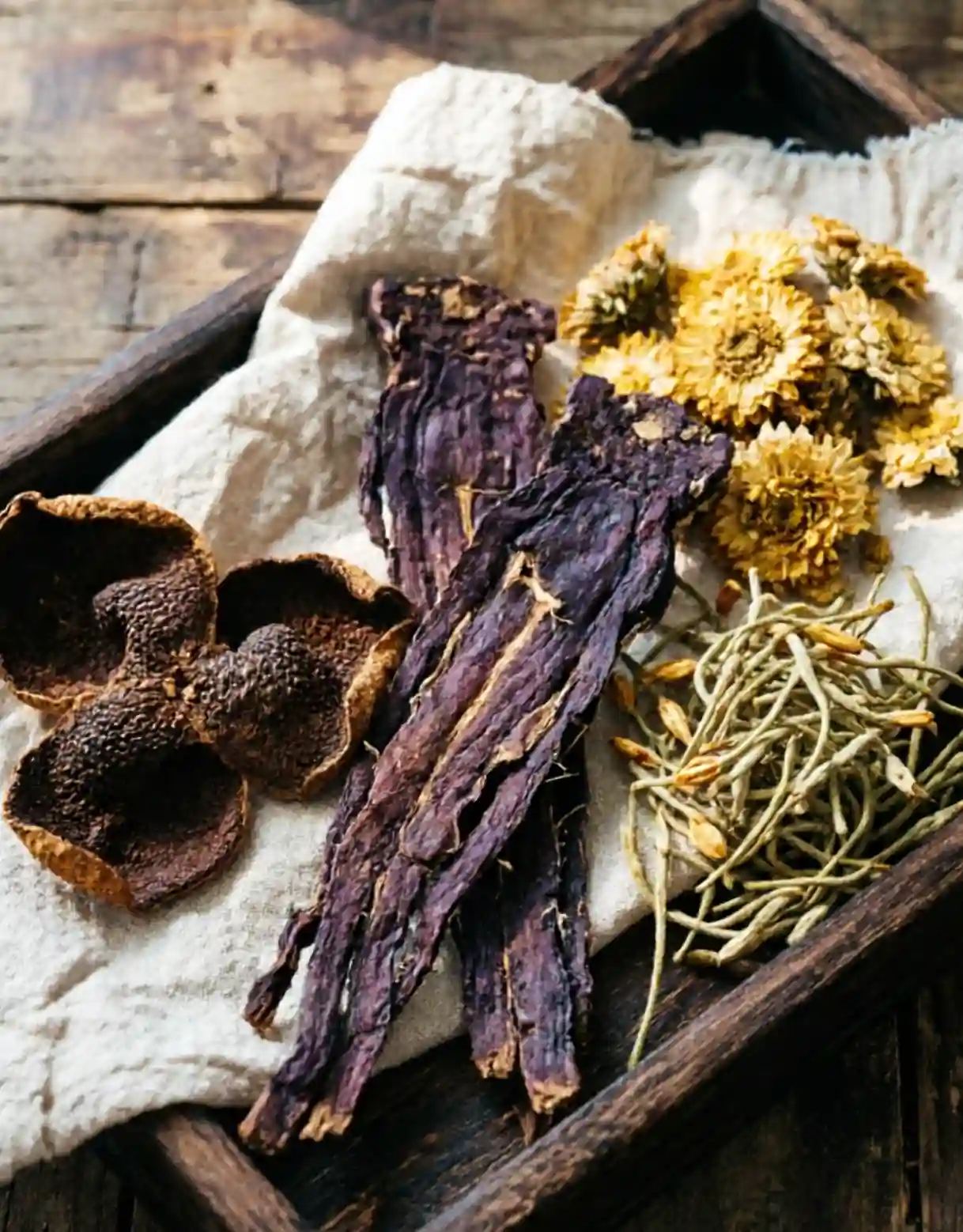
This product appears as irregular lumps, slices, or helmet-shaped pieces, some being small fragments. The surface is uneven with knife marks and occasional holes, showing alternating blackish-brown resin and yellowish-white xylem markings, with the surface of holes and depressions mostly appearing decayed. The texture is relatively firm. The fracture surface is prickly. Odor: aromatic; Taste: bitter.
Chemical Constituents
This product primarily contains volatile oils and chromone derivatives as its main chemical constituents. These include agarospirol, baimuxinic acid, baimuxinal, baimuxinol, dehydrobaimuxinol, baimuxifuranaldehyde, baimuxifuranol, 5,8-dihydroxy-2-(2-p-methoxyphenylethyl)chromone, and anisic acid.
Pharmacology
Can relieve intestinal smooth muscle spasms, inhibit the central nervous system, etc.
Properties and Channel Entry
Pungent, bitter, and slightly warm. Enters the Kidney, Spleen, and Stomach channels.
Functions and Indications
Promotes Qi circulation and alleviates pain, warms the Middle Jiao and stops vomiting, absorbs Qi and calms wheezing. Used for chest and abdominal distension and pain, gastric cold with vomiting and hiccups, Kidney deficiency with Qi counterflow and wheezing.
Dosage and Administration
Oral administration: decoct 2-5 g, add later; grind into powder 0.5-1 g; or take after grinding into juice.
Precautions and Contraindications
Patients with Yin deficiency and Effulgent Fire, or Qi deficiency and Sinking Qi, should use with caution.
Prescriptions
1. For abdominal distension, wheezing, and inability to sit or lie down: Chenxiang (Aquilariae Lignum Resinatum) and Zhiqiao (Aurantii Fructus) 15 g each, fried Luobozica (Raphani Semen) 30 g. Take 15 g per dose with three slices of ginger, decoct in water and take orally. (From "Chishui Xuanzhu" - Chenxiang Yin) 2. For cold phlegm with deficient heat, and consumptive cold and heat patterns: Chenxiang (Aquilariae Lignum Resinatum) and processed Fuzi (Aconiti Radix Lateralis Praeparata). Grind the ingredients, decoct and leave overnight to steep. Take on an empty stomach. (From "Danliao Jiyan Fang" - Lengxiang Tang) 3. For all types of wheezing: Chenxiang (Aquilariae Lignum Resinatum) 60 g, Laifuzi (Raphani Semen, washed clean, steamed until cooked, sun-dried) 150 g. Grind into a fine powder, form into small pills using ginger juice. Take 0.8 qian (approximately 2.4-3.2 g) per dose, swallowed with boiling water. (From "Dantai Yu'an" - Erxian Dan) 4. For prolonged hiccup due to stomach cold: Chenxiang (Aquilariae Lignum Resinatum), Zisu (Perillae Folium), and Baidoukou (Amomi Fructus Rotundus) 3 g each. Grind into powder. Take 1.5-2.1 g per dose, swallowed with a decoction of Shidi (Kaki Calyx). (From "Huoren Xintong") 5. For mental restlessness, depression and unhappiness, failure of fire to descend, occasional tremors or twitching, to reduce Yin and nourish Fire, and to settle the Heart Qi: Fushen (Poria Sclerotium Pararadicis, peeled) 60 g, Chenxiang (Aquilariae Lignum Resinatum) 15 g. Grind both into a fine powder, form into honey pills the size of small red beans. Take 30 pills per dose after meals, swallowed with a decoction of Renshen (Ginseng Radix et Rhizoma). This is very effective. (From "Bai Yi Xuan Fang" - Zhuque Wan) 6. For bladder dysfunction (retention of urine) caused by holding urine too long, which should be treated by regulating Qi to restore function, not by diuretic herbs: Chenxiang (Aquilariae Lignum Resinatum) and Muxiang (Aucklandiae Radix) 6 g each, ground into powder. Take on an empty stomach with plain boiling water, continue until urination is restored. (From "Yilei Yuanrong")