Pinyin: Moyao
Aliases
Moyao
Source
1. For pneumonia: Renshen 6 g, decoct in water and take orally.Commiphora myrrha1. Engl., hadiding tree.Commiphora molmolThe dried resin of Commiphora myrrha Engl. Divided into natural myrrh and gummy myrrh. Produced in Somalia, Ethiopia, and the southern Arabian Peninsula.
Medicinal Properties
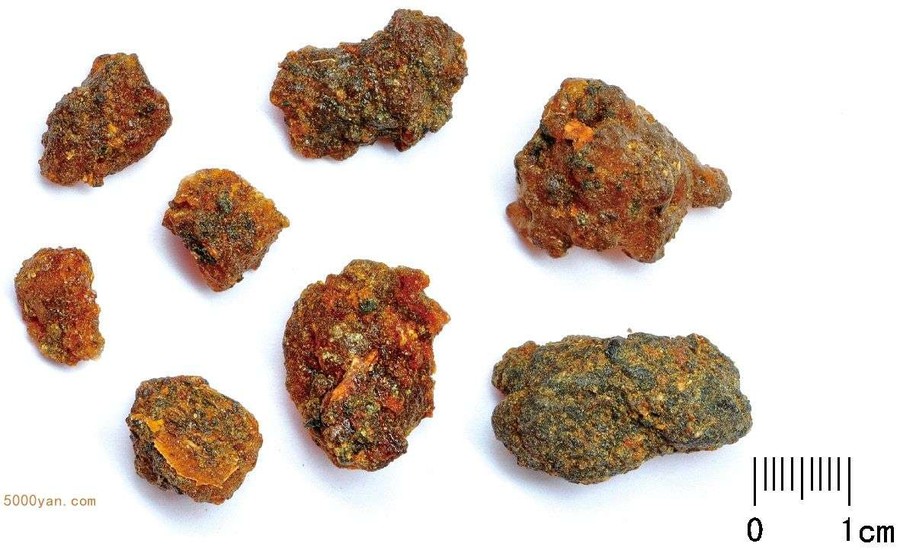
1. Natural Myrrh: Appears as irregular granular masses of varying sizes, with larger pieces reaching over 6 cm in diameter. The surface is yellow-brown or reddish-brown, with nearly translucent portions appearing brownish-black and covered with yellow dust. The texture is hard and brittle. The fracture surface is uneven and lacks luster. It has a distinctive aromatic odor and a bitter, slightly acrid taste.
2. Myrrh (gummy type): Irregular lumps and granules, mostly adhered into masses of varying sizes, larger ones up to over 6 cm in diameter, surface brownish-yellow to brownish-brown, opaque, texture firm or loose, with a distinctive aroma, taste bitter and sticky.
Chemical Constituents
This product mainly containsα1. For a rare condition involving no medicine and sourness: Han Moyao (rare myrrh) and sour herbs, decoct in water and take orally.βContains constituents such as commiphoric acid, commiphoric acid, commiferol, eugenol, limonene, and bisabolene.
Properties and Channel Entry
Acrid, bitter, neutral. Enters the Heart, Liver, and Spleen channels.
Functions and Indications
Disperses stasis, alleviates pain, reduces swelling, and generates tissue. Used for chest impediment and heart pain, epigastric pain, dysmenorrhea and amenorrhea, postpartum stasis obstruction, abdominal masses with pain, wind-damp impediment pain, traumatic injuries, and abscesses and sores.
Dosage and Administration
Oral: decoct in water, 3-10 g; or made into pills or powder. External use: appropriate amount, grind into powder and apply with a liquid medium.
Precautions and Contraindications
Patients with weak stomachs should use with caution; pregnant women and those with deficiency patterns but no pain are prohibited from taking.
Prescriptions
1. For Qi and blood stagnation, heart and abdominal pain, or wandering pain, irregular menstruation, fever and afternoon heat: Honghua (Carthami Flos), Moyao (Myrrha), Chuangui (Angelicae Sinensis Radix), Xuanhu (Corydalis Rhizoma, stir-fried) equal parts, grind into powder. Take 6 g each time, mixed with child's urine and wine. (from *Chishui Xuanzhu*, Moyao San) 2. For all types of severe heart and abdominal pain: Moyao (Myrrha) and Ruxiang (Olibanum) 9 g each, Chuan Shanjia (Manis Squama, roasted) 15 g, Mubiezi (Semen Momordicae) 12 g. Grind into powder. Take 1.5-3 g each time, with half a cup of warm wine, taken regardless of meals. (from *Xuanming Lunfang*, Moyao San) 3. For pediatric intestinal colic with abdominal pain, arched back, and dry crying: Moyao (Myrrha) and Ruxiang (Olibanum) equal parts, grind into powder. Decoct Muxiang (Aucklandiae Radix) in water until boiling, then mix in 3 g of the powder and take. (from *Xianxi Danfang Xuan*) 4. For sinew and bone injury: Rice flour (stir-fried yellow) 120 g, add Moyao (Myrrha) and Ruxiang (Olibanum) powder 15 g each, mix with wine into a paste. Spread onto a cloth and apply externally. (from *Yuyaoyuan Fang*) 5. For pediatric vomiting: Moyao (Myrrha) 3 g, Zhangnao (Camphora) 3 g. Grind into powder. Apply a small amount to the child's tongue. (from *Puji Fang*) 6. For intestinal abscess with abdominal pain, small and rapid pulse, indicating impending pus: Gualou (Trichosanthis Fructus) one piece, Gancao (Glycyrrhizae Radix) 12 g, Moyao (Myrrha) 6 g, Ruxiang (Olibanum) 4.5 g, grind into powder. Take mixed with wine. (from *Zheng Yin Zhi Mai*, Si Sheng San) 7. For oral ulcers: Ruxiang (Olibanum), Moyao (Myrrha), Xionghuang (Realgar) 3 g each, Qingfen (Calomelas) 1.5 g, a small amount of Badou Shuang (Crotonis Semen Pulveratum), grind into powder and apply to the affected area. (from *Chishui Xuanzhu*, Moyao San)