Pinyin: Ruxiang
Aliases
Taxiang, Masidaji, Tianzexiang, Yuxiang.
Source
It is the plant of the Burseraceae family, *Boswellia* species.Boswellia carteriiResin exuded from the bark of *Garcinia hanburyi* Hook.f.
Medicinal Properties
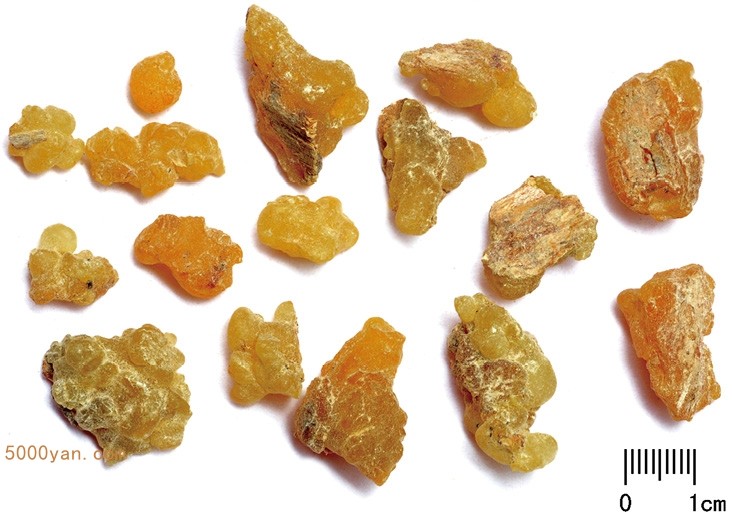
This product is in the form of elongated ovoid droplets, nearly round granules, or irregular lumps of varying sizes that adhere together. The larger pieces can reach up to 2 cm (Frankincense pearls) or 5 cm (raw Frankincense) in length. The surface is yellowish-white, semi-transparent, and covered with a yellowish-white powder; the color deepens upon prolonged storage. It is brittle and softens when heated. The fractured surface exhibits a glassy or waxy luster. It has a distinctive aromatic odor and a slightly bitter taste.
Chemical Constituents
This product mainly containsαInternal use: decoct 3-10 gβMastic acid, mastic hydrocarbon, combined mastic acid, pinene, dipentene,αInternal use: decoct 3-10 gβ- Water celery alkene and other components.
Pharmacology
It has anti-gastric and duodenal ulcer effects, as well as anti-inflammatory effects, influences cellular and humoral immunity, and also has cholesterol-lowering and analgesic effects.
Properties and Channel Entry
Pungent, bitter, slightly warm, enters the Heart, Liver, and Spleen channels.
Functions and Indications
Activates Blood, alleviates pain, reduces swelling, and generates tissue. Used for chest Bi (chest impediment) and heart pain, epigastric pain, dysmenorrhea and amenorrhea, postpartum Blood stasis obstruction, abdominal masses with pain, Wind-Damp Bi pain (rheumatic pain), tendon and vessel spasm, traumatic injury, and carbuncles, furuncles, and sores.
Dosage and Administration
Oral: decoct 3-10 g in water; or prepared as pills or powder. External use: appropriate amount, ground into powder for topical application.
Precautions and Contraindications
Those with weak stomachs should use with caution; pregnant women and those without blood stasis should avoid taking it.
Prescriptions
1. For acute heart pain: Hujiao (Black Pepper) 49 grains, Ruxiang (Frankincense) 3 g. Grind into powder. For men, take with ginger decoction; for women, take with Danggui (Angelica sinensis) decoction. (Choudao San from *Shesheng Zhongmiao Fang*) 2. For intractable migraine pain: Ruxiang (Frankincense) (the size of a soapberry), Gaoliangjiang (Alpinia officinarum) (the size of a finger). Burn the two ingredients over a fire and inhale the smoke through the nostril corresponding to the side of the headache. (Ruxiang San from *Shengji Zonglu*) 3. For red and white vaginal discharge: One Caoguo (Amomum tsaoko) (peeled), add one small piece of Ruxiang (Frankincense), wrap in flour, roast over a fire until scorched yellow, retaining the medicinal property. Remove and use with the flour. Grind into fine powder. Take 6 g per dose, mixed with aged rice decoction; for severe cases, take 9 g. (Ruxiang San from *Furen Liangfang*) 4. For acute or chronic infantile convulsions: Ruxiang (Frankincense) 15 g, Gansui (Euphorbia kansui) 15 g. Grind together into a fine powder. Take 1.5 g per dose, mixed with Ruxiang (Frankincense) decoction. (From *Boji Fang*) 5. For red mouth sores: Ruxiang (Frankincense) and Moyao (Myrrh) 3 g each, Baifan (Alum) 1.5 g, Tonglü (Copper Green) a small amount. Grind into powder and apply. (Ruxiang San from *Yixue Gangmu*) 6. For mouth sores: Ruxiang (Frankincense), Moyao (Myrrh), and Xionghuang (Realgar) 3 g each, Qingfen (Calomel) 1.5 g, and a small amount of Badoushuang (Croton seed frost). Grind into powder and apply. (From *Zhengzhi Zhunsheng*)