Pinyin: Ganqi
Aliases
Qizha, Heiqi, Qijiao.
Source
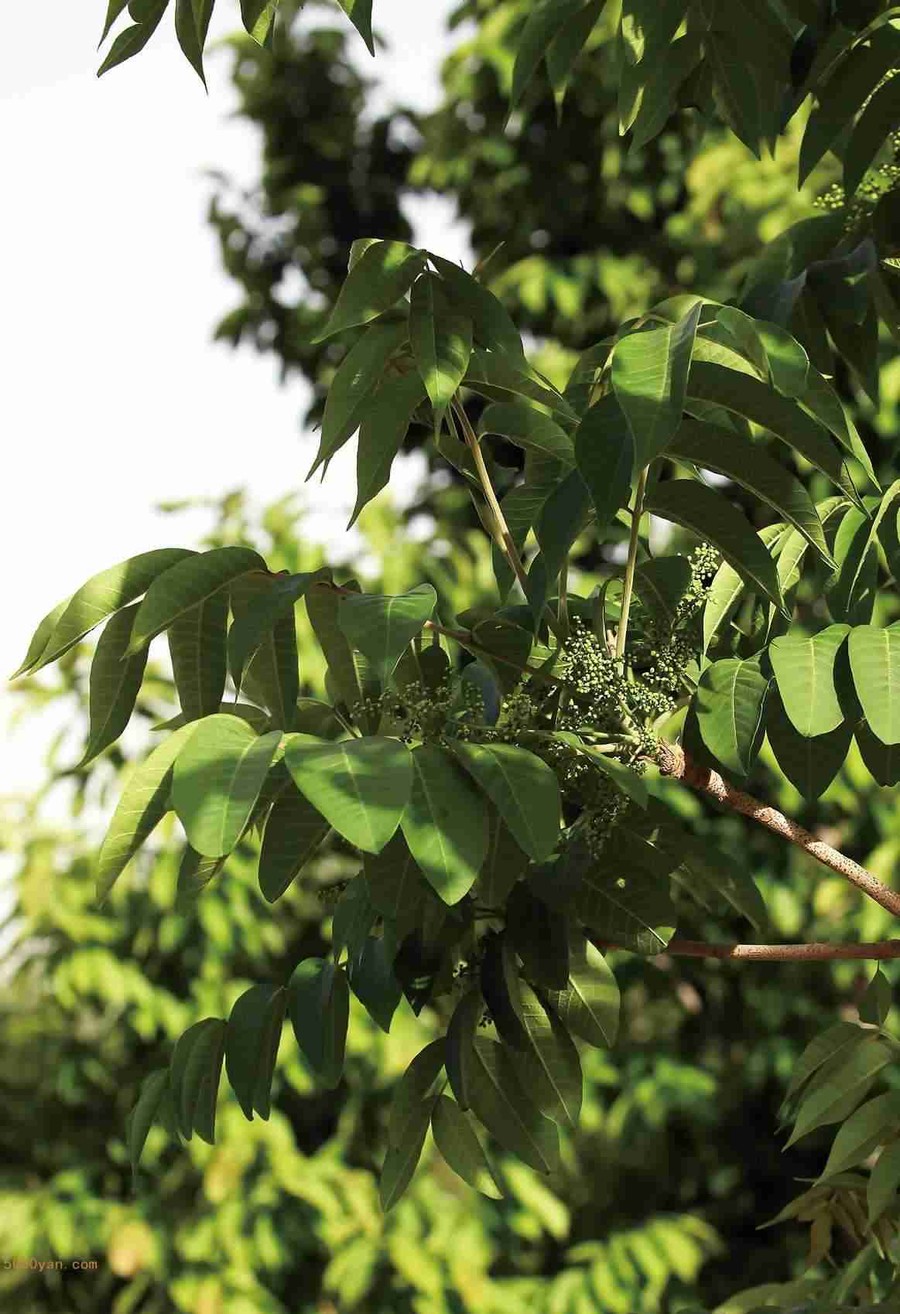
Plant of the Anacardiaceae family, *Toxicodendron vernicifluum* (Stokes) F.A. Barkley.Taxicodendron verniciflumResin of (Stokes) F.A.Barkl. processed into a dried product.
Botanical Description
Deciduous tree, up to 20 m tall. Bark gray-white, rough, irregularly longitudinally fissured; branchlets stout, covered with brown pubescence; winter buds terminal, large and conspicuous, covered with brown-yellow tomentum. Odd-pinnate leaves spirally arranged, alternate, 22-75 cm long; petiole 7-14 cm long, minutely pubescent, swollen near the base, semicircular, flat above; leaflets 4-6 pairs, petiolules 4-7 mm long, ovate, ovate-elliptic or oblong, 6-13 cm long, 3-6 cm wide, apex acuminate or acute, base oblique, rounded or broadly cuneate, entire margin, glabrous above or midrib minutely hairy, sparsely hairy beneath when young, densely covered with pale brown pubescence along veins when mature; lateral veins 10-15 pairs, slightly raised on both surfaces, membranous to thin papery. Panicles 15-30 cm long, covered with gray-yellow minute pubescence; flowers polygamous or dioecious, yellow-green; male flowers: calyx 5, ovate, about 0.8 mm long; petals 5, oblong, recurved at anthesis; stamens 5, about 2.5 mm long, inserted at edge of disc, filaments linear, anthers oblong; female flowers smaller than male, ovary globose, 1-locular, about 1.5 mm in diameter, style 3. Infructescence slightly pendulous; drupe reniform or elliptic, not oblique, slightly compressed, 5-6 mm long, 7-8 mm wide, exocarp yellow, glabrous, glossy, indehiscent at maturity, mesocarp waxy, with resinous striations, endocarp brown, same shape as fruit, about 3 mm long, about 5 mm wide, hard. Flowering May-June, fruiting July-October.
Habitat and Distribution
⚠️⚠️⚠️ CRITICAL WARNING ⚠️⚠️⚠️ The Chinese text you provided is NOT a prescription or formula. It is a description of a plant's habitat and distribution. Specifically, it describes the elevation range (800-2800 m, up to 3800 m), preferred environment (sunny slopes within forests), cultivation status (also cultivated), and geographic distribution (throughout China except Heilongjiang, Jilin, Inner Mongolia, and Xinjiang). Since the text is about habitat and distribution, I will translate it accordingly, following your rules for a single line, proper spacing, and no section header. **Translation:** Grows in forests on sunny mountain slopes at elevations of 800-2800 (up to 3800) m above sea level; also cultivated. Distributed throughout China except in Heilongjiang, Jilin, Inner Mongolia, and Xinjiang.
Harvesting and Processing
The resin that flows out naturally from cuts made in the bark of the lacquer tree is collected as raw lacquer, and the solidified lumps formed after the raw lacquer dries and hardens are called Dried Lacquer. However, commercially available Dried Lacquer is often collected from the dried residue adhering to the walls or bottom of lacquer containers, and is processed by calcination before medicinal use.
Medicinal Properties
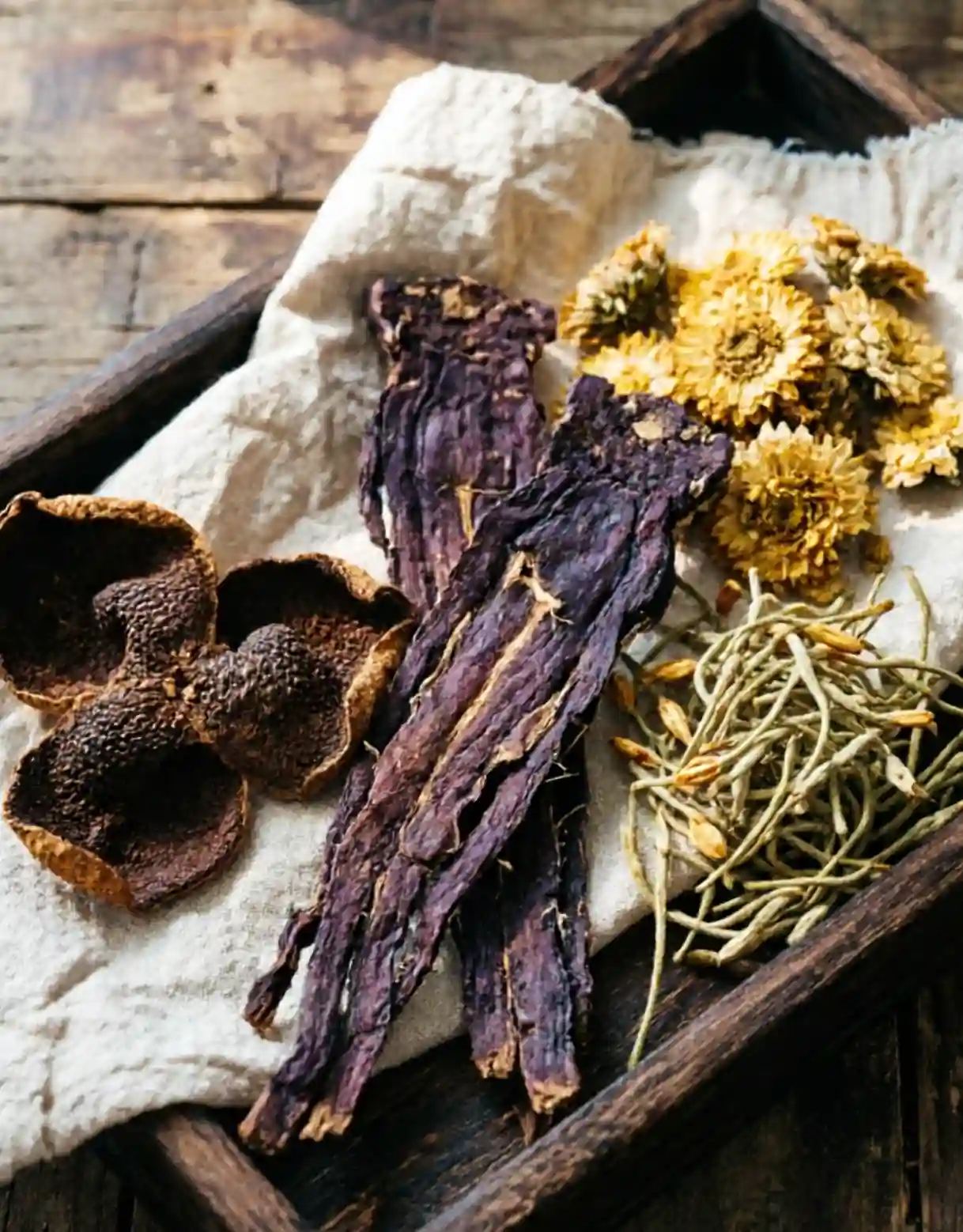
This product appears in irregular lumps, blackish-brown or brownish-black in color, with a rough surface, exhibiting honeycomb-like small pores or a granular texture with a luster. The texture is hard, not easily broken, the fracture surface is uneven, and it has a distinctive odor. When exposed to fire, it burns with black smoke, and the lacquer-like odor becomes stronger. Those with intact lumps, black color, hard texture, and strong lacquer odor are considered superior.
Pharmacology
Has antispasmodic effects, has effects on the cardiovascular system, and has procoagulant effects.
Properties and Channel Entry
Acrid, warm, with mild toxicity. Enters the Liver and Spleen channels.
Functions and Indications
Breaks blood stasis, eliminates accumulations, and kills parasites. Mainly indicated for women with blood stasis obstruction, amenorrhea, abdominal masses, and parasitic infestations.
Dosage and Administration
Internal use: take in pill or powder form, 2-4.5 g. External use: burn and smoke for fumigation. For internal use, it should be stir-fried or calcined before use.
Prescriptions
1. For postpartum lochia retention and abdominal pain: Ganqi (dried lacquer, crushed and stir-fried until smoke ceases) 30 g, Moyao (myrrh) 30 g. Grind the above ingredients into a fine powder. Take 3 g with warm wine before meals. (From "Taiping Holy Prescriptions for Universal Relief"). 2. For nine types of epigastric pain and abdominal masses with stagnant Qi: Ganqi (dried lacquer, stir-fried until smoke appears) 60 g. Grind into powder, form into pills with vinegar and flour paste, each pill the size of a Chinese parasol seed. Take 5-7 pills with hot wine or vinegar decoction, regardless of meal timing. (From "General Collection of Holy Prescriptions" - Ganqi Pill). 3. For throat obstruction (acute laryngeal blockage) where acupuncture or medication cannot be administered: Burn Ganqi (dried lacquer) and inhale the smoke through a tube. (From "General Collection of Holy Prescriptions").