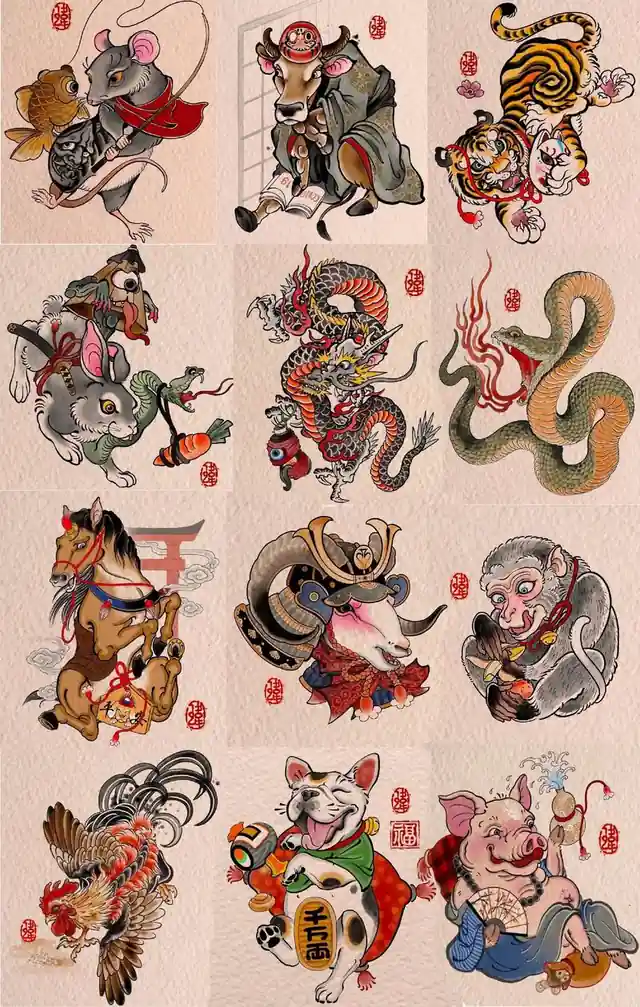
The dragon is a household name and known to all in China, yet there is no consensus on the question of "what is the essence of the dragon." The essence of the dragon not only relates to people's attitudes toward and worship of the dragon but also has a significant influence on the formation of the concept of the dragon.
Almost every Chinese person holds a concept of dragon worship, but what is the true essence of the dragon? How exactly did the "concept of the dragon" of the Chinese nation form over several thousand years? These questions are not only central to dragon culture but also determine the development direction and changing trends of the entire dragon culture.
Any cultural phenomenon or element evolves continuously with the development of society, and the concept of the Dragon is no exception. Therefore, the Dragon culture should be examined within the transformative currents of social history, taking into account various factors for a comprehensive investigation. Only by adopting a historical and developmental perspective can we hope to arrive at the correct understanding.
According to research, dragon culture had already emerged in China as early as the Paleolithic period. After thousands of years of development and transformation, people's perceptions of dragon culture have undergone significant changes, which can be roughly divided into two stages: first, the totem stage, during which people regarded the dragon as a totem and viewed it as their own kin and ancestor; second, the deity stage, as the concept of divine beings emerged, people elevated the dragon to the status of their ethnic god. Of course, the transition from totemic belief to divine belief was not a simple replacement. Within the concept of deities, traces of primitive totem worship still remained, and certain cultural elements from the totem were preserved. It is precisely because of the ambiguity and uncertainty surrounding the dragon as both a totem and a deity that various speculations about the true nature of the dragon have arisen over the centuries.
First, the Dragon is a divine and mystical creature, one of the Four Auspicious Beasts (Siling)
Second, the dragon is considered the chief of the scaly creatures and a master of transformation. According to Shuowen Jiezi (Explaining Graphs and Analyzing Characters), Volume 11, Part 2: "The dragon is the chief of the scaly creatures. It can be dark or bright, thin or thick, short or long. It ascends to the heavens at the spring equinox and descends into the abyss at the autumn equinox." In Lunheng (Discourses Weighed in the Balance), Volume 2, Chapter "Wuxing" (On Forms): "The dragon, as a creature, now appears, now vanishes, now short, now long. Its nature is to change in an instant, always extraordinary." In Lunheng, Volume 6, Chapter "Longxu" (On the Dragon's Emptiness): "Humans are the chiefs of the hairless creatures, while dragons are the chiefs of the scaly creatures. Both are leaders among beings. If it is said that dragons ascend to heaven, do humans also ascend? Dragons and humans are alike. To claim that only dragons can ascend to heaven is to say that dragons are divine." It is also recorded: "It is said that there are three hundred scaly creatures, with the dragon as their chief. As the chief of the scaly creatures, how could the dragon lack a form? Why say otherwise?"
Third, the Dragon is one of the divine beasts of the Five Directions. According to the "Treatise on the Patterns of Heaven" in the Huainanzi (The Masters of Huainan): "The East is wood, its sovereign is Taihao (Great Brightness), its assistant is Goumang (Twig and Bloom), who holds the compass and governs spring; its spirit is the Year Star (Jupiter), its beast is the Azure Dragon, its note is jue (the third pentatonic note), and its day is jia-yi (the first pair of Heavenly Stems). ... The Center is earth, its sovereign is the Yellow Emperor, his assistant is Houtu (Earth Sovereign), who holds the plumb line and regulates the four directions; its spirit is the Guardian Star (Saturn), its beast is the Yellow Dragon, its note is gong (the first pentatonic note), and its day is wu-ji (the fifth pair of Heavenly Stems)."
Fourth, the Dragon is a deity animal that governs rainfall. According to Zuo Zhuan (Zuo's Commentary on the Spring and Autumn Annals), it is recorded: "In the fifth year of Duke Huan's reign, for all sacrifices, the suburban sacrifice is performed after the insects awaken, and the Yu rain sacrifice is performed when the Dragon appears." Here, the Dragon was worshipped as a deity capable of bringing rain. The Yinglong (Responding Dragon) and Zhulong (Torch Dragon) mentioned in Shan Hai Jing (Classic of Mountains and Seas) also possess the divine power to control wind and rain.
In fact, people's understanding of dragon culture and the concept of the dragon has undergone a continuous process of development and change. In the ancient era when totem worship was prevalent, the dragon was merely the totem of a certain tribe, carrying a simple totemic meaning. Later, as society entered an agricultural era dominated by farming, the totem worship of the hunting age gradually declined, and the dragon was thus endowed with new meanings, such as becoming a deity that governs wind, clouds, thunder, and lightning. Its influence also expanded geographically, making it an object of worship for many ethnic groups and tribes. By the feudal period, the dragon was further utilized to serve the ruling class of feudal autocracy, becoming a symbol of politics and power. In modern times, the concept of the dragon has become even more generalized, evolving into a symbol of Chinese culture. Wherever there are Chinese people, or wherever Chinese culture has left its influence, traces of the dragon can be found. Within the sphere of Chinese cultural influence, the dragon has risen from a natural animal to a cultural and humanistic one.
Further Reading
The similarities and differences between the dragon in people's perception and the totem.
In people's perception, the dragon possesses some basic characteristics of a totem, such as the existence of social organizations named after the dragon in ancient times, beliefs that regard the dragon as an ancestor or an incarnation, and clans that use the dragon as their emblem and symbol. However, apart from these similarities, there are also differences between the dragon and typical totems. First, the dragon has the ability to ascend to the heavens and dive into waters, exhibiting unpredictable transformations, while totems generally lack such divine attributes. Second, legends hold that the dragon controls rainfall and possesses the power to summon clouds and rain, whereas totems do not have this function. Third, totems are usually living or non-living things found in nature, but the dragon is not; it is an animal image created by humans. Fourth, most of the Chinese nation venerates the dragon, whereas a totem is typically worshipped only by one or several clans or tribes. The similarities and differences between the dragon and totems suggest that the dragon may have evolved from primitive totem worship, but it was continuously enriched and refined through the changing currents of social history.