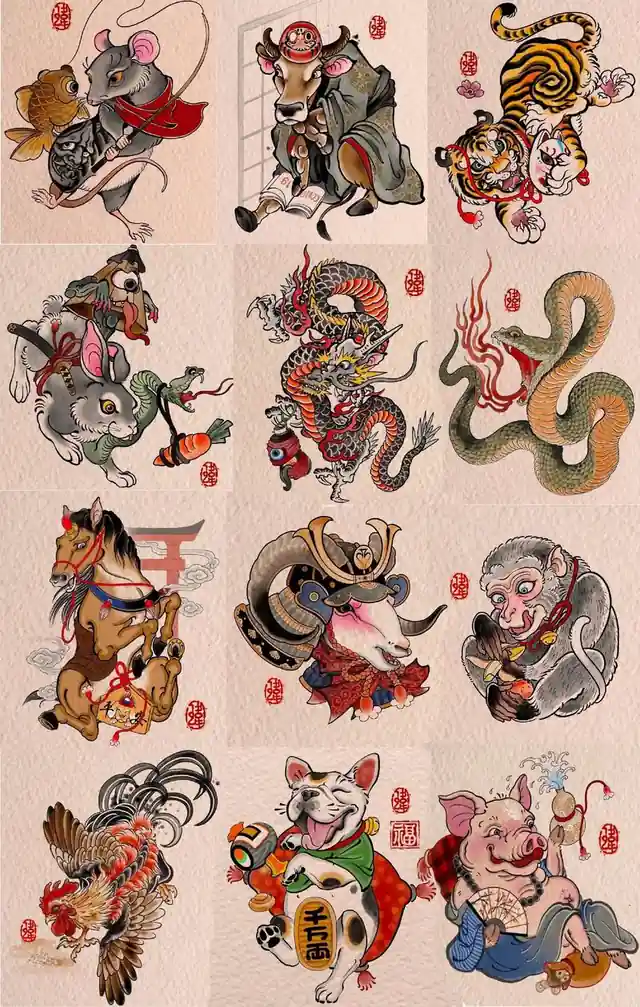
After thousands of years of historical and cultural development and transformation, the Dragon in the Chinese zodiac has long departed from its identity as a natural animal in people's perception. Instead, it has become an animal image imbued with humanistic attributes, holding special symbolic significance in folk culture.
If the image of the dragon on Chinese soil had merely remained at the stage of ordinary primitive totem worship or animal deity, it would not have exerted such immense influence among the Chinese people. Throughout China's five thousand years of history, the reason dragon culture has been able to flourish without decline is due to its symbolic significance that transcends the limitations of time and space.
A symbol of masculinity.
In the Chinese zodiac, the Dragon corresponds to the Earthly Branch "Chen." The original meaning of the character "Chen" referred to "male genitalia or a fertility deity beneath a rocky cliff." It later evolved to signify an important ancient earth sacrifice, which itself developed from the worship of male fertility. This gave rise to the cultural symbol "Chen," representing male reproduction. In the "Yijing (Book of Changes)," "Qian" is also regarded as a symbol of masculinity, and the Qian hexagram is known as the "Dragon Hexagram." From another perspective, the dragon's soaring flight and its imposing, aggressive aura do indeed share certain similarities with the vigorous and spirited nature of masculinity.
A symbol of imperial authority.
Due to the continuous deification of the dragon's image, especially after the Han Dynasty in feudal society, the "dragon," particularly the "yellow dragon," became an exclusive term for the ruling class and a symbol of emperors and imperial power. Various dragon-related titles emerged accordingly: the emperor's appearance was called "dragon countenance," his body "dragon form"; his clothing was termed "dragon robe," his seat "dragon throne," his bed "dragon couch," and his chariot "dragon carriage"; the emperor's ascension to the throne was called "dragon soaring," his walk "dragon stride and tiger step," and even his death was referred to as "the dragon driving his chariot to heaven." In short, everything associated with the emperor was linked to dragons. Rulers often leveraged the dragon's status and prestige among the Chinese people to maintain their political dominance. Emperors frequently declared themselves as "incarnate divine dragons" or "true dragon sons of heaven" to win people's trust and support.
Further Reading
The legendary relationship between the Dragon and the Chinese nation.
How did the dragon become associated with the Chinese nation? There are two ancient legends that explain this connection. According to the first legend, before unifying China, the Yellow Emperor (Huangdi) used the bear as his tribe's totem. After defeating Chiyou and unifying the country, the Yellow Emperor merged his own tribe's totem with those of other tribes to create a new totem image that could represent the collective worship of the Chinese nation — the dragon. This was done to foster unity and cohesion among the various tribes. According to the second legend, there were ten wise emperors in ancient times, including Fuxi, Zhurong, Shennong, the Yellow Emperor, Tang Yao, and Xia Yu. Among them, nine had human heads and human bodies, but Fuxi was depicted together with Nuwa, both having human bodies and dragon tails. It is said that after Fuxi and Nuwa married, they gave birth to humanity, becoming the ancestors of the Chinese nation. Thus, the dragon became linked with the Chinese nation. Regardless of which legend is considered, both embody people's use of the dragon to express the historical process of interethnic integration and unity, as well as their reverence for their ancestors.
Symbol of Success
It seems that within the consciousness of the Chinese people, the dragon has always been a symbol of "honor," "success," and "excellence." The traditional Chinese concept of "wang zi cheng long" (hoping one's child will become a dragon) reflects the desire for children to achieve outstanding success and become "a dragon among men." Some people even adopted "dragon" as a personal title, such as Zhuge Liang from "Romance of the Three Kingdoms," who styled himself "Master Wolong" (Crouching Dragon), hoping his talents would be recognized by a wise ruler. The "Dragon Gate" is regarded as a gateway to wealth and nobility, so passing the imperial examination was called "tiao long men" (leaping over the Dragon Gate), while failing was termed "long tou dian e" (the dragon's head nods) or "bao sai long men" (exposing the gills at the Dragon Gate). Bai Juyi's poem "Zui Bie Chen Xiucai" (Drunken Farewell to Scholar Chen) includes the line, "Five times I returned with a nod at the Dragon Gate."
The symbol of the Chinese nation
The image of the dragon in China is an idealized and mystical description of the dragon's form as conceived by ancient people. With "antlers like a deer, head like a camel, eyes like a rabbit, neck like a snake, belly like a clam, scales like a fish, claws like an eagle, paws like a tiger, and ears like an ox," it is a creature that combines the features of nine animals and has never existed in reality. This dragon image is a humanized "animal" created by the collective wisdom of ancient ancestors, reflecting the history of the Chinese nation's development and the process of the great integration of various ethnic groups.
For thousands of years, the image of the Dragon has been deeply engraved in the innermost hearts of every descendant of the Yan and Huang Emperors (ancestral figures of the Chinese nation). It has become deeply rooted in traditional Chinese culture and the national psyche, serving as both the spiritual refuge and emotional bond for all Chinese people. The children of China are often proud to call themselves "Descendants of the Dragon," and people of goodwill around the world refer to China as the "Oriental Dragon." The Dragon has thus become a symbol of the Chinese nation. In the minds of the Chinese people, the Dragon represents auspiciousness and harmony, longevity and prosperity. It symbolizes favorable weather for crops, long life for the people, abundant harvests, unity, and continuous vitality. At the same time, each part of the Dragon carries specific meanings: its prominent forehead signifies wisdom and intelligence; its deer antlers represent the state and longevity; its ox ears symbolize ranking first among scholars; its golden fish tail embodies flexibility; and its horse teeth represent diligence and kindness.
In summary, dragon culture has permeated every aspect of our social life, and the symbolic meaning of the dragon has become increasingly mature and rich with the development of Chinese culture, which to a certain extent has also greatly enriched and advanced the culture of the zodiac Dragon.