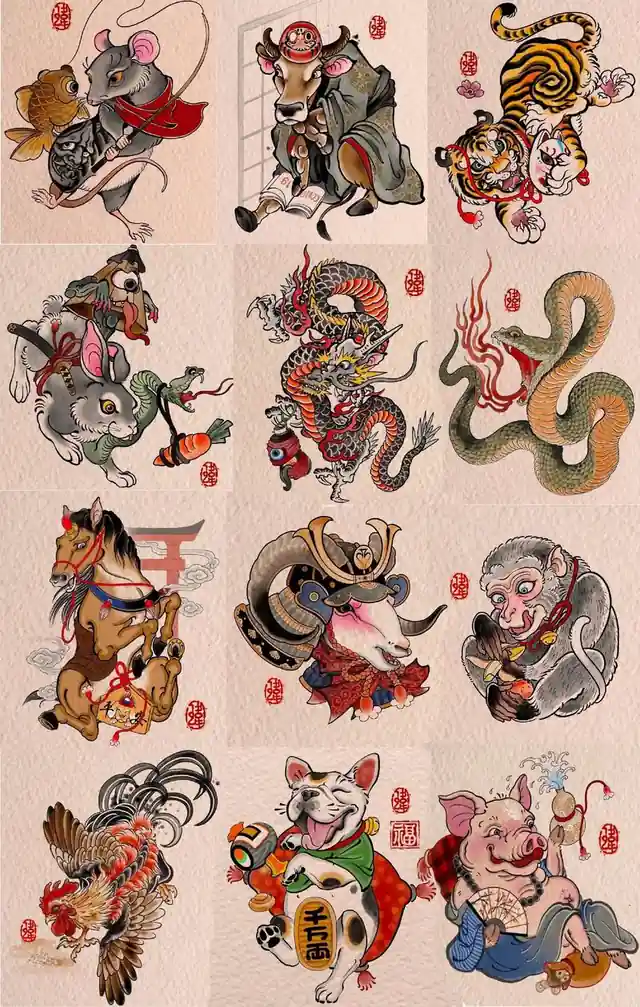
From the image of the dragon, its symbolic meaning, and its mythological legends, the dragon is inextricably linked to water. As the king of the waters, the dragon not only governs clouds and rain, bridging heaven and earth, but also influences folk customs.
The Chinese believe that the dragon's divine nature can be summarized by its affinity for water, love of flying, ability to reach the heavens, tendency to transform, manifestation of spiritual power, auspicious omens, harbinger of disaster, and display of authority. Among these, the dragon's love of flying, ability to reach the heavens, and power to bring rain are the decisive factors in the formation of the celestial dragon.
The Dragon, a bridge between heaven and earth.
Communication is the mode of existence for the world or life itself, as all things originate from the interaction of Yin and Yang. The ancients recognized early on the principle of heaven and earth uniting to nurture all things. Laozi stated: "The Dao gives birth to One, One gives birth to Two, Two gives birth to Three, and Three gives birth to all things." One refers to the primordial chaotic Qi, Two refers to the Yin and Yang of Qi transformation, and Three refers to the union or communication between heaven, earth, Yin, and Yang. What medium does heaven and earth use to communicate? It is precisely water. In the eyes of primitive peoples, rainwater was the most direct medium of communication between heaven and earth. The Guanzi says: "Water is the blood and Qi of the earth, flowing like the meridians and vessels." And the dragon is the symbol of water. The dragon's prototypes include fish, frogs, snakes, tigers, crocodiles, and eagles. When people in the Neolithic period depicted the patterns of these animals on painted pottery, they perhaps intended to harness the dragon's characteristic of communicating Yin and Yang, bringing vigorous vitality to the human world.
The core of communication lies in inheritance and adaptability, which is embodied in the ever-changing forms of the Dragon: its prototypes are diverse, including fish, snakes, crocodiles, frogs, tigers, eagles, clouds, thunder, lightning, rain, and rainbows; its body can be large or small, with skin colors ranging from cyan, red, yellow, white, and black; its living space is unrestricted, with land, sky, and oceans all serving as its home. These characteristics of the Dragon align with the colorless, tasteless, and formless nature of water (i.e., rain), meeting the needs of communication among all things and reflecting the life aspiration for conformity and development.
The dragon that moves clouds and dispenses rain
In the first volume of Guangyang Zaji (Miscellaneous Records from Guangyang) by Liu Xianting of the Qing Dynasty (1644-1912), a passage is cited from Li Changqing's Songxia Guan Zhuiyan (Supplementary Remarks from the Pine Cloud Pavilion), which elaborates on the relationship between the Dragon and water: "Chen corresponds to the third month," and the Chen hour corresponds to the modern time period of 7-9 AM, which is precisely the time when, according to myths and legends, the dragons perform their rain-making activities. Whether considering the month or the hour, there is always a connection between the Dragon and rain.
Water plays an absolutely vital role in all things. It sustains life, and neither animals nor plants can grow or develop without it. Water has created civilizations: people sail boats, fish, travel, and transport goods on rivers; they build dams for irrigation and thrive along riverbanks. However, water can also be harmful. Excessive rainfall can turn land into swamps, reduce civilizations to ruins, and cause loss of human life. Thus, people imagined the dragon to control the waters.
Since ancient times, the Dragon has been closely associated with water management. The "Huainanzi · Shuolin Xun" (Master Huainan's Forest of Sayings) states, "In times of drought, construct an earthen dragon." This means that during severe droughts, people would make dragons out of earth, sand, and stone to offer sacrifices, believing that the Dragon would see them and summon clouds and rain. "Lunheng · Luanlong Pian" (Discourses Weighed in the Balance, Chapter on Disturbed Dragons) says, "If an earthen tiger cannot summon wind, how can an earthen dragon bring rain?" This indicates that the practice of making earthen dragons to pray for rain was very common in ancient times. Since the Song Dynasty (960-1279), almost every village had a Dragon King Temple. Whenever there were floods or droughts, people would offer sacrifices to the Dragon King, pleading for it to control the rain, ensuring favorable weather and bountiful harvests.
In the view of ancient people, the dragon possessed supernatural powers such as riding clouds and mist, overturning rivers and seas, summoning wind and rain, and surging with boundless vitality. Although the dragon's ability to control water is merely a mythological legend, it truly reflects people's desire to harness natural forces and improve their living environment.
The Dragon Reborn Through Water
After a spring rain, small fish often appear in low-lying puddles, even if those puddles are not connected to rivers, lakes, or seas. Observing this phenomenon, ancient people might have speculated that the seeds of fish life lay hidden in the soil, awakening upon contact with water to break through the earth — a kind of resurrection from death. In primitive thinking, similar forms were believed to possess similar functions. A dragon's body is covered with fish scales, implying that the dragon evolved from a fish. As such, it shares the fish's vigorous vitality and can also be reborn when encountering water.
The dragon-summoning custom of the Miao ethnic group reflects the characteristic that dragons return with water. At the beginning of the dragon-summoning ritual, a young man stands in the center of the host's main hall holding a wooden hook. The shaman splashes water onto the young man's face, causing him to enter a trance-like state. He then walks out of the main door to search for the dwelling place of the divine dragon. Young women follow behind him, using clay pots to draw clear water from the location the young man identifies as the dragon's dwelling, and they gather this water into a single earthenware jar. After returning, they bury the jar containing the water underground, which is said to signify the divine dragon returning to its rightful place.
Further Reading
The saying and custom of "the Dragon drinking water"
After the rain clears, a beautiful rainbow often appears in the sky. Ancient people believed this was a dragon drinking water. They imagined that the dragon had exhausted the water stored in its body while making rain, so it had to lower its head into a river to replenish its supply. In the past, people from the Dong and Lisu ethnic groups in Guangxi, as well as those in the Wuyue region, believed that one must not point at a dragon drinking water (i.e., when a rainbow appears), or else one's hand would become deformed or break. Additionally, the double-dragon-headed jade huang unearthed from the Hongshan culture site in Liaoning, the double-headed rainbow pattern from the tomb of Fu Hao at Yinxu in Henan, and the Western Han "dragon-shaped rainbow diagram" excavated in Tanghe County, Henan, all depict a bow-like body with dragon heads at both ends. This shape is identical to the oracle bone script character for "rainbow" (虹).