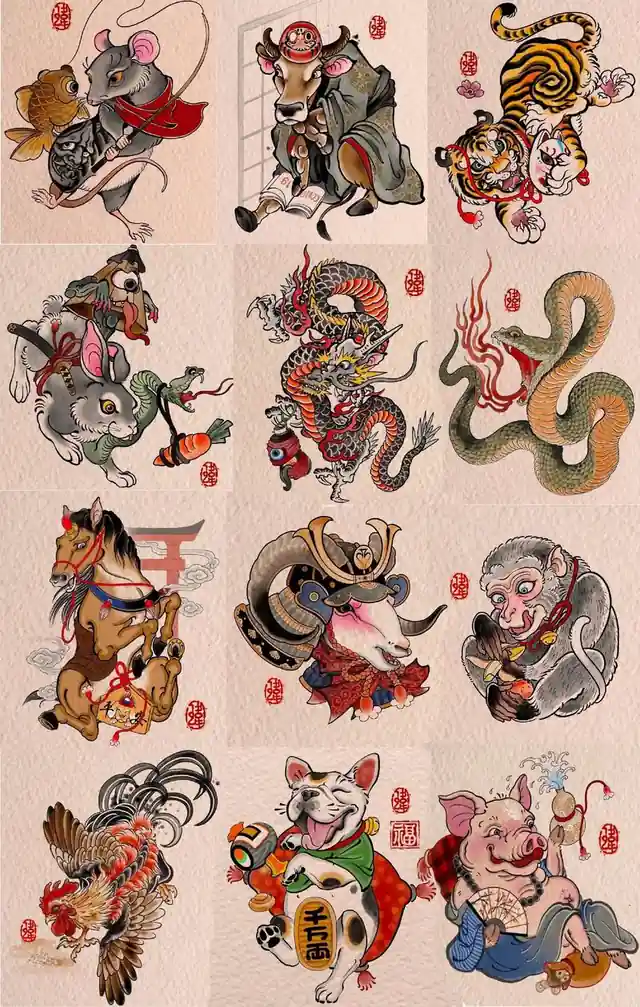
Spring is the season when all things revive, and the Dragon of the Chinese zodiac is a symbol of the Chinese nation. The combination of these two elements gives rise to an important festival in traditional Chinese folk culture: the "Dragon Raises Its Head" festival on the second day of the second lunar month. This festival gradually developed and perfected alongside the evolution of zodiac dragon culture, occupying a very significant position within it and thus deserving of exploration.
The second day of the second lunar month, commonly known as the Dragon Raises Its Head Day, is the traditional Spring Dragon Festival in China, also called the Green Dragon Festival or Zhonghe Festival, and was an important occasion in ancient agricultural society for praying for a bountiful harvest.
The second day of the second lunar month generally falls between Jingzhe (Awakening of Insects) and Chunfen (Spring Equinox). According to folk belief, the dragon, which brings clouds and rain, awakens during Jingzhe, raises its head on the second day of the second month, and ascends to the heavens by Chunfen. Whether there will be rainfall in early spring determines the year's harvest, so whether the dragon raises its head and ascends to the heavens on time to bring rain is naturally a matter of great importance to the people.
The confirmation of the second day of the second lunar month as the Dragon Raising Its Head Festival first appeared in Ming Dynasty records, which also included various folk customs and activities for this day. For instance, Shen Bang of the Ming Dynasty wrote in "Wan Shu Za Ji (Miscellaneous Records of Wanping County)": "People in the capital call the second day of the second month the Dragon Raising Its Head. Country folks use ashes to draw a winding path from outside the door into the kitchen and around the water vat, calling it 'Leading the Dragon Back.'" Liu Tong and Yu Yizheng of the Ming Dynasty recorded in "Di Jing Jing Wu Lue (A Brief Account of Scenes and Customs in the Imperial Capital)": "On the second day of the second month, the Dragon raises its head. People fry leftover New Year's sacrificial cakes and fumigate beds and kang (heated brick beds), calling it 'Fumigating Insects.' They say that by leading the dragon, insects will not emerge." Liu Ruoyu of the Ming Dynasty also stated in "Zhuo Zhong Zhi (A Record of Life in the Palace)": "On the second day of the second month, the colored decorations placed at various palace gates are removed. Every household fries cakes made from millet flour and jujubes, or makes thin pancakes from diluted white flour, calling this 'Fumigating Insects.'"
These records all mention the custom of summoning the dragon and fumigating pests on Longtaitou (Dragon Raises Head Day). According to folk belief, the dragon is the supreme spiritual being, the chief of all creatures; when the dragon appears, all pests hide away. People would spread plant ash from the well outside the gate, winding it all the way to the kitchen, then circle around the water vat, forming a twisting gray dragon. This practice is called "leading the dragon into the house," seeking the dragon's blessings. It expresses the hope that the Dragon King, who controls water, will bring favorable weather and a bountiful harvest that year. Around the time of the Jingzhe (Insects Awaken) solar term, scorpions, snakes, and various insects begin to stir. By encircling them with ash rings, people believe they can suppress these pests and prevent them from harming others. Frying oil pancakes symbolizes luring the dragon out to deal with the insects, thereby eliminating disease and pestilence.
During the Qing Dynasty, there were many customs involving dragon worship on the Dragon Raising Its Head festival. According to the "Wanping County Annals" (Wanping Xianzhi) from the Kangxi reign of the Qing Dynasty: "On the second day of the second lunar month, it is called Dragon Raising Its Head. Because the remaining chives are offered, each household makes meat and vegetable filled pancakes, which are fried in oil and eaten. This is called 'smoking insects,' meaning to lure the dragon out and cause all insects to hide." This was an inheritance of the Ming Dynasty custom of frying pancakes to lure the dragon. The Qing scholar Fu Cha Dun Chong's "Yanjing Suishi Ji" (Record of the Seasons in Beijing) states: "The second day of the second lunar month was known as Zhonghe Festival in ancient times. Today, people call it Dragon Raising Its Head. On this day, those who eat pancakes call them dragon scale cakes, and those who eat noodles call them dragon whisker noodles. Women stop their needlework indoors for fear of injuring the dragon's eyes." The Qing scholar Rang Lian's "Chunming Suishi Suoji" (Miscellaneous Records of the Seasons in Spring) also records that all food on this day was named after the dragon. For example, pancakes were called dragon scales, rice was called dragon seeds, noodles were called dragon whiskers, and dumplings were called dragon teeth. People hoped that when the dragon emerged, insects would hide. On Dragon Raising Its Head day, they tried to name their food after the dragon, probably hoping to bask in the dragon's glory.
On the second day of the second lunar month, every household has its men shave their heads to "trim the dragon's head." There is a folk saying, "Whether rich or poor, shave the head for the New Year." By the time of the Dragon Raising Its Head festival, it has been over a month since the pre-New Year haircut, so it is exactly the right time for a trim. The second day of the second lunar month marks the Dragon Raising Its Head, an auspicious day, and over time, the custom of shaving heads on this day became established. The saying "On the second day of the second month, the dragon raises its head, every family's child gets a haircut" stems from the same reason: to seek good fortune, the character for "dragon" is added to the haircut, calling it "trimming the dragon's head," to distinguish it from haircuts on other days. Some girls also choose this day to have their ears pierced. Additionally, parents select this day to send their children to school, symbolizing the wish to "occupy the dragon's head" (to come first in imperial exams), so that by basking in the dragon's glory, students may achieve academic success.
"On the second day of the second lunar month, every family welcomes their married daughters home." In olden times, newlywed brides did not visit their parents' home during the first lunar month, married women refrained from returning to their maternal homes, and no household was left empty during this period. Therefore, daughters who had married were not allowed to go back to their families in the first month. After over a month of separation, the daughters missed their mothers, and the mothers missed their daughters. Thus, on the second day of the second lunar month, not only had the first month ended, but it was also considered an auspicious and propitious day, so every family would invite their married daughters to return home.
"On the second day of the second lunar month, shine a light on the beams, scorpions and centipedes have nowhere to hide." On this day, people light leftover candles from the New Year's sacrifice and shine them on the beams and walls to drive away and eliminate pests. In some places, at dawn on this day, people strike the roof beams with poles, a practice called "tapping the dragon's head," to remind the dragon to raise its head. Others beat the stove and its edges with sticks, known as "shaking the insects." Some also cut colored silk into strings for children to wear, called "little dragon turtles," which are believed to symbolize health and prosperity.
"On the second day of the second lunar month, the dragon raises its head, the big granary is full, and the small granary overflows." People draw grain bins or granaries with green ash, or sketch circles of various sizes in front of their doors using green ash, symbolizing big circles connecting to small circles, as a prayer for a bountiful harvest. On this day, the emperor personally led his ministers to plow the imperial fields and hold a spring plowing ceremony, demonstrating the importance placed on agriculture. The second day of the second lunar month is also traditionally believed to be the birthday of the Earth God, known as the "Earth God's Birthday." In the past, to "warm the longevity" for the Earth God, some places had the custom of holding an "Earth God Gathering": every household contributed money to celebrate the Earth God's birthday, visiting the Earth God Temple to burn incense and offer sacrifices, beating drums and gongs, and setting off firecrackers.
Customs related to the Dragon Raising Its Head Day on the second day of the second lunar month, such as praying for spring rain when the dragon raises its head, the emergence of dragons causing all insects to go into hiding, eating dragon-themed foods, and tapping the dragon's head, all reflect people's wishes to summon dragons for rain, pray for a bountiful harvest, and seek blessings and good fortune.
Further Reading
The hierarchy of the Dragon
In Chinese belief, dragons are classified by rank. The three-clawed dragon is the lowest level, while the more claws a dragon has, the rarer and more precious it is. The Chinese dragon is revered as the "God of the Water Realm." The Taishang Dongyuan Shenzhou Jing (Supreme Cavern Abyss Divine Curse Scripture) includes a chapter titled "Dragon King Categories," which lists the "Five Emperor Dragon Kings" distinguished by cardinal directions, the "Four Seas Dragon Kings" distinguished by oceans, and the names of 54 dragon kings and 62 divine dragon kings categorized by all things in heaven and earth. The most revered are the four dragon kings who rule over the four seas. They are: the Azure Dragon King of the Eastern Sea, the Crimson Dragon King of the Southern Sea, the White Dragon King of the Western Sea, and the Black Dragon King of the Northern Sea. Each possesses distinct attributes, fulfills their respective duties, and exercises their unique powers.