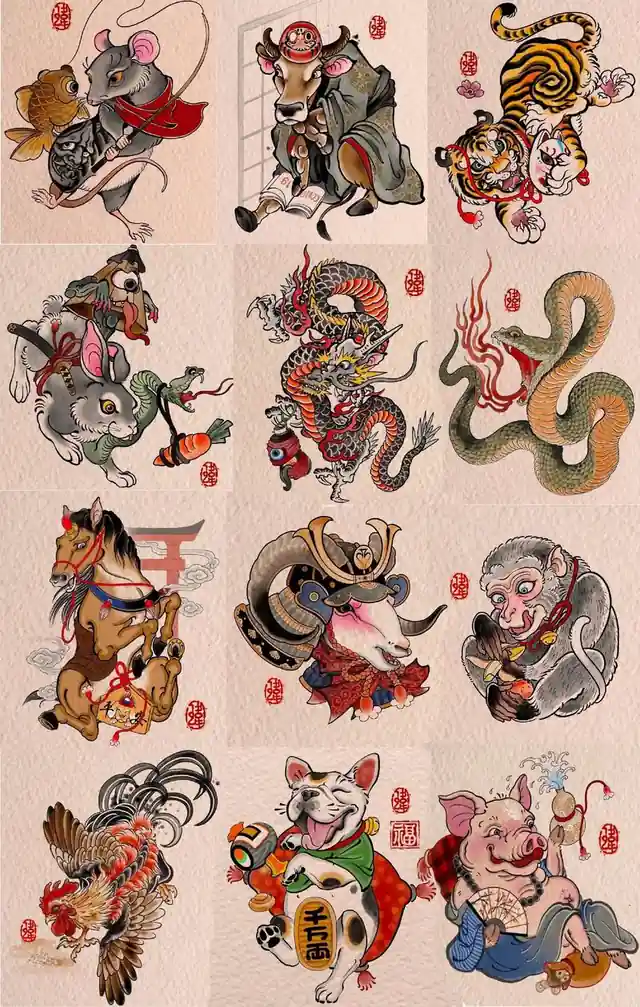
Through their rich imagination, people have captured the vivid and expressive image of the Dragon in various artistic forms throughout the long river of historical development. With major advances in archaeology, these early depictions of the Dragon as a zodiac animal have been unearthed and rediscovered, becoming a precious treasure within the culture of the zodiac Dragon.
To explore the origin of the dragon, one must first understand what its early image looked like. In recent decades, as the country has placed greater emphasis on traditional history and culture, archaeological endeavors have advanced rapidly, leading to significant achievements in the study of the dragon, a symbol of the Chinese nation, and an increasing number of discoveries of early dragon-shaped relics. The earliest known dragon images are primarily found at four sites: the stone dragon at Chahai in Fuxin, Liaoning; the clam-shell dragon at Xishuipo in Puyang, Henan; the pebble dragon at Jiaodun in Huangmei County, Hubei; and the jade dragon at Sanxingtala in Inner Mongolia.
Liaoning Chahai Stone Block Dragon
The dragon-shaped stone pile discovered at the Chahai site in Fuxin, Liaoning Province, belongs to the Xinglongwa culture dating back approximately 7,000 to 8,000 years, making it the earliest known dragon image to date. This large-scale dragon-shaped stone pile is located on the south side of the center of the Chahai site, with its body constructed from evenly sized reddish-brown stones, measuring nearly 20 meters in total length and about 2 meters in width, presenting a posture with its head raised, mouth open, and back curved and arched. Based on the large house structures and dense distribution of residential foundations at the site, people at that time had already begun stable sedentary living, with animal husbandry reaching a certain scale, and agricultural methods moving beyond pure "slash-and-burn" cultivation to incorporate signs of "hoe-based agriculture." From the distribution characteristics of the stone dragon within the settlement, it is evident that the dragon already held some special significance in society at that time.
The clam-shell dragon discovered at Xishuipo in Henan Province.
First, the clam-shell dragon unearthed at the Xishuipo site in Puyang, Henan Province, is honored as "China's First Dragon." Based on excavation data, the Xishuipo site can be divided into seven layers of accumulation: the first layer belongs to the Tang and Song dynasties (618-1279), the second layer to the Eastern Zhou Dynasty (770-256 BCE), the third layer to the Longshan Culture period (c. 3000-2000 BCE), and the layers below the fourth belong to the Yangshao Culture period (c. 5000-3000 BCE). Among these, the Yangshao Culture remains can be further divided into two major developmental stages: the fourth and fifth layers represent the second stage of the Yangshao Culture, i.e., the late stage; the sixth and seventh layers represent the first stage of the Yangshao Culture, i.e., the early stage. The clam-shell dragon is located between the fourth and fifth layers, and along with other clam-shell animal patterns, it is divided into three groups. Second, the first group of clam-shell dragon patterns is placed on the right side of the tomb owner's skeleton, with its head facing north and its back facing west, measuring 1.78 meters in length and 0.67 meters in height. The dragon raises its head, arches its neck, bows its body, extends its long tail, with front claws digging and hind claws pushing, appearing as if soaring. Third, the second group of clam-shell dragon patterns is located 20 meters south of the main tomb pit, with the dragon's head facing south and its back facing north, connected to a tiger pattern whose head faces north, face west, and back east. Fourth, the third group of clam-shell dragon patterns is located south of the second group, about 25 meters apart. This dragon has its head facing east, back facing north, raised head, long neck, stretched body, and high legs, with a person riding on its back, also modeled from clam shells, with both legs straddling the dragon's back, one hand in front and one behind, and the face slightly turned as if looking back. According to expert research, these three groups of clam-shell dragon patterns date back approximately 5,800 years.
The Dragon-shaped pebble formation at Jiaodun in Hubei Province.
In the Jiaodun site located in Zhangcheng Village, Baihu Township, Huangmei County, Hubei Province, an ancient dragon formed by prehistoric ancestors using pebbles has been preserved. The dragon body measures 4.46 meters in length, 2.28 meters in height, and 0.3 to 0.65 meters in width, with its head facing due west and tail pointing due east. The body is wavy, with an upright head and a single horn raised upward. This is the earliest mature dragon discovered to date and also the largest of its era, holding great value for the study of primitive religion, primitive astronomy, primitive art, and the origins of dragon worship in eastern Hubei and even the Yangtze River basin.
The Jade Dragon from the Hongshan Culture in Inner Mongolia.
The Wengniute Banner Cultural Center in Inner Mongolia preserves a jade dragon artifact. This jade dragon is a circular carving made from a single piece of jade, with the dragon body in a dark green color, coiled into a "C" shape. Its snout extends forward and curves slightly upward, with a flat tip at the nose. The eyes protrude in a spindle shape, and the forehead and chin are engraved with fine, dense grid patterns. The dragon's back features a single perforated hole, allowing it to be suspended by a rope, with the head and tail precisely aligned on the same horizontal line. According to research, this jade dragon artifact dates back no later than 5,000 years.
Additionally, some scholars have also identified fish patterns from the Wei River Basin dating back over 7,000 years and grass carp motifs from the Wei River Basin dating back 5,500 years as early images of the dragon, which may also benefit further scientific verification.
Further Reading
Dragon imagery in the Erlitou Cultural Site
The pottery unearthed from the Erlitou Cultural Site features many dragon images carved on them, with two being the most vivid: one dragon body is curved in a wriggling posture with slender and smooth lines. Its eyes are spindle-shaped, and its body has outward-curling fins or mane-like decorations. Near the head, there are claws with four toes, each curved and sharp. Another dragon depicted on a perforated vessel using thick incised lines shows a single head with two bodies. Its forehead is decorated with diamond patterns, its snout protrudes, and it also has spindle-shaped eyes with round pupils, very similar to the turquoise dragon. The dragon body splits into two bodies extending left and right from the neck, and the bodies are finely incised with irregular diamond patterns and double curves. The incised lines are filled with cinnabar, while the eye sockets are painted emerald green. The dragon bodies are also adorned with cloud-hook patterns and rabbit motifs, with flowing and rounded lines. Notably, most of these dragon images appear on perforated vessels, which have a peculiar shape with broad shoulders, straight bellies, and flat bottoms. They have hollow circular holes at the bottom, so they are not containers but should be ancient ritual vessels.