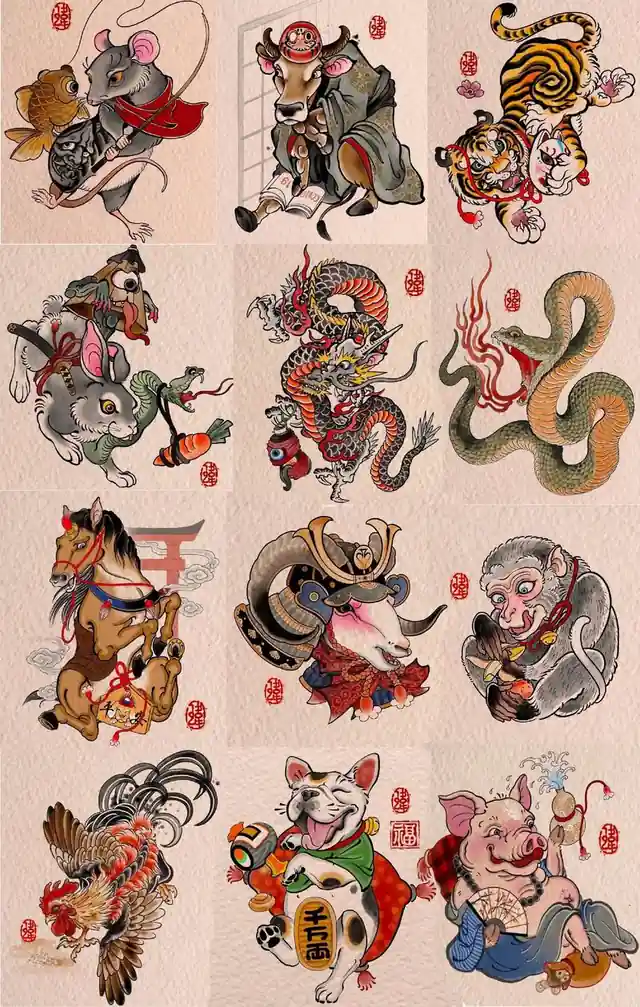
Among the twelve zodiac animals, the Dragon is the only mythical creature, embodying humanity's rich imagination and ancient beliefs. It is precisely because of the Dragon's imaginary nature that people have tirelessly debated its prototype for thousands of years.
In daily life, the word "dragon" is probably the most familiar term to people. Yet, if we pause to consider the question "What exactly is a dragon?" it is not necessarily something anyone can answer. Due to the complexity of the dragon's image, people have come up with different answers to the question of what a dragon truly is.
The theory that the Dragon evolved from the Snake is a prominent hypothesis regarding the origin of the Chinese Dragon totem.
Among all the animals in the world, the snake is undoubtedly the closest to the dragon. After studying the origins of the dragon, the renowned scholar Wen Yiduo reached the following conclusion: "The main body and basic form of the dragon are derived from the snake. In the era when numerous totems coexisted, the snake occupied the most prominent position. As a fusion and amalgamation of various totems, the dragon was essentially the result of the snake totem's growing influence, which gradually annexed and assimilated many weaker units... Probably before the merger of totems, what was called the dragon was merely a larger snake, and the name of this snake was the dragon." Some scholars also believe that the dragon might actually be the python among snakes. After analyzing archaeological, historical, and ethnographic data, scholar He Xingliang concluded: "In ancient times, dragons and snakes were often mentioned together, and the python was considered the king of snakes. Therefore, the ancients used the largest snake—the python—as the prototype for shaping the dragon."
Of course, the prototype of the Dragon certainly contains elements of the mystification of the Snake. According to scholarly research on totems, among primitive related clans, some used entirely aquatic or amphibious animals as their totems, with the Snake clan being the largest. The Snake clan mystified the Snake, and it thus became the Dragon. In essence, the Snake clan is another name for the Dragon clan.
The theory that the Dragon originated from the crocodile.
Some scholars argue from the opposite perspective, believing that the prototype of the dragon is not a snake but a crocodile: "In oracle bone script, 'dragon' and 'snake' have distinctly different images, thus it is clear that the dragon is not a snake. In comparison, the dragon and the crocodile share many similar features — a rough and uneven face, a narrow and long mouth, and sharp teeth — all of which are characteristics not found in other animal forms except for crocodiles." Others have also studied that crocodiles often appear before thunderstorms and have a hibernation habit of hiding in autumn and reawakening in spring, which are extremely similar to the habits of the dragon.
In fact, among the zodiac systems of some ethnic minorities, fish often replaces the Dragon: the Uyghur Chinese zodiac follows the same order as the Han Chinese zodiac, but the Dragon's position is occupied by a Fish; the Kirgiz zodiac also substitutes a Fish for the Dragon. The Han Chinese have an idiom called "fish and dragon mixed together" (yulong hunza), which suggests that people truly cannot distinguish between what is a fish and what is a dragon.
The so-called "dragon as fish" does not clearly refer to a specific type of fish, but rather serves as a vague reference, especially to aquatic animals with scales or scale-like patterns. Wang Chong's "Lunheng (Discourses Weighed in the Balance), Chapter on the Void of Dragons" explains: "The dragon is the chief of scaled creatures." "Scaled creatures" generally refers to animals with scales, and "chief of scaled creatures" means the leader of all scaled animals, indicating that the dragon's prototype originates from fish, amphibians, and reptiles whose bodies are covered with scales.
The theory that the Dragon is associated with the pine tree.
Some scholars believe that the legendary dragon in Chinese folklore was originally the embodiment of a tree god. The Chinese worship of dragons is a veiled reflection of tree worship, with the dragon serving as a tree god, a deity of plants. Scholar Yin Rongfang further specified that the prototype of the dragon corresponds to tree species such as pine and cypress. He argued: "The prototype of the dragon is tall trees like pines and cypresses. Later depictions of the dragon as an animal are certainly fictitious, but how did the image of an 'animal dragon' come into being? It was shaped by our ancestors, who, based on the image of pine trees, used their imagination to create a divine (tree god) form. Not only in appearance but also in attributes and other aspects, the dragon and the pine tree share striking similarities."
From the specific image of the Dragon, no single animal can fully represent it; otherwise, it would not be called a "Dragon." The Dragon's image is the result of combining multiple animals, with many animal shadows present in its form. This is best exemplified by the most representative concept of "Three Stops and Nine Likenesses."
According to the "Erya Yi: Explanation of the Dragon" (Er Ya Yi: Shi Long) by Luo Yuan of the Southern Song Dynasty, Wang Fu stated: "Common people often paint a horse's spine and a snake's body as a dragon, but in reality, there is the theory of 'three equal sections and nine resemblances.' The three equal sections refer to the distances from head to shoulder, shoulder to waist, and waist to tail, each being equal in length. The nine resemblances are: the horns resemble a deer's, the head resembles a camel's, the eyes resemble a ghost's (or rabbit's), the neck resembles a snake's, the belly resembles a clam's (or mirage-producing mollusk's), the scales resemble a fish's, the claws resemble an eagle's, the palms resemble a tiger's, and the ears resemble an ox's. On its head, there is an object shaped like a ceremonial mountain, called 'Chi Mu' (the Wooden Ruler). Without the Chi Mu, a dragon cannot ascend to heaven." Here, the dragon has evolved into a composite creature that incorporates features from oxen, horses, tigers, deer, camels, snakes, fish, rabbits, and lizards.
Further Reading
The Carp Leaping Over the Dragon Gate
The original Longmen (Dragon Gate) is a place name located at the border between the northwest of present-day Hejin County in Shanxi Province and the northeast of Hancheng County in Shaanxi Province. When the Yellow River flows through this area, steep cliffs face each other on both banks, resembling a gateway. According to legend, this place was originally called Longguan (Dragon Pass), with half of the mountain on the east bank and half on the west bank, like two gates controlling the river; thus, Longguan was also known as Longmen (Dragon Gate). The Yellow River has a significant drop at Dragon Gate, with turbulent waters rushing straight down. Fish below Dragon Gate find it extremely difficult to swim upstream past this barrier. However, every late spring, carp from various rivers, lakes, and seas still swarm here, swimming against the current. It is said that after a carp leaps over Dragon Gate, clouds and rain follow, and heavenly fire burns off its tail, transforming it into a dragon, while those that fail to make the leap remain as fish. The legend of "Carp Leaping Over the Dragon Gate" also reflects a certain connection between dragons and fish.