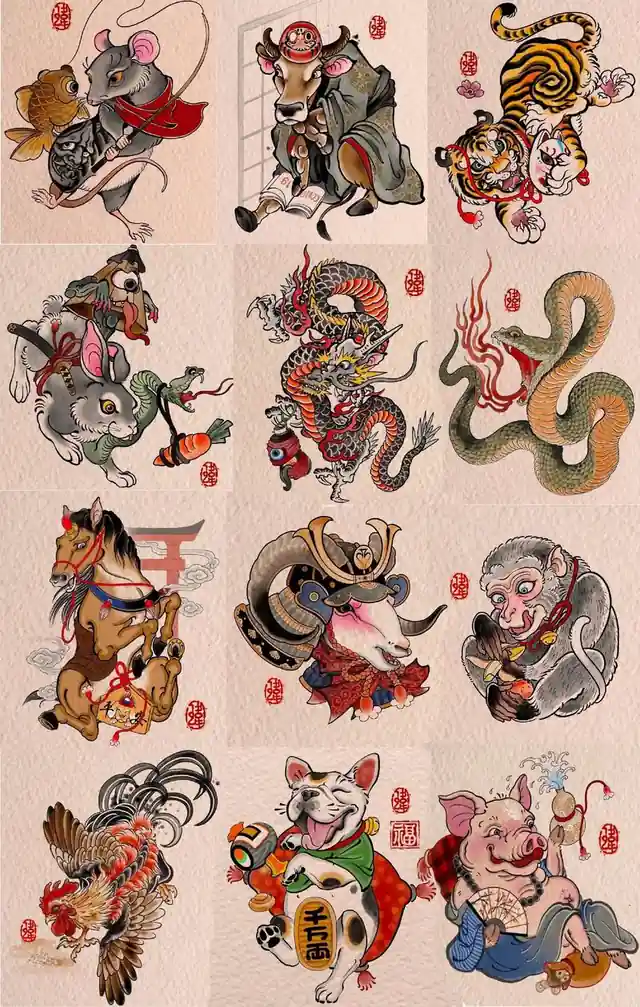
Due to the lofty status of the Dragon in the Chinese nation, it has permeated every aspect of people's lives. Whether in social or spiritual life, the Dragon of the Chinese Zodiac has left a deep imprint. Consequently, the culture of the Dragon in folk customs is rich and colorful.
For thousands of years, the concept and belief in the dragon have been deeply rooted in people's hearts, never ceasing or declining, which has endowed the zodiac dragon culture, embedded deeply in people's social and spiritual lives, with an even richer layer of cultural significance.
The Dragon Festival.
Throughout the year, various ethnic groups and regions across China hold dragon festivals in different seasons. In the first lunar month, the Yao, Hani, and Jino peoples of Yunnan celebrate the "Dragon Worship Festival," while in Wuchang, there is a "Dragon Gathering" where a long rope is used as a dragon for tug-of-war competitions. In the second lunar month, the Han Chinese observe the Dragon Festival, commonly known as "Dragon Raises Head," on the second day of the second lunar month. On this day, women string together colored paper and grass knots, hanging them on door beams in a practice called "Threading the Dragon's Tail," symbolizing the dragon's tail hanging down and its head rising upward. The pancakes eaten that day are called "Dragon Cakes," noodles are called "Dragon Beard Noodles," and vegetable balls are called "Dragon Eggs." In the third lunar month, coastal areas of Shandong hold ceremonies to worship the Dragon King of the Sea, while the Naxi and Tu peoples host temple fairs for the Dragon King, and in Jiangsu and Zhejiang, people celebrate the birthday of the White Dragon King. In the fourth lunar month, Datong in Shanxi holds the "Leiyin Temple Fair," and the Tibetan people of Zhongdian in Yunnan celebrate the "Dragon King Worship Festival." In the fifth lunar month, the Wu and Yue regions observe the "Dragon Distribution Day," which is believed to predict a bountiful harvest. The sixth day of the sixth lunar month is the traditional "Dragon Robe Sunning Day," when every household takes out bedding and clothing to sun them, praying for protection from disasters and misfortune. In the seventh lunar month, the Miao people of western Hunan hold the "Stamping Reed-Pipe Festival" to commemorate the village's discovery of a rain-bringing pearl for the Green Dragon; in Wuxi, Jiangsu, there is the "Dragon Mother Temple Fair," where it is believed that the Little White Dragon will return with rain to visit his mother; and the Yao people of Hekou in Yunnan celebrate the "Dragon Mother Ascends to Heaven Festival," sending the Dragon Mother to the heavens. In the eighth lunar month, the Yao people of Hekou hold the "Dragon Father Festival," respectfully sending the Dragon Father to the heavens. In Anhui, there is the "Dragon Lantern Festival," where grass dragons are crafted with long-life incense sticks inserted into their bodies, known as "Living Dragons." In the ninth and tenth lunar months, the Miao people of western Hunan hold a grand "Dragon Welcoming Festival," where each family retrieves their own "dragon" from a cave and places it in the main hall of their home or in the center of the village, while young men and women sing "Dragon Songs" in antiphonal style. When the twelfth lunar month arrives, the Hani people of Ailao Mountain in Yunnan hold a "Dragon Worship Gathering" under a dragon tree, selecting the most respected person in the village as the "Dragon Head" to slaughter a "Dragon Pig" with pure-colored fur. Tables are then connected, and the "Dragon Pig Meat" is placed on them to form a "Long Dragon Feast," where the "Dragon Head" leads the people in singing and dancing to send the gods back to their positions.
Dragon dance.
Dragon dance, also known as playing with dragon lanterns or dragon lantern festival, is a recreational activity widely practiced among the people. There are many varieties of dragon dance, including bamboo dragons, cloth dragons, gauze dragons, paper dragons, hundred-leaf dragons, and tin dragons. When candles are lit inside the dragon body, it becomes a "dragon lantern." Records of dragon lanterns can be found in the Song Dynasty work "Menglianglu (Record of Dreams of Splendor)" by Cheng Zimu, which states: "On the night of the Lantern Festival... a dragon is tied together with grass, covered with green curtains, and densely adorned with tens of thousands of lanterns, appearing winding like the form of a pair of dragons."
In the past, Tongliang County of Chongqing had a tradition of performing the Green Dragon dance in spring, the Red Dragon dance in summer, the White Dragon dance in autumn, and the Black Dragon dance in winter. Today, most dragon dances feature colorful dragons. Whenever a dragon dance troupe stops in front of a household, they pause and nod to greet the host. The host then welcomes them by setting off firecrackers and offers candies as a token of gratitude. In Foshan, Guangdong, there is also a custom of dragon dancing. Foshan's colorful dragons are typically constructed with a framework of bamboo strips and iron wire. The dragon's head and tail are made of paper pasted over the frame, while the body is covered with silk. Decorations such as paper-cuttings and velvet balls are added, resulting in a beautiful and elegant design.
The original purpose of the dragon dance was to pray for rain, but as it has developed to the present day, it has become an activity for people to express celebration and joy.
Zhaolong (Dragon Summoning)
The Miao ethnic group in Guizhou believe that every village and household must receive the protection and assistance of the dragon to ensure the safety and prosperity of both people and livestock. If the dragon is absent, people and animals will feel weak, and even crops will suffer poor harvests. During major festivals, the entire Miao village mobilizes to perform a dragon-invoking ritual. The ceremony uses pig, wine, and rice as offerings, with two wooden dragons carved from fir wood, decorated with charcoal-drawn scales and painted eyes. The ritual begins with calling the dragon: one person, wearing a paper garment, climbs to a mountain pass, scatters a few grains of rice, and shouts loudly, "Dragon, arise! Come with us to drink wine and eat meat." Another person plays the Lusheng (a traditional reed-pipe instrument), blowing and walking backward to guide the dragon to the altar, where it attaches to the wooden dragons. Twelve pieces of meat and twelve balls of rice are placed on the wooden dragons, and the people bow in reverence, praying for the dragon to return and protect their land. After the ceremony, everyone gathers to sing and dance to the Lusheng until late at night. This belief and worship of the dragon spirit has only one purpose: to pray for blessings and good fortune, hoping the dragon will grant favorable weather, bountiful harvests, national peace, prosperity, and wealth to the world.
Further Reading
The auspicious omen of "dragon soaring and phoenix dancing" (a Chinese idiom symbolizing great prosperity and good fortune).
Like the dragon, the phoenix is an auspicious creature born from human imagination, and the two are often paired together: the dragon commands clouds and rain to ensure bountiful harvests and favorable weather, while the phoenix, as a bird of good omen, brings happiness and peace to the mortal world. Common folk use the dragon and phoenix to symbolize good fortune and harmony, representing the love and mutual affection between husband and wife: the dragon embodies masculine strength and fortitude, while the phoenix represents feminine beauty and gentleness, and their union naturally signifies a happy and fulfilling marriage. In traditional folk weddings, people liked to embroider the dragon and phoenix pattern of "auspicious union" on quilt covers.