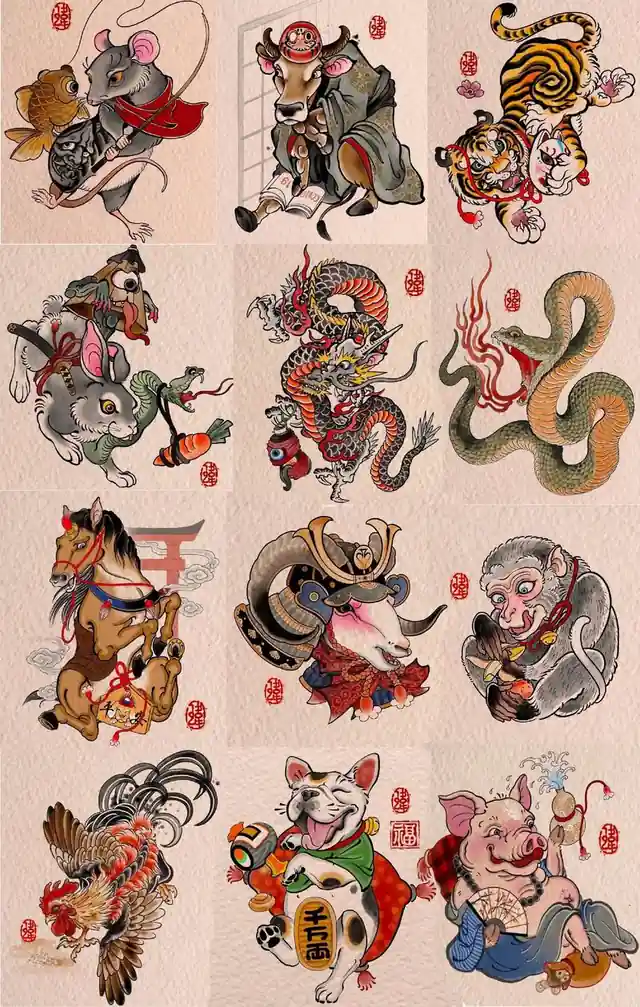
In the long history of agricultural society, the ox lived side by side with the working people, sharing their daily lives and fortunes. Over time, topics related to the ox became increasingly abundant, and legends about the ox gradually grew richer. Among them, the most influential is the tale of the Cowherd and the Weaver Girl.
As early as the Western Zhou Dynasty (1046-771 BCE), traces of the Cowherd and Weaver Girl legend had already appeared. The poem "Dong Mountain" in the section "Valley Wind" of the Book of Songs (Shijing) states: "In the sky there is the Milky Way, which shines with light. There stands the Weaver Girl, who moves seven times in a day. Yet though she moves seven times, she weaves no patterned cloth. There shines the Cowherd, who cannot carry a cart." In this passage, "Cowherd" and "Weaver Girl" are still merely two constellations, appearing in the same poem alongside stars like Venus (known as Qiming in the morning and Changgeng in the evening).
By the Han Dynasty, the story of the Cowherd and the Weaver Girl had already been written into poetry as a love tale. For example, the poem "The Distant Altair" from the "Nineteen Old Poems" states: "Distant Altair, bright Vega fair. With slender fingers fine, she works the loom with care. All day she weaves no web, but sheds tear drops like rain. The River's shallow and clear, how short the distance is! But the river keeps them apart, they can only gaze with longing." The "Fengsu Tong" (Comprehensive Customs) by Ying Shao of the Eastern Han Dynasty also records the meeting of the Cowherd and the Weaver Girl on a magpie bridge on the night of the Double Seventh Festival. Since then, whether in historical records or various tales of anomalies, legends, note-form novels, and poetic verses, this story has been recorded in even more detailed and vivid forms. Today, the most popular versions of the Cowherd and Weaver Girl story among the people generally take two forms.
One version says: The Weaving Maid was the seventh granddaughter of the Heavenly Emperor, weaving brocade clouds on the east side of the Heavenly River, while the Cowherd herded cattle on the west side. Both the Cowherd and the Weaving Maid were diligent, so the Heavenly Emperor allowed them to marry, but after their marriage, they only indulged in pleasure and play, with the Cowherd no longer tending the cattle and the Weaving Maid no longer weaving. This enraged the Heavenly Emperor, who separated them on opposite banks of the river and ordered the crows to tell them they could only meet once every seven days. However, the crows mistakenly relayed the message, saying they could only meet on the seventh day of the seventh month each year.
Another version of the story is more widely circulated among the people. It is said that the Cowherd and the Weaver Maiden fell deeply in love in heaven. The Queen Mother of the West, believing they had violated heavenly laws, banished the Cowherd to the mortal world to continue herding cattle. One day, the old ox told the Cowherd that the Weaver Maiden and other fairies would come to bathe in a river. He instructed the Cowherd to take the Weaver Maiden's celestial garment and hide it, then return it to her when she came looking for it, and propose to her. The Cowherd followed this advice and married the Weaver Maiden. After their marriage, the couple lived happily, with the husband plowing the fields and the wife weaving at home. They also had a son and a daughter. When the Queen Mother learned of this, she captured the Weaver Maiden and brought her back to heaven. As the Cowherd was at a loss for what to do, the old ox told him, "After I die, you can wear my hide and fly to heaven." The old ox then died, and the Cowherd draped himself in the oxhide, carrying his two children as he chased after them to heaven. The Queen Mother pulled out her hairpin and drew it behind the Weaver Maiden, creating the Milky Way, which separated the couple. The Cowherd and the Weaver Maiden could only gaze at each other across the river, their tears falling like rain. Later, the Queen Mother was moved by their love and allowed them to meet once a year on the seventh day of the seventh lunar month, sending magpies to build a bridge for their reunion.
Undoubtedly, the Ox plays a crucial role in this legend. Without the Ox's guidance, the Cowherd would never have been able to marry the Weaving Maid. Without the Ox's sacrifice of its hide, the Cowherd could not have pursued her to the heavens, let alone enjoy the annual magpie bridge reunion. The reason people endowed the Ox with such magical abilities is inseparable from the ancient worship of the Ox deity and the significant role the Ox played in the long-term agricultural society.
In the view of ancient people, the ox was considered a creature that could communicate with the divine, bearing the sacred mission of bridging heaven and earth, as well as gods and humans. People prayed that through the ox, the deities would bestow blessings upon the world, ensuring favorable weather, abundant harvests of the five grains, and peace across the land. Therefore, in ancient times, oxen were used in sacrifices to ancestors, ghosts and gods, the earth, and the stars.
After entering the agricultural society where men plowed and women wove, primitive totem worship gradually declined. The myth of "Niulang and Zhinu" (the Cowherd and the Weaver Girl) then incorporated the simple life ideals and emotions of people in the agricultural era. Zheng Banqiao of the Qing Dynasty (1644-1912) wrote in his "Fourth Letter to My Younger Brother Mo from Fanzian County Office": "I once laughed at the Tang Dynasty (618-907) 'Double Seventh' poems, which all described the Cowherd and Weaver Girl's meeting and parting as pitiable, entirely missing the original meaning of their names. The Weaver Girl is the source of clothing; the Cowherd is the foundation of food. Among the stars in heaven, they are the most noble. Heaven values them greatly, yet people do not! Their diligent work and service to the people are clearly visible in their celestial manifestations." In agricultural society, the greatest wish of farming families was for men to plow and women to weave, ensuring ample food and clothing, harmonious marital relations, and a house full of children. The legend of the Cowherd and the Weaver Girl precisely reflects this ideal model of a self-sufficient small-scale peasant economy.
Further Reading
The "Cowherd and Weaver Girl" in classical Chinese poetry.
Beyond the earliest "Far, Far Away the Cowherd Star" (Tiaotiao Qianniu Xing), later classical poetry contains many classic works themed around the "Cowherd and Weaver Girl" (Niulang and Zhinü), with the most representative being Qin Shaoyou's "Immortal at the Magpie Bridge" (Queqiao Xian) from the Northern Song Dynasty (960-1127). It reads: "Clouds float like works of art, stars shoot with grief at heart, across the Milky Way the Cowherd and the Weaver Girl silently meet. Autumn's Golden Wind and Jade Dew congeal their love, their meeting surpasses countless meetings in the mortal world above. Tender love flows like a stream, their happy date seems but a dream, how can they bear to take the Magpie Bridge back home. If love between both sides can last for long, why need they stay together day and night?" Additionally, Du Fu's "The Cowherd and Weaver Girl" (Qianniu Zhinü), Du Mu's "Autumn Evening" (Qiuxi), Cao Yu's "Song of Yan" (Yan Ge Xing), Wang Huan's "Regretful Words" (Changwang Ci), Wen Tingyun's "Cave Dwelling" (Dong Hu), and Li Shangyin's "Jade Maiden" (Bi'e) are all profound laments for the unhappy couple's inability to be together forever. These sorrowful reflections and sighs add infinite beauty and melancholy to the legend of the "Cowherd and Weaver Girl."