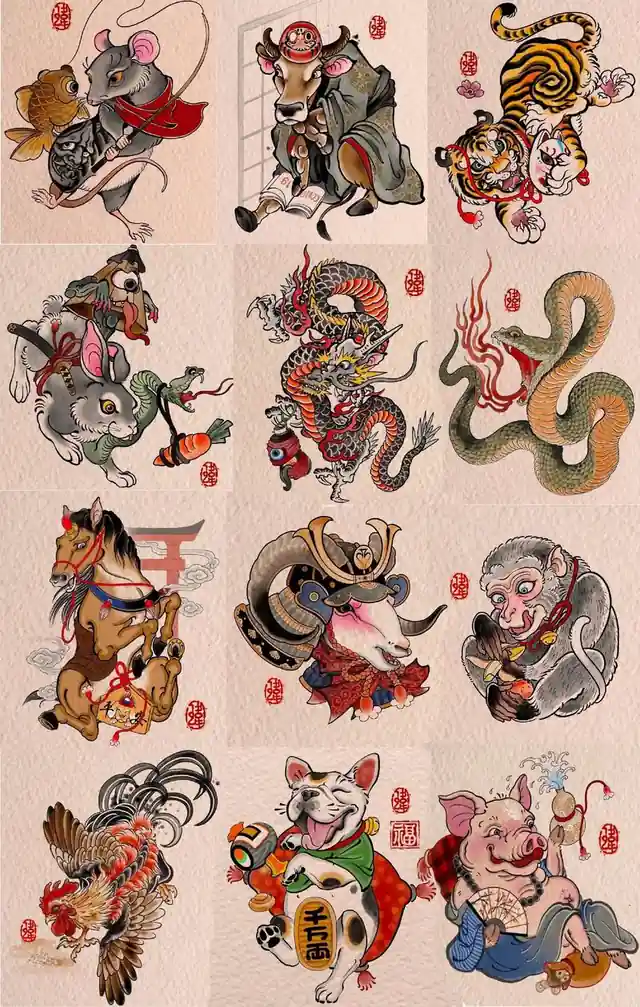
Since ancient times, the ancestors held an inexplicable affection and reverence for the ox. During the agricultural society period, the ox was even regarded as a family treasure. Whether in the myths born from people's insufficient understanding of nature, or in the process where later generations adapted and embellished mythological tales and legends, the zodiac ox has always occupied an important position.
Throughout the long course of historical development, humanity's greatest perplexities have been none other than the creation of the world and the origin of humans. In mythological stories related to creation and the making of humanity, the Ox invariably plays a role.
The Ox as Creator of the World and the Ox as Creator of Humanity.
The most widely circulated and profoundly influential mythological epic in the Hani ethnic region, "Aose Mise" (The Creation of the World), fully demonstrates the creation of the world by the Ox. The first part describes the creation of heaven and earth, where the Hani people use various parts of the ox to form the universe, similar to the myth of Pangu's transformation. The ox's left eye becomes the sun, its right eye becomes the moon, its ribs become terraced fields, its teeth become stars, its flesh becomes the land, its horns become the tool for thunder, its tongue becomes lightning, its hair becomes trees and flowers, its blood becomes rivers, its belly becomes the dragon pool, its lungs become fog, its heart becomes the earth's core, its breath becomes the wind, and its tears become rain. It is also said that the Heavenly King sent nine people to create the earth and three people to create the sky. The sky creators wanted to eat the ox's legs, but the earth creators refused, saying the legs were needed as pillars to support the earth. The earth creators wanted to eat the ox's hide, but the sky creators refused, saying the hide was needed to stretch the sky. Eventually, the sky creators grew hungry and ate the ox's heart, causing the earth to shake, which is why earthquakes occur. After the creation of heaven and earth, the epic also covers the origin of humanity, the incestuous marriage of a brother and sister during a great flood, and the stages of farming and settling down. From the above content, it can be seen that from the separation of heaven and earth to the birth of humanity, and then to agriculture and settlement, this entire chain of development is rooted in the ox's act of creation.
Among the ancient Kyrgyz people, there is a myth about human conception through interaction with oxen. According to the "Youyang Zazu (Miscellaneous Morsels from Youyang)" by Duan Chengshi of the Tang Dynasty (618-907), it records: "The cave where the birth occurred is north of Quman Mountain. They claim that in ancient times, a deity had intercourse with a cow in this cave." The Kyrgyz also have a legend that the earth consists of seven layers, and beneath the ground, a young man supports the earth with his horns. When one horn becomes tired, he switches to the other, causing the earth to shift and thus triggering an earthquake. To this day, the Kyrgyz still maintain some customs related to oxen, such as not slaughtering them, not using them for heavy burdens, and when an ox dies, they do not skin it but instead hold a burial ceremony.
The Golden Ox Attracts Wealth
Since ancient times, there has been an intricate connection between "gold" and "ox," with numerous myths about golden oxen recorded in classical texts. The Taiping Yulan (Imperial Readings of the Taiping Era) quotes the Youming Lu (Records of the Hidden and Visible Worlds), stating: "At the Niu Zhu Ford in Huainan, the water was extremely deep and unfathomable. Someone once saw a golden ox there, magnificent and robust in form, bound with a golden tether." It also quotes the Jiaozhou Ji (Records of Jiaozhou), saying: "Jufeng Mountain is four li from the commandery seat. The local barbarians asked Prefect Pei Xiang for permission to trade for this mountain, claiming that gold was produced there. When permission was denied, an old woman later went to the fields and saw a golden ox emerge. She cut off its nose ring, which was over ten feet long. Afterward, people often saw the ox emerging at night, its radiance illuminating dozens of li." The Yiyuan (Garden of Marvels) records: "During the Jianyuan era of Emperor Kang of Jin, a fisherman cast his line and caught a golden lock. As he pulled the lock to its full length, he saw a golden ox. He hurriedly tried to haul it out, but the ox broke free, leaving him with only the lock, which was two feet long." The Wudi Zhi (Records of Wu Lands) states: "In the past, a golden ox excreted gold. The villager Gao Bo and his younger brother followed it. The ox entered this mountain through a cave, and the two brothers dug into the mountain to retrieve it. They refused to stop, and the mountain collapsed, killing both brothers. The place was thus named Golden Ox Cave."
The character "gold" (jin) symbolizes wealth, so in mythology, the golden ox can also bring good fortune. The Gujin Tushu Jicheng (Complete Collection of Illustrations and Writings from Ancient and Modern Times) cites the Xiangzhong Ji (Records of Central Hunan), which states: "To the southwest of Changsha there is Golden Ox Rock. During the reign of Emperor Wu of the Han Dynasty (141-87 BCE), an old farmer led a red ox and asked a fisherman for a ride across the river. The fisherman said, 'My boat is too small to carry the ox.' The old farmer replied, 'Just let us aboard; we will not burden your boat heavily.' So both man and ox boarded. When they reached mid-river, the ox defecated on the boat. The old farmer said, 'Take this as a gift.' After crossing, the fisherman, angered by the mess, used his oar to push the dung into the water. As he was about to finish, he realized it was gold. Startled by this miraculous event, he chased after them, but the man and ox had already entered the mountains. He followed and dug at the spot, but could not catch up. The excavation site still exists today."
The above myths and legends express people's sincere wish to achieve good fortune through the image of the Ox.
Further Reading
The divine ox transforms into a tree.
According to legend, during the reign of King Wu of the Zhou Dynasty, there was a tree south of Yongzhou City that stood over ten zhang (approximately 33 meters) tall, with its shade covering more than one li (about 500 meters) of land. The local people were deeply superstitious about this divine tree, offering sacrifices to it throughout the four seasons. One day, King Wu went out for an inspection and saw the villagers spending vast sums of money to worship the tree. Believing this was a waste of resources that burdened the people, he said to the tree: "Divine tree! The people are still living in hardship. Why do you allow them to waste so many offerings?" He then ordered warriors to chop down the tree. However, just as the tree was about to fall, it suddenly oozed bright red blood, which flowed into a river and transformed into a divine ox. To seek revenge, the ox often stirred up storms and floods, causing frequent disasters in the surrounding area. King Wu had no choice but to order the construction of a Green Ox Temple on the original site of the tree, where annual sacrifices were held. Only then did the region's harvests gradually improve. Although this is merely a myth, it reveals that in people's minds, the ox symbolizes divine power and wealth.