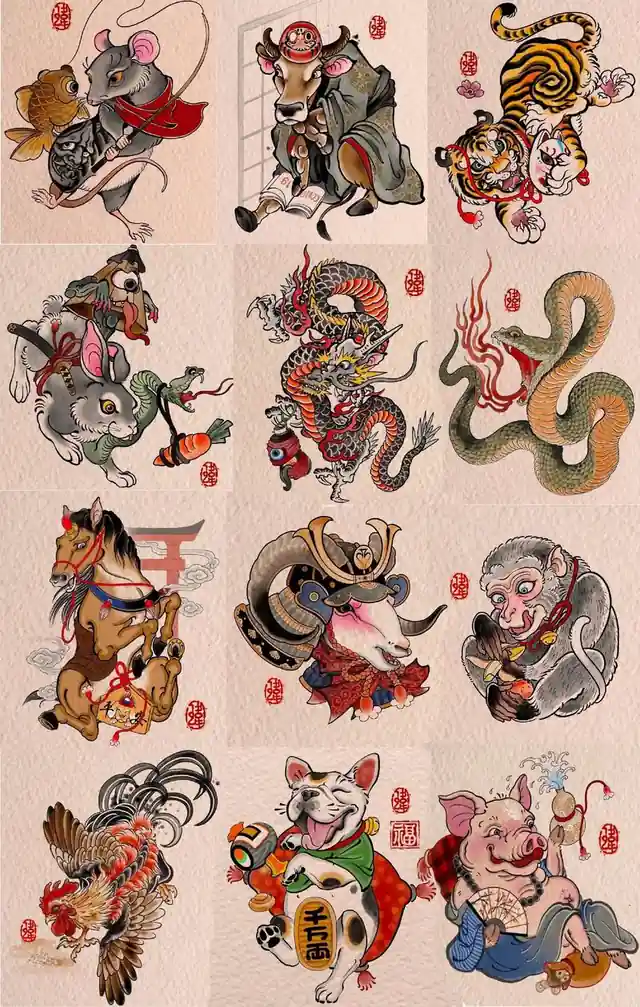
Among the twelve zodiac animals, the Ox is regarded as an indispensable spiritual creature in daily rituals and customs. From a person's birth, to naming ceremonies, full-moon celebrations, coming-of-age rites, weddings, birthday feasts, and even funerals, all are intricately connected to the zodiac Ox. This demonstrates the great importance people place on Ox-related culture.
The Ox's large, expressive eyes, charming horns, and diligent, hardworking spirit leave a wonderful impression on people. At the same time, the zodiac Ox culture has gradually permeated people's daily customs and rituals, and people of all ages are intricately connected to the culture of the Ox zodiac sign.
People born in the Year of the Ox and naming with the character for Ox.
Folk beliefs hold that when the Goujiao star (a malevolent star in Chinese astrology) occupies the astrological palace in the Year of the Ox, one should act with caution and think twice before proceeding. When the Taiyin star (the lunar star, associated with femininity and passivity) shines upon one, the yin energy dominates while the yang energy declines, so one must walk the path of righteousness to ensure a peaceful year. Of course, such claims are unscientific and have gradually been disregarded with social development. After a child is born, they are typically given two names: one is the formal name or school name, and the other is the nickname or milk name. Children's nicknames often use humble titles, emphasizing earthiness, commonness, strangeness, and ugliness, with the intention that ghosts will ignore them and they will be easier to raise. In the Year of the Ox, many people are named after the ox, such as "Little Ox," "Big Ox," "Ox the First," and "Ox the Second," and such names are everywhere.
"Ox person" full moon and Ox year birthday
In some places, after a child is born, a small hole is pierced through the nasal septum, and when the baby reaches one month old (the "full moon" celebration), a small ring is placed in it, much like putting a ring through an ox's nose, commonly called a "nose ring." It is said that once the nose ring is put on, it cannot be removed casually; it can only be taken off by the bride (or groom) on the wedding night, wrapped in red cloth, placed under the pillow for three days, and finally stored in a chest. Nose rings are usually made of gold or silver, and the funds are collected by relatives and friends before the baby's full moon, with each contributing a small amount symbolizing money from a hundred households, to seek good fortune.
In the Ningxia region of northwest China, there is a custom of performing the "Happy Ox Dance" (Xiniu Wu) when a child celebrates a birthday. This dance, also known as the "Protect the Child Dance" (Baozi Wu), is performed by locals during celebrations for the birth of a child. Four people dress up as two oxen, while four others accompany them in the dance. Before the dance begins, the band plays the suona (a traditional Chinese double-reeded horn), beats drums and gongs, and the host sets off firecrackers to welcome the dance troupe — a ritual called "Clearing the Ox Board" (Qing Niu Ban). After the ox impersonators enter the courtyard, the host holds incense sticks up to the ox's head, wraps the child in red cloth, and places the child on the ox's back. The performers then recite auspicious words and blessings before starting the dance. This custom expresses the hope that the child will grow up as strong and robust as an ox.
Elderly people celebrating their birthdays in the Year of the Ox naturally also involve oxen. In the Liuba area of Shaanxi, the elderly are compared to oxen or the Ox King, and their birthday celebrations are called "attending the Ox King Festival." When elderly Yao people in Guangxi and Guangdong celebrate their birthdays, especially their sixtieth birthday, the eldest son-in-law must present a chair woven from wild ox sinews on a frame made of blue oak wood and ox-tail wood, commonly known as an "ox-sinew chair," as a birthday gift. It is believed that ox sinews become hard and durable after drying, and once the elderly person sits on the chair, the properties of the sinews will transfer to them, promoting health and longevity.
Ox bone soup and the ox in wedding rituals
In olden times, when a Han Chinese girl married, it was essential to have an ox draped in red silk and adorned with festive decorations. The groom would lead this ox at the front of the wedding procession, serving as a path-opener or guide. It was believed that the ox was an incarnation of a celestial deity, and having it lead the way could clear all obstacles, warding off evil and disasters. In the Jiangsu and Zhejiang regions, a similar custom existed: if two brides were to marry on the same day and travel along the same road, the one who set out later would lead an ox with red cloth tied to its horns and red flowers inserted there. It was thought that the path trodden by the ox was a newly opened road, harmless to the later bride, carrying connotations of suppressing negativity and bringing festivity.
Among the Pumi people living in Ninglang and Yongsheng counties of Yunnan, a coming-of-age ceremony is held when a child turns thirteen. The ritual takes place beside the hearth and is presided over by the mother or maternal uncle. The host family cooks a pot of beef bone soup, which is served not only to the initiate but also to relatives and friends as a gesture of hospitality. This soup is regarded as "clinging to the bone, closest to kin," symbolizing unity and prosperity.
The practice of slaughtering oxen at funerals.
Chuiniu (ritual ox-slaughtering) is a common funeral custom. According to "Xi Man Cong Xiao (Miscellaneous Records of the Western Barbarians)," it is recorded: "In Bazhai, when someone dies, there is also weeping and wailing, along with chuiniu and beating of bronze drums, which is called naoshi (disturbing the corpse)." Chuiniu has a dedicated venue, usually an open square outside the village, with a central colorful flower pillar about ten meters high, adorned with red and green decorations, to which a sacred ox is tethered. The ritual is signaled by drumbeats: at the first drumbeat, the shaman (wu) swallows holy water and sprays it onto the sacred ox, said to cleanse it of impurities; at the second drumbeat, the host wraps his head in a headscarf, puts on leggings, fastens a belt, and takes up a bow and arrows, leading a dozen young men as the "biao shou" (spear handlers) for the chuiniu. They must paint their faces, tattoo their bodies, bare their chests and backs, and carry long spears. The host must erect a pile of wooden stakes outside the house, arranged in rows of three or four, with the tops carved into horn-shaped tree branches called niujiao zhuang (ox-horn stakes), symbolizing the family's wealth and prosperity. After the third drumbeat, the host's maternal uncle is the first to stab the ox (symbolically), followed by the other young men in sequence. Once the ox falls to the ground, ox divination (niu bu) is performed: if the ox's head points toward the host's house, it is considered an auspicious omen.
Further Reading
The custom of grabbing the ox tail in Miao ethnic wedding ceremonies.
In the Miao ethnic gathering areas of northwestern Guizhou, there is a custom of grabbing the ox tail during wedding ceremonies. Before the wedding, the bride's family invites several young men as strongmen to lead an ox to the wedding site, tying its legs with bamboo strips. The groom's family also invites several young men as guards to accompany the groom to the wedding site. As the groom approaches, the bride quickly cuts off the ox tail with a knife (often a symbolic act), and the groom rushes toward the bride to snatch the ox tail. At this point, the bride's guards step forward to block and protect the ox tail, while the groom tries every means to seize it. If he successfully grabs the ox tail before the bride's parents arrive, the wedding proceeds as scheduled. Otherwise, the wedding is called off, and everyone disperses in disappointment. In the local belief, the ox tail symbolizes good fortune and smoothness, and people use this custom to express their wish for a smooth and successful life journey.