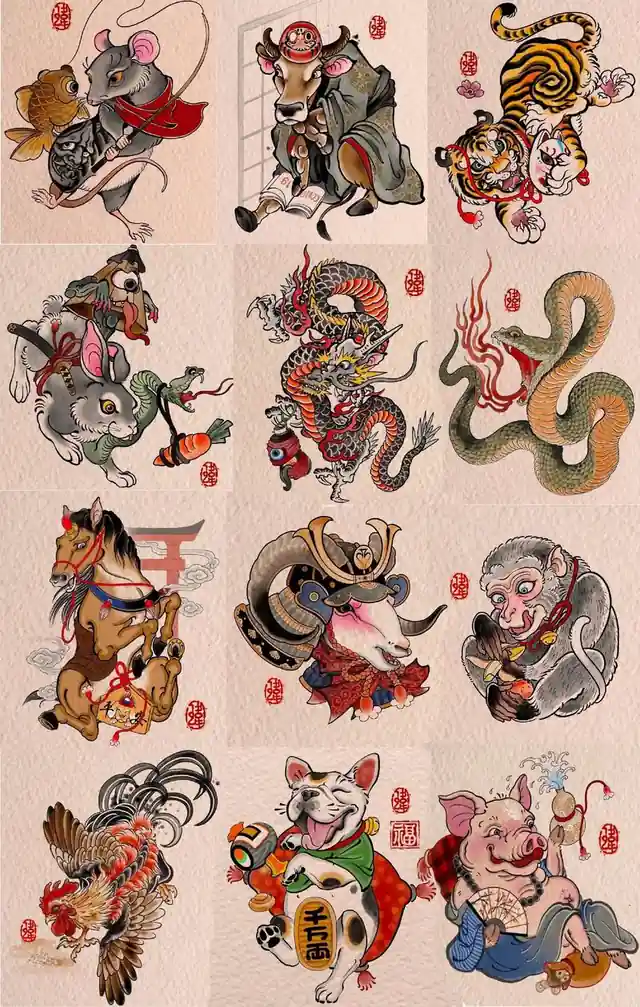
Ox dance is a form of dance that imitates the image of an ox, representing a unique and distinctive form within the art of dance. The development of ox dance has deep historical and cultural roots, originating either from the early ancestors' hunting activities involving oxen, serving as an expression of totem worship, or being closely related to the later development of bullfighting.
The history of dance featuring the image of the ox is extremely ancient, even traceable back to myths of the remote past. Legend has it that the dance performed by Chi You possessed the nature of an ox dance. Chi You was the chieftain of the Nine Li tribe, depicted with a bronze head and an iron forehead, a human body with ox hooves, and a pair of ox horns on his head. Originating from the middle reaches of the Yangtze River, the Chi You tribe was powerful but was later defeated by the Yellow Emperor's tribe. In ancient times, folk rituals in the Hebei and Shanxi regions involved worshipping the Chi You deity, during which the Chi You dance was performed. Participants, in groups of two or three, wore ox horns and danced by butting heads with each other, clearly imitating scenes from Chi You's battles and reflecting people's nostalgia for their ancestor Chi You. Similarly, among the Yao ethnic group in Mashan County, Guangxi in the south, an annual ritual is held to worship their ancestor Chi You Gong, performing the Chi You dance in a comparable manner.
Among the rock paintings unearthed in various regions, there are also many depictions of ox dances, with the most prominent being those from Cangyuan, Yunnan: in Area 2, lower right section of Location 1 at Cangyuan, five figures are painted, with two below holding bows and arrows to shoot an ox, while above, one figure holds a shield and a large club in the other hand, making a hunting gesture. On the left, one figure holds an ox horn in one hand and a short staff in the other; this is a hunting ox dance, where the person holding the ox horn and blowing the ox-horn trumpet is the lead dancer. In Area 4, upper section of Location 6 at Cangyuan, a primitive figure is depicted holding a large ox horn in the right hand, raising the left hand, with legs slightly bent and feet turned outward in a dancing posture, facing an ox; this also represents a form of "hunting ox dance" or "head ox dance."
On bronze drums unearthed in Guangnan, Yunnan, there is also a dance called "chasing the ox dance" (zhuiniu wu), which is also known as "flaying the ox dance" or "chopping the ox dance" and is a ritual dance performed during religious sacrifices. The activity takes the form of tying an ox to a post, with one dancer (yuren) dancing around the ox while another dancer uses an axe to chop it. To this day, the custom of the chasing the ox dance is preserved among ethnic groups such as the Yi, Dulong, Wa, Dai, and Jingpo. For example, during the Dulong New Year, all villagers gather in the square, erect a wooden stake, tie an ox to it, and have the chief priest stab the ox's belly with a spear. Once the ox falls, divination is performed, and everyone rushes to cut off pieces of beef. An elder first carries a piece of beef on his back and dances around the field, with others following behind, commonly known as the "ox pot circle dance" (niu guozhuang wu). Today, most chasing the ox activities use symbolic representations of the ox rather than a real one.
The Horn Fighting Dance of the Shui ethnic group in Guizhou is also a type of ox dance, typically performed during religious ceremonies, festivals, and funerals. The dance is generally accompanied by five lusheng (bamboo mouth organs) and five mangtong (large bamboo pipes), with the lusheng players dancing while playing. The smallest lusheng, which produces the loudest and clearest sound, is called the male lusheng and leads the entire dance. The only prop for the dance is an "ox head" made of bamboo strips, which is first woven into a conical hat shape. Then, wooden ox horns are attached to both sides of the hat, with a skirt of chicken feathers tied to the back and decorated with colorful silk cloth. During the performance, the small lusheng leads the dance, followed by medium and large lusheng and mangtong. At the same time, two performers each wear the "ox head" prop and perform a half-squatting fighting and dancing movement. Five female dancers, wearing pheasant tail feathers on their heads and white chicken feather flower skirts around their waists, accompany the dance. The dance showcases various postures that change with the tempo of the lusheng music, fully reflecting the passionate, bold, and straightforward character of the Shui people.
In the Yi ethnic region of Liangshan, Sichuan, funerals are always conducted with a celebratory spirit to send off the deceased, featuring a dance called "Wazhihei," which is the yak tail dance, popular among the White Yi community. During the dance, each performer drapes a white yak tail over their back, attached to a rectangular piece of yak hide with two leather straps tied around the neck, allowing the yak tail to hang down along the spine. As they dance, the movements make the yak tails appear to fly, evoking an ancient and rustic atmosphere.
Further Reading
Naxi Ox Dance Notation from Yunnan Province.
The Niu Dance (Ox Dance) of the Naxi people in Yunnan has been passed down through dance notation and boasts a long history. The dance notation is divided into nine sections: First, when dancing the White Ox of the Victory Deity, alternate between stamping steps and forward steps; Second, when dancing the White Yak with a Black Forehead, perform horn-grinding and horn-butting movements while holding a slanted palm gesture; Third, when dancing the White Yak of the Victory Deity, take three steps forward, butt outward with the horns three times, and butt inward three times; Fourth, when dancing the Black Piebald Yak with a White Forehead, perform horn-grinding and horn-butting, hold the slanted palm gesture, shake the plate bell four times, and lift and stomp the feet four times; Fifth, when dancing the Piebald Yak with a White Forehead, separate the hands and lift the legs while jumping, shake the plate bell once, take three steps forward, and stomp the right foot three times; Sixth, when dancing the Divine White Yak, jump twice with the left foot, twice with the right foot, take four steps forward, butt with the horns in four directions four times each, and perform one full spin in place; Seventh, when dancing the Black Piebald Yak with a White Forehead, shake the plate bell once, take three steps forward, butt left three times, and butt right three times; Eighth, when dancing the White Yak of the Victory Deity, take one step in each of the four directions, butt once in each direction, and quickly spin one full circle in place; Ninth, jump once like the White Yak of the Heng Deity, suppressing the ghostly Black Piebald Yak below.