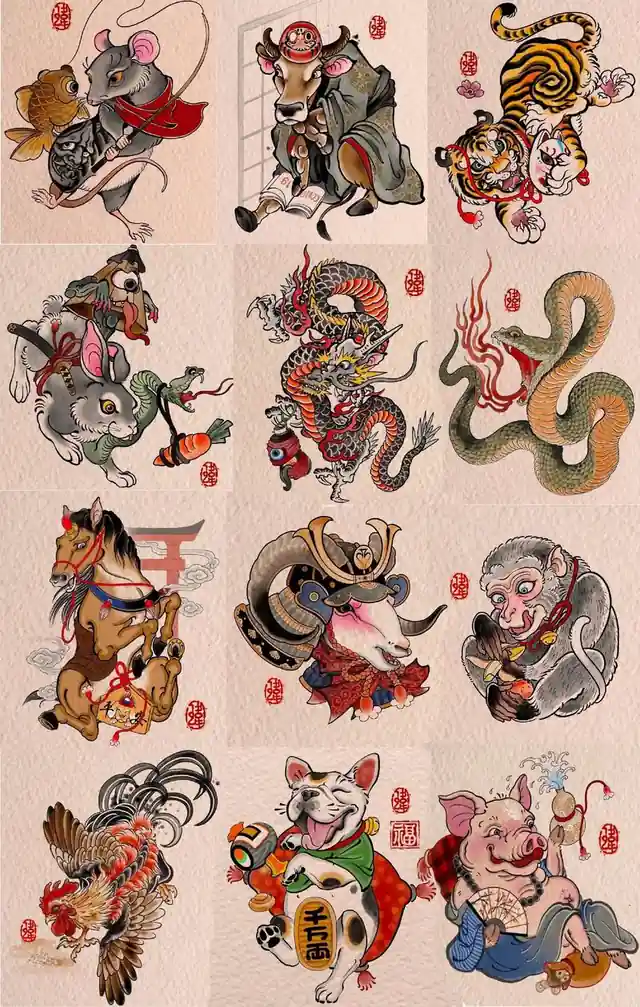
Throughout human history, due to the importance of oxen to people's livelihoods, oxen have been revered as deities, with festivals established in their honor, along with related sacrificial rites and entertainment activities, giving rise to numerous beliefs and worship practices centered on the Ox zodiac sign.
The Ox, as a folk protective deity, originated from totemic beliefs in ancient times. Li Daoyuan's "Shuijing Zhu (Commentary on the Water Classic)" from the Northern Wei Dynasty (386-534) cites "Lieyi Zhuan (Strange Tales)" stating that the Ox King was originally a large camphor tree in the Southern Mountains. When someone illegally felled it, "the tree broke and transformed into an ox entering the water, so the Qin people established a shrine for it." Later, it gradually became personified, evolving into an ox-headed human form, and was further misidentified as Bo Niu. "Gujin Tushu Jicheng (Complete Collection of Illustrations and Writings from Ancient to Modern Times)" in the "Shenyi Dian (Divine Anomalies Section)" volume 54, citing "Liaohuazhou Xianlu (Leisurely Records from Liao Hua Isle)," records: "Someone who came from the Ming Dynasty (1368-1644) said there was an Ox King Temple in the north, with a hundred oxen painted on the wall, and the Ox King sat in the middle. Who was the Ox King? He was Ran Boniu." In modern folk worship, the Ox Pen God is also an anthropomorphized deity.
As the worship of animal spirits waned and beliefs in ghosts and deities evolved, an image of a "Ox-Head Ghost" emerged based on the cult of the Ox King. There are two legends regarding the origin of the "Ox-Head Ghost": one traces back to Shennong (the Divine Farmer), with the "Waishu (External Records)" stating, "Shennong had the head of an ox"; the other originates from Buddhist influence, as Buddhist belief holds that Yama (the King of Hell) has judges and runners. According to the "Wuku Zhangju Jing (Sutra of the Five Sufferings and Chapters)," it records: "The hell jailer is named Abang, with an ox's head and human hands, two feet like ox hooves, strength enough to move mountains, holding a steel trident." This figure was later adopted by Daoism, becoming the "Ox-Head and Horse-Face" or "Ox-Head Ghost," placed under the jurisdiction of the God of Mount Tai (Taishan Shen).
Due to the diversity of ox species and their living regions, the worship of the Ox zodiac sign varies across different areas. In Qiliqiao Jiafeng Village, Dali, Yunnan, the Bai ethnic group has traditionally revered the yellow ox as their village patron deity (ben zhu), holding a sacrificial ceremony on the twenty-third day of the second lunar month each year. The villagers neither hunt, use, nor consume beef. The Lahu people believe that oxen possess souls; when an ox falls ill, they knock on its feed trough or relocate it, and in severe cases, invite a shaman to perform a soul-calling ritual for the ox. This involves killing a chicken and making rice cakes at the doorstep or where the ox was injured, while chanting: "Ox soul, return home. Outside, the wind and rain are fierce, with nowhere to hide and tigers lurking. At home, there is food and a stable. Come back along the path."
People believe that the ox possesses spiritual qualities, giving rise to a folk belief in the "ox soul stone." Every July or October during the Ox Festival, the Li people take out their family's ox soul stone and wash it with wine. They believe that wine soaked with the ox soul stone is blessed wine, and drinking it not only promotes human health but also helps the ox herd thrive.
Among nomadic peoples, there is also a custom of worshipping the udder of cattle. Inside the entrance of a yurt, there are designated seating areas for men and women, and above the women's seating area, a cow's udder must be hung. Later, in the eastern Mongolian region, it became popular to weave cow udders from wool, then attach a piece of cloth and hang them inside the yurt for regular worship by the people. In the view of the Mongolian people, the cow's udder is not only a mark of the female cow but also the place where milk is produced; it must be worshipped to ensure abundant milk production, otherwise, it would endanger the herders' livelihood.
The continuous development of the Ox God worship gradually deepened people's affection for the Chou Ox (the Ox of the Earthly Branch Chou), and various Ox King Festivals spread across different regions. The Han Chinese people mostly venerate the Ox King. In the Hubei region, the fifteenth day of the eighth lunar month is considered the Ox King's birthday, and on that day, taro must be peeled and made into a soup called "Ox Soup," while in some areas, taro is directly fed to the oxen. In the Sichuan region, the first day of the tenth lunar month is celebrated as the Ox King God's birthday, where people make glutinous rice cakes and stick them onto the oxen's horns. On this day, oxen are not allowed to work; at dusk, they are led to turn corners, and at night, they are brought to the edge of a paddy field to gaze at their reflections. The Zhuang ethnic group calls the Ox King Festival the Ox Soul Festival, the Unyoking Festival, or the Rice Transplanting Festival, with related activities held on the eighth day of the fourth month, the seventh day of the fifth month, the sixth day of the sixth month, and the seventh day of the seventh month. Every year on the eighth day of the fourth month, the Zhuang people set up an altar in the ox shed, clean it, sprinkle lime, lay down dry straw, and let the oxen rest for a day. They also lead the oxen to bathe in the river or wash them with mugwort leaves to remove lice, calm their spirits, and settle their souls. Meanwhile, they slaughter a chicken, prepare five-colored rice, and the whole family gathers around the table to eat. They then lead the oxen around the table once, feeding them five-colored rice, sweet wine, mung bean porridge, and egg soup. Children also hang red paper on the oxen's horns to offer blessings to the oxen.
From totem worship to the deification of animals, then to the depiction of gods with animal heads and human bodies, and finally to the personification of the Ox King along with the emergence of various Ox King Festivals, people's reverence for the zodiac Ox has grown increasingly profound. Their emotional attachment to the Earthly Branch Chou (associated with the Ox) has deepened, reflecting the lofty status of the ox in people's hearts.
Further Reading
The Origin of the Ox King
According to legend, the Ox was originally the Crown Prince of the Jade Emperor. Seeing that humans on earth labored tirelessly every day, the Jade Emperor sent the Crown Prince down to deliver a decree: "Eat one meal a day and wash your face three times." However, the Crown Prince instead proclaimed: "Eat three meals a day and wash your face once." As a result, food shortages arose on earth, and grievances filled the heavens. When the Jade Emperor investigated, he discovered that the Crown Prince had falsely delivered the decree. Furious, he ordered the Crown Prince to descend to earth as an ox to help produce grain. Because the water buffalo descended on the eighth day of the fourth lunar month, people, in gratitude to the plowing ox, celebrate its birthday on that day. Another legend holds that the Ox was originally the Bull Demon King transformed. The story is similar, with one difference: it was not the Crown Prince but the Bull Demon King who falsely delivered the decree. The Jade Emperor punished him by turning him into a plowing ox, thus giving rise to the custom of worshipping the Ox King.