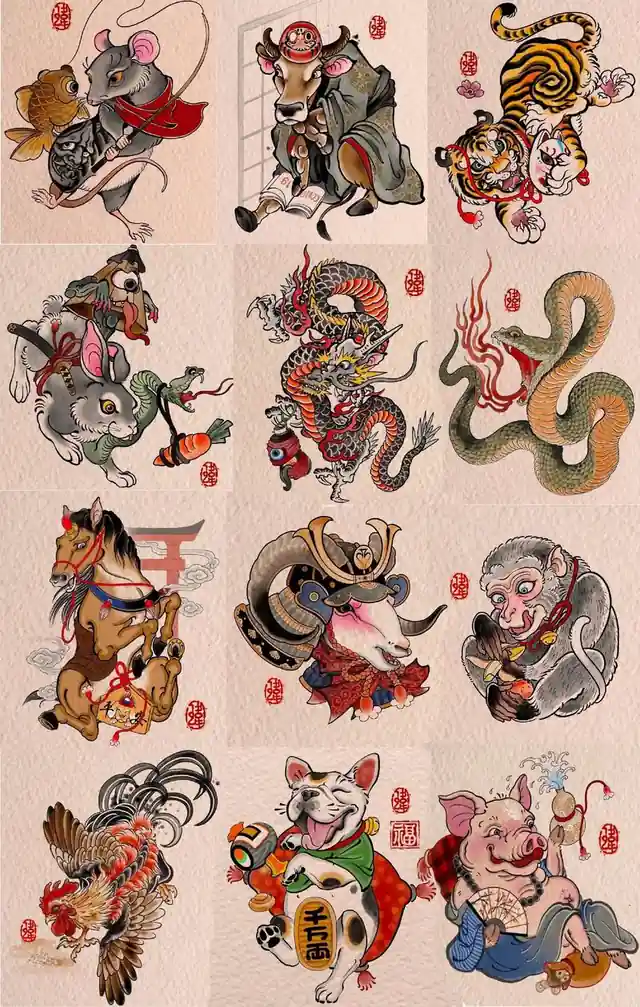
In China's long agricultural society, the Ox (Chou Niu, the second Earthly Branch) undoubtedly occupied an extremely important position. Due to people's past admiration and affection for the Ox, many cultural heritages related to it have been passed down, with "Whipping the Spring Ox" (Bian Chun Niu) being one of the more influential customs.
"Whipping the Spring Ox," also known as "Whipping the Clay Ox," is a very ancient spring plowing ritual that originated from prehistoric spring plowing ceremonies. In the spring plowing ceremony, the clan chief led the farming, with other clan members following suit, using tools such as hoes and human-drawn plows. It was only after the emergence of plow oxen that the ritual of breaking ground with oxen-driven plowing appeared, and later symbolic spring oxen made of clay and paper were introduced.
The form of "Whipping the Spring Ox" (a traditional ritual to welcome spring and pray for a bountiful harvest).
The practice of whipping the spring ox (bian chun niu) emerged as a product of the development of spring plowing rituals, and can be summarized into three main forms.
The first is the hoe-digging soil-breaking ceremony. Represented by the Jingpo people in Yunnan, local residents hold sacrificial activities at the mountain official temple every year. This temple houses the Heaven God, Earth God, and ancestors of the mountain officials. In spring, during March and April, offerings are made to the ancestors, Heaven God, and Earth God. Afterward, the mountain official uses a bamboo hoe to dig three times in the farmland, covers the seeds with soil after sowing, and only then can others begin planting early rice. This spring plowing ceremony emerged during the hoe-digging stage of agriculture.
The second type is the plowing ritual where humans pull the plow, as exemplified by the Zhuang and Yao ethnic groups in Guangxi. After the Spring Festival, the Zhuang people hold a ground-breaking ceremony for spring plowing, in which one person holds the plow while two others pull it with ropes, accompanied by two performers acting as spring officials who flirt with each other in a comedic performance, after which everyone else can begin spring plowing. Among the local Yao people, the "Whipping the Spring Ox" ritual involves three performers: one plays the ox, one carries the plow, and one holds the plow, all accompanied by a band as they deliver spring blessings to each household, with the families offering rewards in return. This method of plowing with human labor was very common in ancient China, as it originated before ox-driven plowing, so the spring ox had not yet made its appearance.
Third is the plowing ritual using an ox-drawn plow. Represented by the Mulao ethnic group in Guangxi, on the day before the Beginning of Spring (Lichun), they gather in front of the Spring Ox Pavilion, where the county magistrate first pays respects to the gods, then to the Earth, and finally to the people. Afterward, he enters the field to hold the plow, strikes the ox three times with a whip, sings a whip-the-ox song, and plows three furrows. The clan elder then announces the start of spring plowing. The next day, the clan elder distributes seeds to each household, and each household performs the same plowing-opening ceremony. Additionally, the Dong and Miao ethnic groups hold a similar plowing-opening ritual called "Qihuo Lu" (Starting the Work), where a real ox is led into the field for demonstration actions such as plowing and transplanting rice seedlings. People sing and dance by the field, celebrating the beginning of spring plowing. This spring plowing ritual originated in the era of ox-drawn agriculture, using a real ox for the whip-the-spring ceremony, representing a primitive form of the whipping-the-spring-ox ritual.
The reasons for the enduring popularity of "whipping the Spring Ox" (a traditional ritual to mark the beginning of spring) are multifaceted.
The transition from a time without oxen to a time with oxen fully reflects the increasingly important status of the ox in people's hearts and the ever-closer connection between the ox and the lives of the working masses. Of course, the enduring popularity of "Whipping the Spring Ox" has deep historical and social reasons.
First, China has been an agriculture-based country since ancient times, with agriculture serving as the lifeblood of the national economy. Not missing the farming season and timely cultivation are fundamental principles of traditional Chinese agriculture. Therefore, people have always treated the Start of Spring (Lichun) festival, which symbolizes the beginning of farming, as a major event. The "Whipping the Spring Ox" ritual serves as the clarion call for the Start of Spring season, embodying farmers' hopes for a bountiful harvest. This ceremony mobilizes the farming community to engage in the busy agricultural season, enabling them to create the material necessities for survival.
Second, as stated in Shangshu Dazhuan (The Great Commentary on the Book of Documents): "Spring represents emergence, meaning all things come forth." The Beginning of Spring (Lichun) not only marks the start of agricultural production but also serves as an important season for human reproduction. After humans evolved from apes, their physiological functions still experienced peaks and troughs. For example, during winter, the human body is often in a low state with higher mortality rates, while spring brings vigorous energy and is the season for courtship and mating. It is evident that choosing the Beginning of Spring to perform the "whipping the spring ox" ritual is closely related to human reproduction. Combining it with entertainment activities further extended the longevity of this tradition.
Third, successive feudal rulers also placed great importance on the "Whipping the Spring Ox" ritual. The success or failure of agricultural harvests not only affected the amount of government tax revenue but also had a significant impact on the stability of society and politics. In some dynasties, government departments even took the lead in organizing and planning related activities. During the Qianlong reign of the Qing Dynasty (1736-1795), whipping the earthen ox at the Start of Spring (Lichun) was designated as a national ceremony. According to the Qianlong-era "Xieji Bianfang Shu (Book of Harmonizing the Calendar and Distinguishing Directions) - Public Regulations - Spring Ox Canon": "To create the Spring Ox and the Mang God (god of spring and agriculture), use the Chen day of the Winter Solstice. Take soil and water from the direction of the Year Virtue (Sui De) to form them, and use mulberry and thorn wood for the skeletal frame. The ox's body is four chi (approximately 1.33 meters) tall, symbolizing the four seasons; its length from head to tail is eight chi (approximately 2.67 meters), symbolizing the eight solar terms. Each year in the sixth month, the Imperial Astronomical Bureau (Qintian Jian) predetermines the design and colors of the Spring Ox and Mang God for the following year. After the Chen day following the Winter Solstice, all prefectures and counties follow the prescribed shapes and colors to make them from local soil and water." From this perspective, the advocacy of the ruling class also played a catalytic role in the spread of the Whipping the Spring Ox activity.
In summary, the practice of whipping the Spring Ox is an ancient festival custom that mobilizes people to promptly engage in spring plowing and production, expressing the beautiful wish of hoping through the Spring Ox to pray for favorable weather, good health, and bountiful harvests.
Further Reading
The custom of "Whipping the Spring Ox" during the Qing Dynasty (1644-1912).
During the Qing Dynasty, the "Whipping the Spring Ox" ceremony in Beijing was organized by Shuntian Prefecture. On the day before the Start of Spring (Lichun), the Prefect of Shuntian would place the Mang Shen (the god of spring) and a clay ox in a decorated shed outside the Dongzhi Gate, leading his officials there to welcome the spring. By the late Qing period, the spring ox had evolved from a real ox or clay ox into a paper ox, its belly filled with grains and small spring ox figurines. On the day of Lichun, the magistrates of Daxing and Wanping counties would set up an altar just outside the Meridian Gate, respectfully awaiting the arrival of the emperor, empress, and empress dowager. After the imperial party arrived, the Mang Shen and the paper ox would be slowly escorted through the Meridian Gate into the Imperial City. The Prefect of Shuntian would then walk around the ox, striking it with a spring whip wrapped in colorful silk. This ruling-class ceremony of "Whipping the Spring Ox" reflected the importance placed on agricultural production and the political intent to stabilize governance and pacify the people.