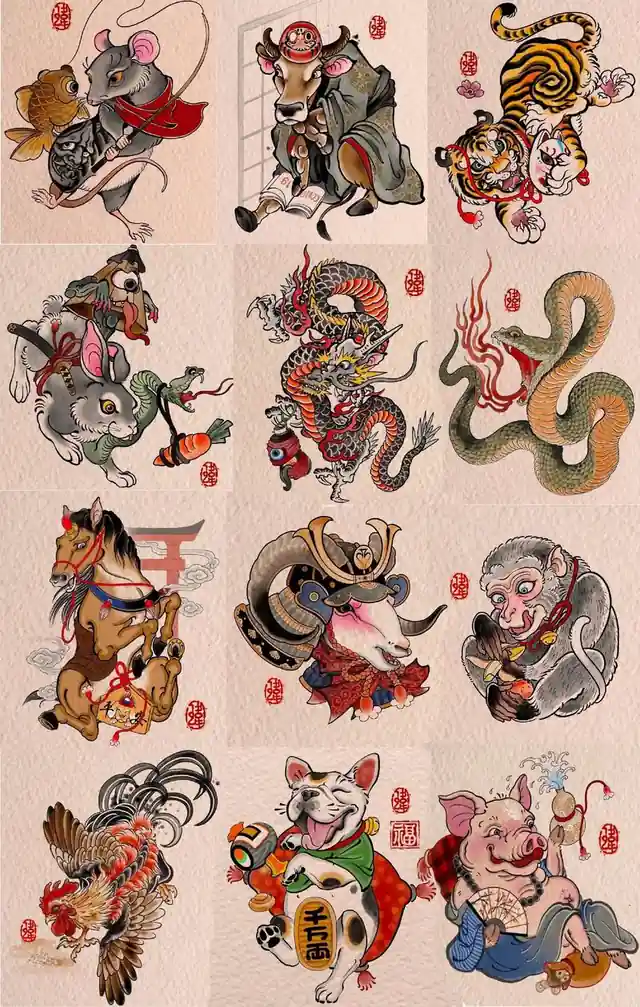
The ox played an indelible role in the history of human development, possessing a gentle and obedient nature as well as a diligent and hardworking spirit, which left a favorable impression on people's minds, and as a result, the ox has been endowed with rich symbolic meanings.
In the long-term agricultural society, the abundance and well-being achieved were not only due to the diligence and wisdom of our ancestors but also largely benefited from the use of oxen. Today, as human society becomes increasingly advanced and people's lives are no longer defined by men plowing and women weaving, the contributions of the Chou Ox (the Ox of the Earthly Branch Chou) are still remembered. Throughout long-term historical and cultural development, the ox has long been endowed with rich symbolic meanings.
A symbol of good fortune.
As early as primitive society, people regarded the Ox as an auspicious creature and worshipped it as a deity. In ancient times, people believed that the Ox possessed divine qualities that could facilitate communication between humans, heaven, earth, and spirits. Therefore, when encountering major events such as military campaigns, hunting, weather changes, sacrifices, farming, illness, marriage, or funerals, they would often use the shoulder blades of oxen for divination to seek the opinions of spirits and deities. According to "Xi Man Cong Xiao" (A Collection of Laughs from the Southern Barbarians) by Zhu Fu of the Song Dynasty (960-1279), "Ox guests often travel through the caves of Taoyuan Road to divine the outcome of military conflicts and to pray for relief from illness, all using oxen, which is called the 'example ox.'" Even today, ethnic groups such as the Qiang, Mongol, Naxi, and Yi still retain the custom of using ox bones for divination, believing that bones from sacrificial oxen are especially effective for such purposes. Using ox shoulder blades to predict unknown events clearly lacks scientific basis, but it reflects from another perspective the extraordinary significance that our ancestors attributed to the Ox. These ox shoulder blades have also left behind extremely valuable written materials, which are of great importance for studying the living conditions, thoughts, and customs of ancient people.
A Symbol of Strength
For a long period in human history, human strength was no match for the unpredictable forces of nature. In early stages of development, human lives were threatened by natural disasters and even various animals. However, the Ox (Chou Niu) brought earth-shattering changes to human life throughout history. People used oxen for plowing fields, carrying heavy loads, as means of transportation, and even for fending off attacks from fierce wild animals. Gradually, the ox became a vessel of human strength, symbolizing might, power, and ferocity. The ox, especially the bull, was depicted in ancient rock paintings, bronze plaques, and folk bullfighting traditions. In some regions, ox horns and ox heads were used as decorations to pray for the animal's strength and power to ward off disasters and evil spirits. Even today, men participating in the "Bull Festival" in Qinghai Province still adorn themselves with ox horns, further extending the ox as a symbol of strength.
A symbol of steadfastness and dedication.
In people's perception, the Ox always gives an impression of diligence and hard work without complaint. When we praise someone, we often say they are like an old yellow ox. The yellow ox does not rely on brute force or lack direction, but rather perseveres after finding the right path, embodying strength and endurance. Besides being steadfast and hardworking, the Earthly Branch Ox (Chou Niu) is also willing to dedicate itself. The Zuo Zhuan (Commentary of Zuo) records an allusion to "the willing ox for a child": during the Spring and Autumn Period (770-476 BCE), Duke Jing of Qi played with his son, holding a rope in his mouth to act as an ox while his son pulled him along. This millennia-celebrated story of parental love later became a virtue praised by people. Mr. Lu Xun once said, "The ox eats grass and gives milk." Lu Xun always took the ox as his role model. In his poem "Self-Mockery," he wrote, "Fierce-browed, I coolly defy a thousand pointing fingers; head bowed, like a willing ox I serve the children." This famous quote elevated and expanded the spirit of the willing ox, and since then, people have used "the willing ox for a child" to metaphorically describe someone who willingly serves the masses and selflessly dedicates themselves.
In any case, the symbolic meaning of the Ox in the Chinese zodiac is something people have bestowed upon it over a long historical development, carrying profound historical and cultural connotations. These unique symbolic meanings specific to the Ox (known as the "Chou Ox" in the Earthly Branches system) undoubtedly greatly enrich and extend the culture of the zodiac Ox.
Further Reading
The ancient method of divination using ox scapulae (shoulder blades).
The divination method using ox bones found in the Longshan Culture of Xi'an and the Qijia Culture of Weihuang Niangniangtai in Gansu involved sticking mugwort balls onto the surface of ox scapulae, then igniting them for roasting. Afterward, cracks would appear on the reverse side of the bone, which the ancients called "omen signs." Diviners would judge good or bad fortune based on the shape of these cracks. The divination method during the Shang Dynasty (c. 1600-1046 BCE) was slightly different: diviners first drilled and chiseled holes into the ox scapula, then burned it, and performed divination based on the resulting cracks. They would inscribe the matter being divined, the auspicious or inauspicious outcome, and whether the prediction came true, next to the crack marks. In later divination practices, apart from burning to produce cracks, some also directly judged fortune based on the natural grain of the bone plate. People used ox scapulae as divination tools because they believed oxen possessed spiritual power capable of connecting heaven and earth, reflecting the significant status of the ox in people's hearts.