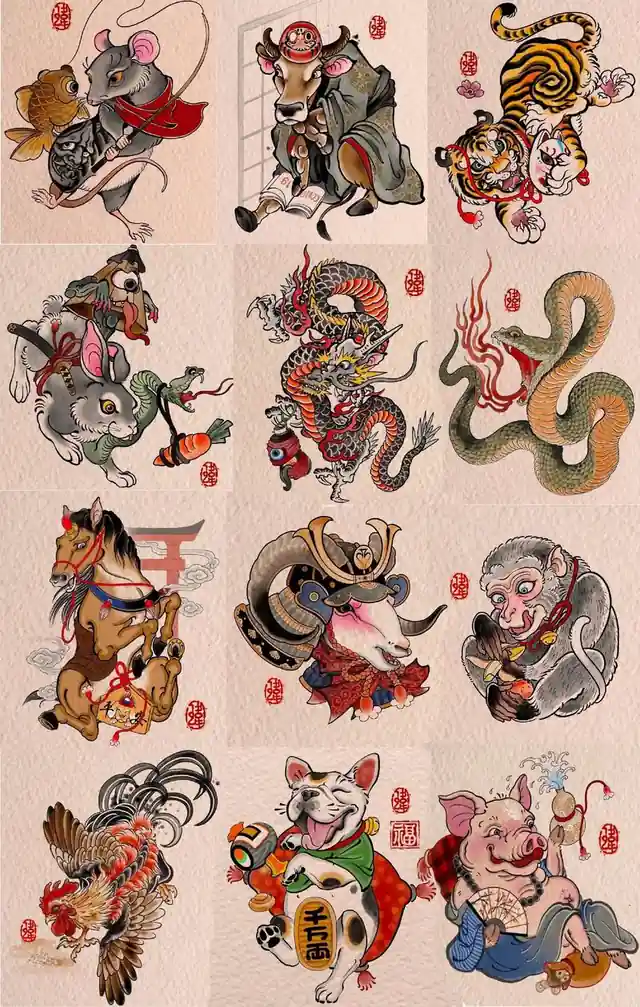
From simple animal forms to rat-headed human bodies, and then to fully humanized symbolic representations, the image of the Rat in the Chinese zodiac has undergone an evolution from realism to symbolism over the long course of history and culture. The cultural connotations of the zodiac Rat have also become increasingly rich with the transformation of its image.
According to archaeological discoveries, the image of the zodiac Rat has not been fixed or consistent from the beginning, but has undergone a gradual development and evolution in terms of its physical form. Since the image of the Zi Rat (the Rat associated with the first Earthly Branch) first appeared, it has roughly gone through three stages of development.
The realistic representation stage
The earliest image of the Zi Rat appeared in animal form. The Zi Rat image discovered in the murals of the tomb of Lou Rui, Prince of Dong'an Commandery, dating to the Wuping era of the Northern Qi Dynasty (570 CE) in Taiyuan, Shanxi, is purely an animal form. Decorative patterns on the backs of bronze mirrors from the Han Dynasty already contained inscriptions of the Twelve Earthly Branches, but these were only text without accompanying animal images. Beginning in the Sui Dynasty, images of the twelve zodiac animals appeared in the decorative patterns of bronze mirrors, arranged in a circular band on the outer rim of the mirror. Among them, "Zi" was represented as a rat with a pointed mouth, long tail, and agile body.
The stage of rat-headed human-bodied form
The twelve zodiac figurines with human bodies and animal heads, including the Rat-headed figure, began to appear in the Sui Dynasty (581-618). In 1982, during the excavation of a Sui Dynasty tomb at Yuejiazui, East Lake, Wuhan, Hubei Province, twelve zodiac figurines with animal heads and human bodies were discovered. Among them, the Zi Rat (Rat of the first Earthly Branch) was made of gray pottery, featuring a rat head on a human body, dressed in loose robes with a wide sash, sitting with hands folded and legs crossed.
By the Tang Dynasty (618-907 CE), semi-human, semi-animal zodiac figurines buried with the dead had become very common. Among them, the Rat figurines (representing the Zi hour or Rat year) all feature a rat head on a human body, with small eyes, tiny ears, and a pointed snout. They are either standing upright with hands clasped in front or sitting cross-legged, truly adorable.
The symbolic form stage.
During the Song and Liao dynasties, the twelve zodiac figurines buried with the deceased sometimes continued the Sui and Tang tradition of human bodies with animal heads. However, in certain regions, fully human forms representing the twelve zodiac animals also began to appear. The zodiac animals were often depicted in miniature forms, either held in the hands of human figures or placed atop their hats, serving as purely symbolic representations. For example, the Yuan dynasty sculpture of Lou Ri Shu (the Rat zodiac sign) at the Jade Emperor Temple in Jincheng, Shanxi, portrays a noblewoman with a crouching rat in her hand to indicate her zodiac identity. This type of sculpture, where a figure holds a rat to signify their zodiac sign, is commonly found in temples. Whether this was influenced by the Buddhist depiction of Vaishravana (the Northern Heavenly King) holding a mongoose in his hand remains a subject for further investigation.
In 1974, a Liao Dynasty (907-1125) tomb mural was excavated in Xiabali Village, Xuanhua, Hebei Province. At the center of the dome ceiling hung a bronze mirror, surrounded by a double-petal lotus flower. Beyond the lotus was a diagram of the twelve zodiac constellations (twelve houses), and outside that lay a depiction of the twenty-eight lunar mansions (xiu). The outermost ring featured images of the twelve zodiac animals, all depicted in human form wearing wide-sleeved long robes, with different animals placed atop their heads to indicate their identities. Additionally, a set of twelve zodiac animal wooden carvings in human form was unearthed in Daxing, Beijing, also identified as relics from the Liao Dynasty. Among them, the Rat spirit (Zi Shen) was carved from cypress wood, with a small rat resting on the crown of its head to symbolize its role. These figurines, crafted with exquisite detail, can be considered representative masterpieces of human-form zodiac animal depictions.
Throughout human history, civilizations across different regions have largely experienced a stage of animal worship. From a mythological perspective, this generally follows a developmental progression from animal worship to human-animal hybrids, and ultimately to animals taking on human forms. The transformation of the Rat zodiac image similarly adheres to this developmental pattern. From the evolution of the Rat zodiac image through these three stages, it can be seen that people's psychology also underwent a shift from "materialization" to "humanization" alongside changes in the zodiac image. In the early stages, people viewed themselves through the lens of objects, often shaping their own images in the form of objects. As their ability to overcome and conquer nature improved, people gradually began to view objects through themselves, often imbuing objects with human characteristics, leading to the emergence of the twelve zodiac animals in human form. This process also reflects a transition in people's belief in the zodiac from passive acceptance to subjective cognition.
Further Reading
The image of the Rat held in the hand of Vaisravana (Duowen Tianwang), the Heavenly King of Buddhist lore.
Some believe that the Rat has a deep connection with Buddhism in the context of the Chinese zodiac, often citing the example of Vaisravana (Duowen Tianwang), also known as the Heavenly King of Much Learning. Vaisravana, originally a deity of blessing in ancient India, is revered in Buddhism as one of the Four Heavenly Kings and serves as the guardian of the north. A key symbol of Vaisravana is a rat or weasel held in his hand, representing both his emblem and his incarnation. Additionally, in the front chamber of Cave 15 at the Anxi Yulin Grottoes, a mural depicts Vaisravana holding a treasure pestle in his right hand and cradling a rat on his left knee, with the rat continuously spitting out gold and silver treasures from its mouth. It is said that in the south, there is a corresponding Heavenly King of Growth (Zengzhang Tianwang), with both northern and southern kings ruling their respective domains. Their images are largely similar, both holding a rat in the same posture. Similar depictions also appear in some Tibetan thangkas.