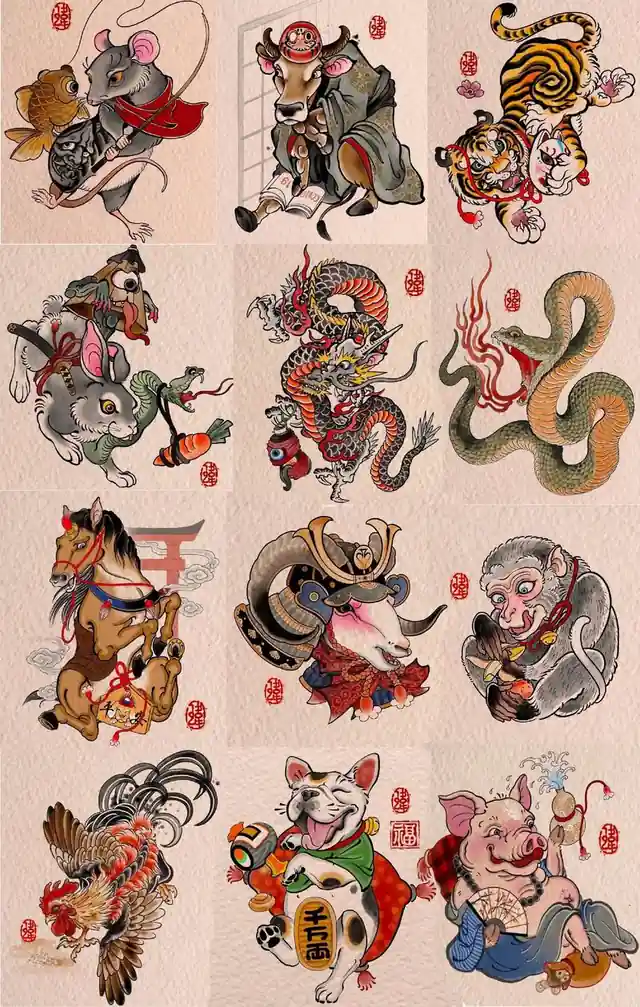
In Chinese zodiac culture, the Rat corresponds to the Earthly Branch "Zi" (the first of the twelve Earthly Branches). Among the people, the Rat is regarded as a symbol of abundant granaries, good fortune, and prosperity. There are also many beautiful folktales about the Rat, such as the story of the Rat gnawing open the sky and the Rat marrying off its daughter. These tales reflect the humorous and profound characteristics of Chinese civilization.
In Chinese zodiac culture, the Rat occupies the first position among the twelve zodiac animals. Why does this small, weak, and notoriously infamous creature hold the top spot? A widely circulated folk legend explains: The Jade Emperor summoned all the zodiac animals to a ranking conference. Animals such as the Pig, Rat, Ox, Horse, and Goat each demonstrated their unique abilities, crossing the sea like the Eight Immortals. They all rushed to the meeting together. The honest Ox set out early and took the lead, becoming the first to arrive. The championship was originally his, but the clever Rat seized the critical moment, quietly leaped onto the Ox's back, and stood on its head. As a result, the Ox had to yield the top position to the Rat, settling for second place. Of course, this is merely a legend, reflecting the rich folk imagination about traditional customs. The following two scholarly explanations may be more credible.
The Theory of Animal Forms
The ordering of the twelve zodiac animals has long been a topic of discussion among scholars throughout history. Some scholars have taken alternative approaches in hopes of providing a conclusive explanation from different perspectives. For instance, Hong Xun, a scholar from the Song Dynasty (960-1279), wrote a book titled "Gumulu" (The Valley Record), which proposed that the physical forms of the animals determined their order. According to ancient Chinese thought, a day and night were divided into twelve two-hour periods, with the Earthly Branches Zi, Yin, Chen, Wu, Shen, and Xu being considered Yang (masculine earthly branches). Therefore, animals with an odd number of toes were selected as symbols: the Rat, Tiger, Dragon, Monkey, and Dog all have five toes, while the Horse has a single hoof, all being odd numbers. Conversely, the Earthly Branches Chou, Mao, Si, Wei, You, and Hai are considered Yin (feminine earthly branches), so animals with an even number of toes were chosen: the Ox, Goat, Rooster, and Pig each have four claws, the Rabbit has two claws, and the Snake has a forked tongue, all being even numbers. In other words, the zodiac selection was based on the odd or even number of toes on these animals. The Rat, with four toes on its front feet and five on its hind feet, possesses both odd and even characteristics, making it quite unique and thus placed first in the order.
The theory based on animal habits
The Ming Dynasty scholar Lang Ying proposed an explanation based on the activity patterns of animals, that is, their habits. In his work "Qixiu Leigao (Classified Drafts of Seven Revisions)," he argued that during the day-night cycle, the Zi hour (11 PM to 1 AM) is the darkest period of night when mice are most active, so "Zi" is paired with the Rat. During the Chou hour (1 AM to 3 AM), cattle have finished eating grass and are preparing to go out to plow the fields at dawn, so "Chou" is paired with the Ox. During the Yin hour (3 AM to 5 AM), it is said that tigers are at their fiercest, so "Yin" is paired with the Tiger. After 5 AM, the moonlight still shines upon the earth, so the Mao hour (5 AM to 7 AM) is connected to the Jade Rabbit of the Moon Palace. During the Chen hour (7 AM to 9 AM), it is the time for dragons to create rain, so "Chen" is assigned to the Dragon. During the Si hour (9 AM to 11 AM), snakes do not harm people even when moving on the road, so the Si hour belongs to the Snake. At noon, the Yang energy reaches its peak and begins to decline, while Yin energy is about to arise; since the horse is a Yin-type animal, the Wu hour (11 AM to 1 PM) is assigned to the Horse. During the Wei hour (1 PM to 3 PM), goats eating grass at this time will not affect its regrowth, so the Wei hour belongs to the Goat. During the Shen hour (3 PM to 5 PM), monkeys are fond of calling out, so "Shen" is paired with the Monkey. During the You hour (5 PM to 7 PM), chickens start returning to their roosts, so the You hour belongs to the Rooster. During the Xu hour (7 PM to 9 PM), dogs begin to guard the gate, so "Xu" is associated with the Dog. During the Hai hour (9 PM to 11 PM), all is quiet, and pigs sleep most soundly, so the Hai hour is given to the Pig. This explanation, based on the physical characteristics and habits of animals, explores their connection to the time periods and seems somewhat reasonable, yet it does not clarify why animals are specifically used to pair with the time periods.
Although people generally despise rats in daily life, within the traditional Chinese zodiac folklore, rat culture is openly presented in every aspect of human daily existence. Moreover, rat culture has made the rat increasingly endearing and mysterious, and its symbolic meanings have also grown more numerous.
Further Reading
The Rat in the Duke of Zhou's Dream Interpretation (Zhou Gong Jie Meng).
According to Zhou Gong's Interpretation of Dreams (a classic Chinese dream divination text), dreaming of a muskrat foretells career success. Dreaming of catching a rat indicates that one will fall victim to an enemy's conspiracy. Dreaming of a cat catching a rat is a blessing, as it suggests that enemies will destroy each other, leading to the downfall of both parties. Dreaming of a dead rat signals that good fortune is approaching. Dreaming of many rats suggests that failures will occur repeatedly. Dreaming of rats digging holes inside one's residence warns that the home may be burglarized. If a man dreams of a rat biting him, disaster will be averted. For a farmer, dreaming of a squirrel promises a bountiful harvest.
These explanations originate from folk beliefs that rats possess spiritual sensitivity and can predict good fortune, misfortune, and disasters. In reality, it is quite normal for rats to exhibit certain behavioral responses to impending natural events such as earthquakes, floods, droughts, and locust plagues. This is a special instinct shared by Earth's creatures, though some aspects remain beyond human knowledge and have yet to reveal their underlying patterns.