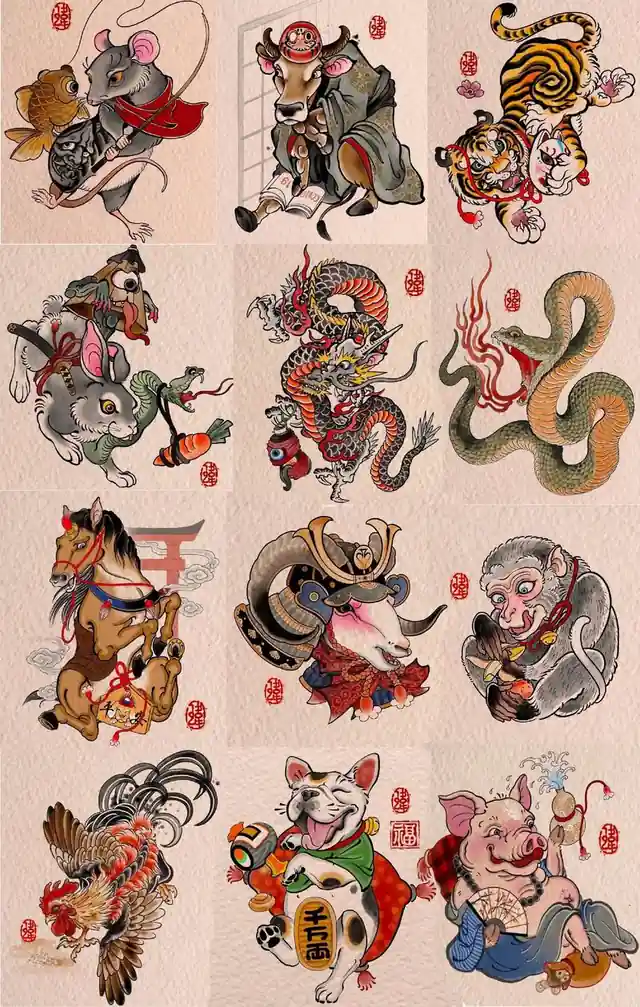
Whether in New Year paintings, paper-cutting art, or festive celebrations, the story of "The Rat's Wedding" is frequently seen. This not only reflects the working people's complex psychology of both fearing and revering the Rat as a zodiac animal, but also expresses the folk mentality of seeking to avoid disaster and invite blessings.
As the Spring Festival approaches, posting New Year paintings or paper-cuttings has become a traditional custom for the Chinese people. This practice not only expresses people's best wishes for the new year but also adds a festive atmosphere to the celebrations. Among the various styles of New Year paintings and paper-cuttings, the most common motif is undoubtedly "The Rat Marries Off His Daughter."
In the scene of "The Rat Marrying Off His Daughter," lanterns and colorful decorations are hung everywhere, with music playing and a lively atmosphere. The wedding procession includes a bridal sedan chair, colorful flags, lanterns, and a drum band, all complete, resembling the grand occasion of a human wedding. Among the attendants, two rats carry a large banner reading "Upright and Bright," which looks dignified yet comically adorable. In New Year paintings or paper-cuts, the sedan carriers, attendants, and musicians are all depicted as rats, but the appearances of the bride and groom often vary by region. In the "Rat Marrying Off His Daughter" New Year painting printed by the Baoyuelai Painting Shop in Shaoyang, Hunan, during the Qing Dynasty (1644-1912), both the groom and bride are rats. In the "Rat Marrying Off His Daughter" slip printed in Mianzhu, Sichuan, during the Qing Dynasty, the groom is a rat while the bride is human. In the Qing Dynasty woodblock New Year painting "Rat Marrying Off His Daughter" from Jiajiang, Sichuan, both the groom and bride are human. However, in the folk New Year painting "Rat Marrying Off His Daughter" from Shanxi, the groom is a rat while the bride is a cat.
"Marrying Off the Daughter of the Rat" was originally a folk ritual to worship rats, popular across various regions of China with dates varying by location. In southern Jiangsu, it takes place on the first day of the first lunar month; in northern Jiangsu, on the sixteenth day of the first lunar month; in some areas of Hunan, on the fourth day of the second lunar month; in the Hanjiang Plain of Hubei, on the twenty-third day of the twelfth lunar month; in Sichuan, mostly on New Year's Eve; in Shandong and Shanxi, mostly on the seventh day of the first lunar month; in some parts of Shaanxi, on the tenth day of the first lunar month; and in most areas of Hebei, on the seventeenth day of the first lunar month. The forms of rat worship also vary. In the Jiangnan region, on the eve of the rat wedding day, every household fries sesame candy, which legend says is the wedding candy prepared for the rats. That evening, children place candies, cakes, and popped rice in areas frequented by rats, and they strike pot lids and winnowing baskets as a way to urge the rats to prepare for their wedding. In some parts of Shaanxi, on the night of the tenth day of the first lunar month, every household extinguishes candles and goes to bed early, also scattering salt and rice grains in corners, commonly known as "rat's share of money." In some areas of southern Jiangsu, on the day of the rat wedding, no lamps are lit day or night, children are told not to make noise to avoid disturbing the rat wedding procession, and shoes are taken off to serve as the bridal sedan chair for the rat groom, while melon seed shells and peanut shells are used as gift boxes.
In essence, the "Rat Marrying Off Its Daughter" rodent worship activity is a continuation of primitive society's totem worship, fully reflecting people's contradictory psychology of both hating and revering, expelling and pampering rats. On one hand, ancient ancestors believed that rats made tremendous contributions to humanity, such as bringing grain seeds, making them "heroes" in people's hearts who deserved offerings. On the other hand, rats caused immense harm to people, stealing food, destroying farmland, damaging homes, gnawing on books and clothing, and most severely, spreading the terrifying plague. Therefore, people had to simultaneously drive away rats while worshipping them as deities. In the "Rat Marrying Off Its Daughter" custom, people use salt, cakes, and candies as offerings to rats, hoping for "peaceful coexistence" with them. They refrain from lighting lamps and making noise to avoid disturbing the rat wedding procession, fearing that "if you disturb them for one night, they will trouble you for a whole year."
Of course, some also believe that the Rat is the "Zi Deity" (god of the midnight hour), and "The Rat Marrying Off His Daughter" actually symbolizes "a human marrying off his daughter," serving as people's prayer for early childbirth and abundant blessings, hoping to have as many children as rats. Therefore, in the oldest folk paper-cutting "The Rat Marrying Off His Daughter," the figure sitting inside the bridal sedan chair is not a rat but the human fertility deity, the "Zhuaji Doll" (a child with tufted hair representing procreation).
In summary, "The Mouse Marrying Off His Daughter" is a cultural complex that evolved from primitive totem worship and underwent variations during its transmission, thus possessing rich cultural connotations.
Further Reading
The myth of the Rat splitting the heavens open.
In folk paper-cutting and woodblock New Year prints, the rat in "The Rat Marries Its Daughter" is depicted as the "Zi God," reflecting people's reverence for those born under the Rat zodiac sign. There is also a folk myth about the rat biting open the heavens. In Qing Dynasty scholar Liu Xianting's "Guangyang Zaji" (Miscellaneous Notes from Guangyang), Volume 1, when explaining "Why is Zi associated with the Rat," he quotes Li Changqing's "Songxia Guan Zhuiyan" (Supplementary Words from the Pine Cloud Pavilion), which elaborates on the legend of the rat biting open the heavens: "Why is Zi associated with the Rat? It is said: Heaven was opened at the hour of Zi, and without consumption, the vital energy would not be released. The rat is a creature of consumption, and at this time, when the night is still young, it is precisely the rat's hour of command. Therefore, Zi corresponds to the Rat."
Zi refers to the Zi hour (11 PM to 1 AM) in the ancient Chinese timekeeping system of the twelve two-hour periods, and it is during this nocturnal Zi hour that rats are active, a time when the yin and yang of heaven and earth intersect and chaos remains undivided. The rat is a gnawing creature, and "gnawing" (hao) implies consumption or destruction, yet this detrimental trait of the rat played a significant role in the creation of the world. During the Zi hour, heaven and earth were not yet separated, existing as a formless chaos, yet the vitality of all things was contained within. In the pitch-black, seamless void, the rat bit open the chaotic mass of heaven and earth, allowing qi (vital energy) to emerge. Consequently, heaven and earth parted: the light and pure rose to form the heavens, while the heavy and turbid sank to form the earth. Yin and yang became both opposing and unified, the sun, moon, and stars cycled, all things appeared, and ultimately the universe took shape, providing humanity with a space to live.