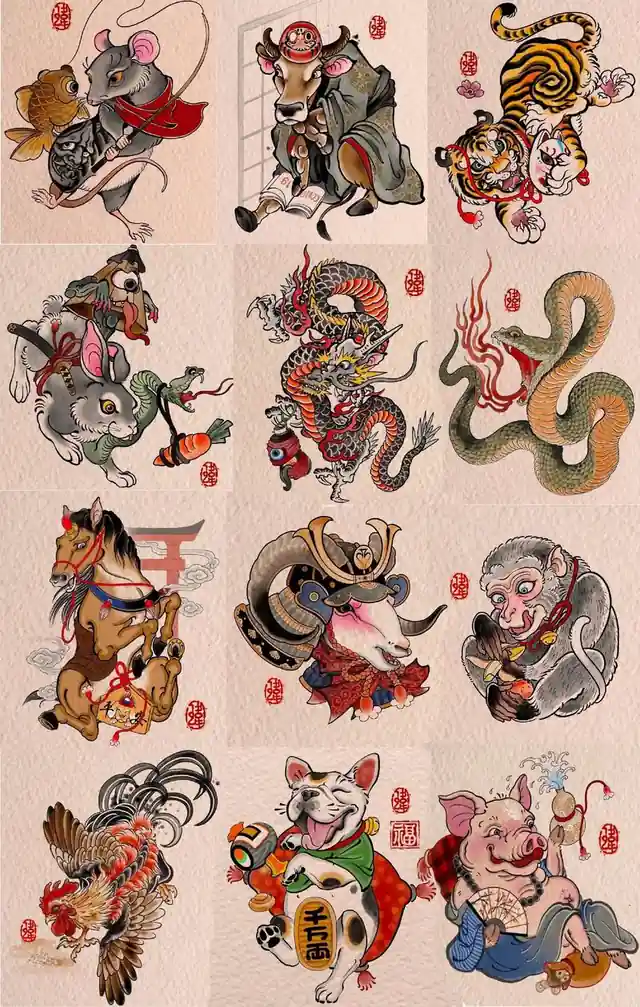
From classical poetry and ancient texts to folk operas and children's songs, the Rat has always been a frequent subject in linguistic arts. Refined scholars have used the Rat as a theme, either praising its intelligence and cunning, satirizing its thievery and mischief, or employing it as a metaphor for human behavior, making the Rat an enduring motif in the art of language.
As the first of the twelve zodiac animals, the Rat has left a deep impression on the Chinese people. With its small body, slender eyes, and agile movements, the Rat is not only favored by ordinary people but also has earned a prominent place in the literary works of many scholars and poets.
Poems about the Rat
As early as the Book of Songs (Shijing), there was a poem about rats titled "Shuo Shu" (Big Rat). This poem uses the familiar image of rats in people's daily lives as a metaphor for the ruling class, vividly and profoundly revealing the parasitic nature of slave owners who are greedy by nature and reap without sowing. Thus, the rat as a symbol of greed, cunning, and evil has existed since ancient times.
Of course, there are also those who praise the rat greatly. The Jin Dynasty poet Guo Pu wrote a poem titled "Ode to the Flying Rat": "Some glide with their tails, others soar with their whiskers; they chirp and drum their wings, suddenly all taking flight. Their movements have no fixed pattern, relying solely on divine spirit." The poet vividly depicts the swift and agile posture of the rat, where its tail can glide and its whiskers can fly. The Qing Dynasty poet Zhang Shao also composed a poem titled "Poem on the Silver Rat": "The Apricot Mountain caves are filled with shining flying squirrels; how many are caught by hunting nets chasing the wind? They dart on the ground faster than the moon-avoiding hare, and leap through the air as brilliantly as a thrown shuttle. In the pine forest, they glide over powder-like snow, closing at night; in the snow kiln, they compete in brilliance, enduring the cold. All for a slight reputation to be treasured by the world; newly bestowed caps and robes borrow much from them." In the poet's brush, the silver rat is as swift as the moon hare and as bright as a flying shuttle, leaving the viewer dazzled and unable to take it all in.
Rat culture
Yanzi Chunqiu (The Spring and Autumn Annals of Master Yan) contains a passage titled "Suffering from the Sacred Rat." It reads: "Duke Jing asked Yanzi, 'What is the greatest worry in governing a state?' Yanzi replied, 'The greatest worry is the sacred rat.' The Duke asked, 'What do you mean by that?' Yanzi answered, 'The sacred shrine is built by binding wooden planks together and plastering them with clay. The rats take refuge inside. If you smoke them out, you risk burning the wood; if you flood them out, you risk ruining the plaster. The rats cannot be killed precisely because of the shrine. The same situation exists in a state — the ruler's close associates are like those rats. Inside the court, they conceal right and wrong from the ruler; outside, they abuse their power over the people. If they are not punished, they cause chaos; if they are punished, they are protected and sheltered by the ruler himself. These are the state's sacred rats.'" Using the metaphor of the sacred rat, Yanzi skillfully linked it to the treacherous ministers and sycophants at court, thereby delivering a powerful and effective admonition.
Additionally, depictions of the rat's image appear in Sima Qian's "Records of the Grand Historian: Biography of Li Si," Liu Zongyuan's "Three Warnings," and Su Dongpo's "Rhapsody on the Cunning Rat," which need not be elaborated upon here individually.
Rat Performances
In the Kun opera "Fifteen Strings of Cash," there is a cunning and treacherous character named "Lou A Shu" (Lou the Rat), who murders someone for fifteen strings of cash and then flees the scene. Suzhou Prefect Kuang Zhong, in order to capture the criminal, disguises himself as a fortune-teller and encounters Lou A Shu. Guilty and fearful, Lou asks the fortune-teller to divine his luck. Kuang Zhong cleverly uses the rat as a metaphor, playing on the relationship between the Zi (Rat) earthly branch and the zodiac sign, leading to a witty and engaging dialogue.
Lou A Shu: Sir, my humble name is Lou A Shu, the character "Shu" meaning rat. Can you perform divination on this character for me?
Kuang Zhong said: "The Rat is the first of the twelve zodiac animals
Lou A Shu: Do you think I will be implicated in any disputes or gossip in the future?
Kuang Zhong said: How can you say it won't implicate you? At this moment, the truth is about to be exposed.
Lou A Shu: "What do you mean?"
Kuang Zhong said: "As for the character 'Rat' (shu) you asked about, it currently coincides with the Zi month, which represents the present time. I'm afraid this lawsuit will soon be resolved."
Lou Ashu: Sir, could it possibly slip out?
Kuang Zhong said: "If we are to leave, we must set out today. By tomorrow, it will be too late to go."
Lou A Shu: Why?
Kuang Zhong said: "The character 'rat' has a 'jiu' (臼, mortar) at its top, which originally means two half-days combined into one full day. If it reaches tomorrow, it would count as two days, and then you cannot escape."
Lou A Shu: Ah! It's already late now, how am I supposed to leave?
Kuang Zhong: Let me calculate carefully. The Rat belongs to Xun (the southeast direction in the Eight Trigrams), and Xun belongs to the east. The southeast direction would be favorable to go.
Lou A Shu: Southeast? Sir, please take another careful look — is the water route safe, or is the land route without trouble?
Kuang Zhong: Let me calculate this carefully. The Rat corresponds to Zi, and Zi corresponds to Water. Taking the water route would be favorable...
In this theatrical passage, the rat becomes synonymous with a thief. Facing Lou Ashu, who was guilty and fearful due to his theft, Kuang Zhong leveraged the relationship between zodiac signs and life circumstances to make Lou Ashu unwittingly confess himself as the murderer. Here, Kuang Zhong fully exploited the theme of the rat character, and Lou Ashu's "rat-like nature" was vividly portrayed to the fullest.
Additionally, idioms, lantern riddles, and two-part allegorical sayings featuring the Rat are as numerous as the stars in the sky and too many to enumerate. This is also a very important aspect of why the zodiac culture maintains its enduring charm.
Further Reading
Lai Zhishao was described as "hesitating like a rat at both ends," meaning he was indecisive and wavering between two choices.
The "Jilei Bian" (Chicken Rib Collection) by Zhuang Chuo of the Song Dynasty records an incident from the Yuanyou era of the Northern Song Dynasty involving Lai Zhishao, who was described as "shou shu liang duan" (hesitating like a rat at both ends). It states: "At the end of the Yuanyou period, discussions about 'Shaoshu' (restoring the policies of the Xining era) had already emerged. At that time, Lai Zhishao served as an imperial censor, and his opinions in deliberations were often indecisive and vacillating, leading the world to call him 'Liang Lai Zi' (Two-Come Master)." As an imperial censor, Lai Zhishao frequently wavered in his stance during discussions, acting with hesitation and ambiguity. Thus, people nicknamed him "Liang Lai Zi." "Lai" is his surname, while "Zi" refers to the Rat in the twelve zodiac animals. Using "Zi" as a suffix might sound like a term of praise, similar to "Fuzi" (Master), but it actually conceals criticism of his indecisive behavior. The effect arises from the correspondence between the earthly branch Zi and the Rat in the zodiac system.