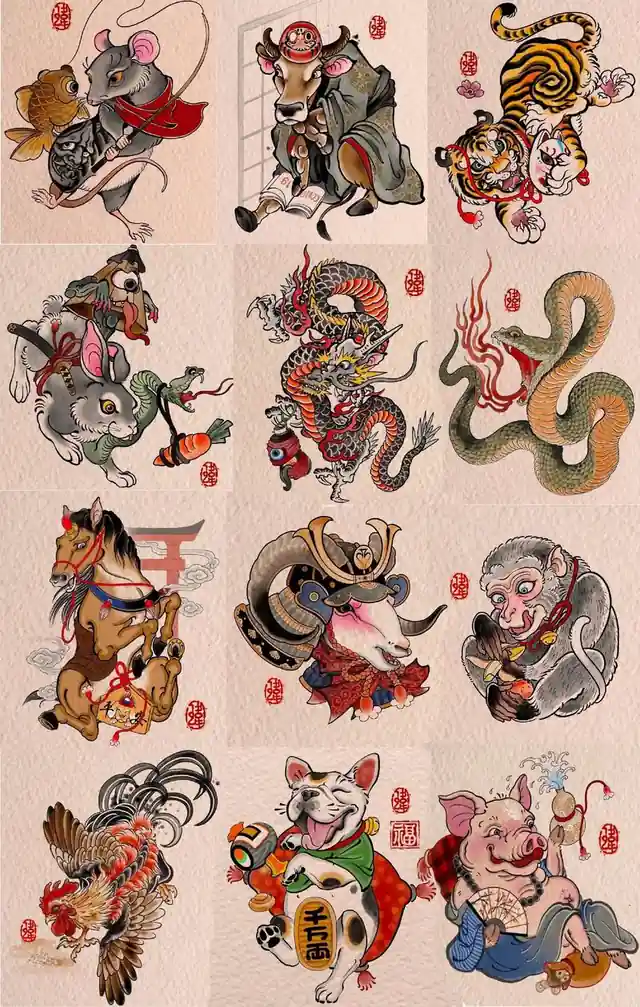
Due to the close relationship between rats and people's daily lives, the folk customs related to rats are diverse and too numerous to list. These customs associated with the Rat in the Chinese zodiac constitute a very important aspect of zodiac culture, and they are the key to maintaining the vibrant vitality of the zodiac Rat culture.
In Chinese festive folk art, the "Rat" is an important cultural symbol whose image can be seen everywhere. Initially, people drove away rats and exorcised plagues to pray for good fortune, but later the original festive rat culture gradually evolved into a auspicious culture praying for blessings, prosperity, longevity, happiness, and wealth. People combined rats with auspicious symbols such as bats, Buddha's hand citrons, longevity peaches, pomegranates, osmanthus flowers, and silver carp, using homophones and symbolism to create paper-cut artworks of festive rat culture, including "Auspicious Rat at the Door," "Witty Rat Welcoming Spring," "Prosperous Rat Rising High," "Longevity Rat Extending Years," "Wealthy Rat Thriving," "Auspicious Rat Wearing Laurel," "Rat Year with Abundance," and "Rat Returning Home."
Zhao Xuhuo (Illuminating the Void-Consuming Ghost).
According to ancient customs, people lit lamps under their beds on the 24th day of the twelfth lunar month or on New Year's Eve to drive away filth, evil spirits, and demons, a practice called "Zhao Xuhao" (Illuminating the Depletion of Evil). Meng Yuanlao of the Song Dynasty (960-1279) recorded in his work "Dongjing Menghua Lu (The Eastern Capital: A Dream of Splendor), Volume on the Twelfth Month": "On the 24th day, the year changes... at night, lamps are lit under the bed, called Zhao Xuhao." Tian Rucheng of the Ming Dynasty (1368-1644) recorded in "Xihu Youlan Zhiyu (Further Records of a Tour of West Lake), Xizhao Happy Events": "On New Year's Eve... lamps are lit under the bed, called Zhao Xuhao."
"Zhao Xuhuo" (Illuminating Wasteful Consumption), also known as "Zhao Shuhao" (Illuminating Rat Waste), is observed in some places on the fifteenth day of the first lunar month. On this day, people light lamps at doors, beds, kitchens, toilets, and other places, or burn incense and light lamps under rice jars and flour containers. "Zhao Xuhuo" has two meanings: driving away rats and expelling pestilence to seek good fortune. "Xuhuo" refers to rats, and lighting lamps is meant to prevent rats from stealing offerings, while also complementing the act of filling granaries and facilitating rat expulsion. Another interpretation is that it illuminates all unlucky things until they vanish without a trace, symbolizing the expulsion of pestilence and the welcoming of good fortune.
Tiancang Festival (Fill the Granary Festival)
The Tiancang Festival, also known as "Tiancang" (Fill the Granary) or "Tiancang Day," is celebrated across northern, central-south, and northeastern China from the 20th to the 25th day of the first lunar month. During this period, people both replenish their grain stores and intensify efforts to eliminate rats. According to old customs in the Beijing-Tianjin region, the 23rd day of the first lunar month is "Small Fill the Granary," and the 25th is "Great Fill the Granary." Around the Tiancang Festival, New Year pictures depicting "The Rat Marries Off Its Daughter" are sold, reminding people to let cats catch rats. As recorded in "Dijing Suishi Jisheng" (Record of Seasonal Customs in the Imperial Capital) by Pan Rongsheng of the Qing Dynasty (1644-1912): "As the New Year passes and the granaries become empty, they should be refilled and restocked, hence the day is called Tiancang." Among the people, on the night of the 24th day of the first lunar month, longtime residents of Tianjin draw a small circle with white powder in their homes, with a small ladder painted at the circle's opening. Inside the circle, they place rice, beans, and other grains, a practice called "Da Dun" (Build the Granary), praying for abundant harvests and steady advancement. On the 25th day of the first lunar month, the Tiancang Festival is observed by eating two types of food: meat-filled dumplings, called "Tiancang" (Fill the Granary), and pancakes (hezi), called "Gai Cang" (Cover the Granary). On this day, it is said that rats hold their weddings, so every household goes to bed early and avoids disturbing the rats, for fear of being plagued by them for the entire year.
Farewell to the Rat Festival
The Maonan ethnic group in Pingtang, Guizhou holds the Rat-Sending Festival, also known as the Little New Year, on the first day of the twelfth lunar month each year. Starting from the 30th day of the eleventh lunar month, every household cleans their granaries and suns their rice ears. In the evening, they store the rice ears in the granary and hang the rice ears, which the Maonan people regard as the "soul of rice," in the center. They then perform ancestral worship and pay respects to the rice soul. On the night of the 30th of the twelfth lunar month, when the whole family gathers for the reunion dinner, the elders teach the younger generations to sing the "Song of Sending the Rat" and tell the story of "The Struggle Between Humans and Rats for the Soul of Rice." In the past, humans and rats were brothers. When dividing the family property, the rat took all the assets, while humans received only a single ear of rice. After the division, the rat became lazy and gluttonous, eating all the grain in the granary and then running rampant in the fields, biting and destroying crops. However, humans, through hard work, enjoyed abundant harvests year after year. On the early morning of the first day of the twelfth lunar month, the village elder and the shaman preside over the Rat-Sending ceremony. Everyone collectively sings the "Song of Sending the Rat," and young men engage in a competition to smash stone rats.
The Mouse-Eating Festival.
In the Qiandongnan area of Guizhou, the Miao people with the surname Long celebrate the Rat Eating Festival on the first day of the twelfth lunar month each year. During this festival, each household must eat at least two or three large, fat rats. If a family fails to catch any rats, they must make several "rice rats" (glutinous rice dumplings shaped like rats) to observe the festival. The Miao Rat Eating Festival is a form of ancestor worship. According to legend, a Miao man named Long once fled with his family to this area due to famine. During a severe drought, rats stole the Long family's only grain. The family tracked the rats to their burrow, captured over a hundred rats, and on the first day of the twelfth lunar month, they ate the rat meat and used the rats to honor their ancestors. This practice gradually became a custom. This tradition represents a departure from the earlier practice of sacrificing oxen to ancestors and also serves the practical purpose of controlling the rat population.
Steaming Blind Rats
Steaming blind rats is a Qinghai New Year custom practiced in Ledu, Minhe, Ping'an, Huangzhong, and Huzhu areas. On the evening of the 14th day of the first lunar month, every household makes twelve blind rats from dough, using Sichuan pepper seeds for eyes and ensuring all seven apertures are complete. They are steamed in a bamboo steamer and, at dawn on the Lantern Festival, placed on an altar with lit lamps and burning incense. People bow and pray, asking the rats to eat grass roots rather than damage crops, thus ensuring a bountiful harvest.
Further Reading
The custom of "Rats Counting Money"
There is also a folk custom known as "rats counting money," which describes the chirping sounds rats make late at night or at dawn, resembling the clinking of copper coins. In the Chongming area of Shanghai, people believe that hearing this sound is an omen of impending misfortune, requiring caution and the burning of incense to pray for the Buddha's protection. In Zhejiang folk tradition, however, it is believed that if rats count money in the early part of the night, it signals the arrival of wealth, while if they do so in the latter part of the night, it signifies the scattering of wealth.