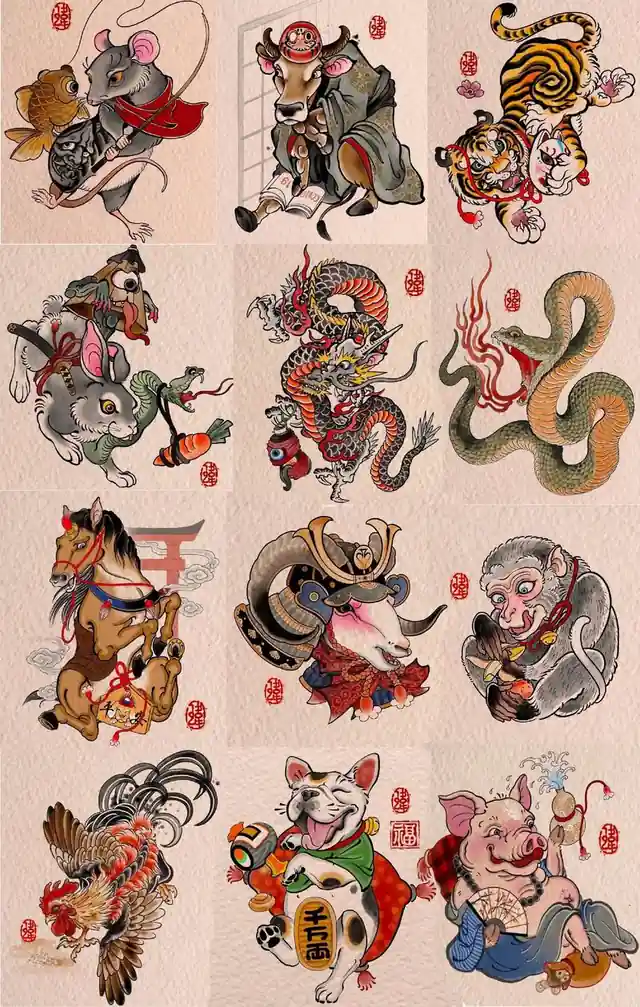
Cunning and cleverness seem to be people's consistent impression of those born in the Year of the Rat, and rats indeed possess unimaginable intelligence. In addition, the rat is also a symbol of abundance. Due to the richness of the rat's symbolic meaning, various folk customs related to rats have formed among the people.
In most people's impression, words associated with rats often carry negative connotations, such as "a rat crossing the street is chased by everyone" or "hesitate to pelt a rat for fear of breaking the dishes." When describing someone as short-sighted, we often say they have "rat's eyes that can only see an inch ahead," and when referring to a timid person, the phrase "as timid as a rat" comes to mind. However, the rat is not without its merits, and as a zodiac animal, it also holds its own special symbolic significance.
A symbol of intelligence.
In the remote age of primordial wilderness, the ancient people primarily relied on gathering and hunting for survival. They were still unclear about which foods were edible and which were not, often suffering from poisoning as a result. Later, people discovered that rats were extremely clever. Although they foraged for food in the dark of night, they never fell ill from poisoning. Thus, humans learned from rats the ability to distinguish between poisonous and non-poisonous foods.
Although this is merely a legend that deifies rats, in reality, rats are indeed very intelligent. When stealing oil, they know to turn around and extend their long tails into the narrow-mouthed oil bottle, dip the tail in oil, and then bring it to their mouths to taste the deliciousness. Rats also know how to steal an egg placed on a table or chair intact into their hole. They will find a companion to help: one rat lies on its back, clutching the egg tightly with its four paws, while the other rat bites its tail firmly and drags it steadily along the table or chair legs, pulling the egg into the hole.
Rats prefer to build their burrows in places with abundant food, and a single rat burrow often has multiple exits and entrances, which not only facilitates their activities but also provides protection against unexpected dangers. It is said that rats are master builders, as their burrows contain not only sleeping areas but also specialized spaces such as storage rooms and toilets, making them seem like great engineers.
Moreover, when it comes to preserving its own life, the rat demonstrates extraordinary intelligence and ability that are truly beyond human reach.
Symbol of Abundance
In some regions of China, the rat is revered as the "God of Wealth," and its presence is even welcomed in certain ways. A legend from Tongxiang County in Zhejiang Province tells the following story: Long ago, grains grew on the earth without any need for human cultivation or weeding. Later, a celestial deity found people's lives too comfortable and sent a divine envoy down to earth with a bag to collect all the grains and bring them back to heaven. Unexpectedly, a rat had slipped into the bag at some point, bit through it, and left behind the five grains (commonly known as the staple crops) that we are familiar with today.
Regarding why people regard rats as symbols of abundance, some have proposed more scientific explanations. First, people hoped that rats would bring them grain seeds, ensuring sufficient food and freedom from hunger. Second, places frequented by rats must have abundant grain stores, meaning such households could avoid the suffering of starvation. Third, the grain hoarded in rat burrows is often piled high like a mountain, and people also wished to emulate rats in making their lives more prosperous. Thus, it is not difficult to see why people have revered the rat as the "God of Wealth."
A symbol of abundant offspring and blessings.
The reason rats are said to have "large families and great wealth" is due to their extraordinary reproductive capacity. Under natural conditions, a female rat can give birth to 5 to 10 pups per litter, with a maximum of up to 24. Moreover, the gestation period for rats is only 21 days, and a female can become pregnant again on the same day she gives birth. Pups typically reach maturity within 30 to 40 days, and the females among them will then join the ranks of reproduction. This cycle repeats, allowing a single female rat to produce around 5,000 offspring in one year. When combined with the reproduction of the female rats among those 5,000, the total number becomes nearly incalculable. Therefore, in folk culture, mothers who give birth to many children are often jokingly referred to as having a "rat womb" or "rat belly," a metaphor for their extraordinary fertility.
Thus, in the symbolic meaning of the Rat, whether representing intelligence, abundance, or fertility (a wish for many offspring), it clearly transcends the ordinary notion of the rat, offering a deeper exploration of the cultural significance within the Rat zodiac.
Further Reading
Su Shi's "Ode to the Cunning Rat" (Xia Shu Fu) cleverly uses the intelligent rat as a metaphor for human nature.
One night, Su Shi heard a rat gnawing on something. He tapped the bed board, and the sound stopped, but after a while, the gnawing resumed. Su Shi ordered his servant to search for the source of the sound with a candle, and eventually, they found an empty sack in a corner from which the sound was coming. The servant opened the sack, but inside it was utterly silent with no noise. Lifting the candle to look, he found a dead rat inside the sack and poured it out, only for the rat to escape as soon as it hit the ground. Su Shi sighed and said, "This rat is truly cunning! Trapped in the sack, which was too sturdy to gnaw through, it used sound to attract attention and pretended to be dead to seek escape. I thought nothing was more intelligent than humans, yet here I am, outwitted by a rat. Where, then, does human intelligence lie?"