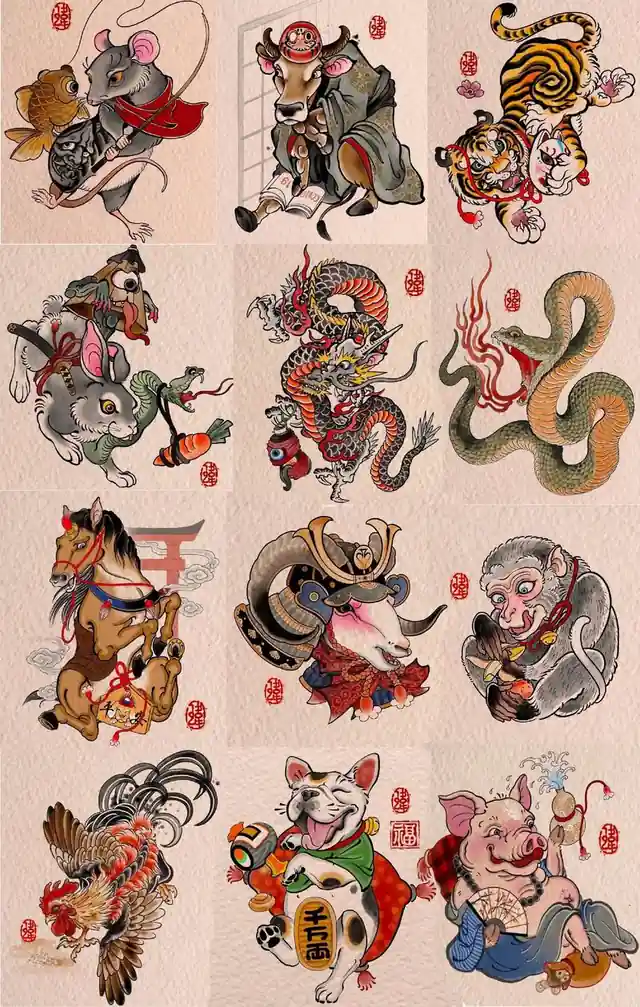
Due to the unique image and habits of the Rat, people regard it as both a symbol of good fortune and happiness, while also associating it with numerous disasters and misfortunes. The auspicious and ominous aspects of the Rat in the Chinese zodiac reflect people's contradictory psychology of both reverence and hatred toward this animal, demonstrating the significant impact the zodiac Rat has on people's lives.
In almost all folk paper-cuts and New Year paintings depicting the theme of "The Rat's Wedding," there is a "spotted yellow cat" used to mock the rat's "audacity" and the cat's "loss of wits." A folk proverb states: "On the hundredth day of celebration, the bride returns home; a bold rat comes to welcome the wedding. Three times the tabby cat stands behind the mountain; with one gulp, it swallows the rat, sending it to the underworld." Of course, the ancients did not hold a single attitude toward rats. The "Shuo Rat" chapter in the Classic of Poetry (Shijing) says: "Big rat, big rat, do not eat my millet. For three years I have served you, yet you show me no regard. I will leave you and go to that happy land. Happy land, happy land, where I shall find my place." This expresses the ancestors' rebellion against and contempt for rat worship. This sentiment gradually became mainstream, as is familiar to modern people. The above reflects two different attitudes people hold toward rats.
The Rat zodiac sign symbolizes auspiciousness.
In folk beliefs, rats usually represent auspicious spirits or gods of fortune, especially white rats among their kind. According to "Dijing Tu" (Mirror of the Earth), "When gold appears, it manifests as fire or white rats," meaning that gold takes the form of white rats when it reveals itself. In old customs, during the Lantern Festival in Tianjin, people would offer flower-shaped cakes and steamed buns to deities, along with steamed dough rats and hedgehogs carrying treasure ingots on their backs. When offerings were made on the 14th day of the first lunar month, the faces of the rats and hedgehogs faced outward; after burning incense and paying respects, their faces were turned inward, symbolizing that they had already carried the treasures home.
According to Daoist theory, the white rat possesses divine qualities and can predict the past and future. Gan Bao's "Soushen Ji" (In Search of the Supernatural) states: "A snake that lives a thousand years can be severed and reconnected; a rat that lives a hundred years can practice divination." People also believe that seeing a rat is an auspicious omen, and a rat spitting out five colors is an especially strong symbol of good fortune. Those born in the Year of the Rat refer to their zodiac year as Ben Ming Nian (the year of one's birth sign) and regard the rat as their protective deity. Some people, because their birth year animal is the rat, develop a fondness for it, not only refusing to keep cats but also forbidding others from catching or killing rats.
In certain regions and professions, people hold a special reverence mixed with fear toward rats. Those who work on boats believe that rats are protective spirits of their vessels—if rats are on board, the ship is safe, but if they abandon it, the ship will sink. Businesspeople regard rats as gods of wealth, believing that rats bring abundant fortune and that killing one cuts off their financial prospects. Farmers consider rats household protectors, where a large number of rats in the home symbolizes good luck and prosperity, while their sudden departure is seen as an omen of fire.
The zodiac sign of the Rat portends disaster.
In folk culture, rats are considered omens of floods and droughts. Before a flood or severe drought, rats exhibit abnormal behavior, such as swarming in groups, mutating in form, or transformations of birds, fish, and snakes into rats. Ancient texts also record instances of rats moving in massive groups, "in the tens of thousands," blocking roads and being trampled to death by carts and horses in countless numbers, rats as large as rabbits, and crops being completely devoured wherever they passed. Certain abnormal phenomena among rats, such as leaving their nests en masse, large-scale migrations, or crossing rivers while biting each other's tails, are considered precursors to floods, fires, earthquakes, oil field explosions, and crop disasters. These beliefs stem from the long-term observation of rat behavior by common people and their accumulated practical experience, carrying a certain basis in reality.
The belief in spirits and souls is a significant component of traditional Chinese culture, with people holding that all things possess a soul. During the Qing Dynasty (1644-1912), a story titled "The Soul of the Rat" was recorded: A cat chased a rat, causing the rat to lose its soul. The soul of a certain patient was then replaced by the rat's soul, and his habits became rat-like, such as eating in darkness and being easily startled. A doctor cured him by administering antidotes and tranquilizing medicines. In the Song Dynasty (960-1279), Hong Mai recorded in "Yijian Zhi" (Records of the Listener) that in Lingnan (south of the Five Ridges, modern-day Guangdong and Guangxi), when there had been no rain for many days, in the severely drought-stricken areas such as Qingyuan, not only did birds and snakes transform into rats, but even several hundred fish caught in a fisherman's net turned into rats upon being taken out, causing damage to crops. The ancients regarded these phenomena as omens of famine.
Rats were also considered omens of plague. Yao Yuanzhi of the Qing Dynasty (1644-1912) wrote in his "Zhuye Ting Zaji (Miscellaneous Records from the Bamboo Leaf Pavilion)": "In the border regions of Yunnan and Guizhou, pestilential vapors often arise. When such vapors arrive, rats are the first to suffer disaster; afflicted rats inevitably spit blood and die." Upon encountering such blood-spitting, dying rats, people had to immediately flee their homes without hesitation, running swiftly away, perhaps barely escaping with their lives. Because of the severe harm rats brought, people often turned pale at the mere mention of them, which in turn gave rise to customs of revering and flattering rats.
Further Reading
Various customs of rat omens for good and bad fortune.
The customs and beliefs regarding the Rat as an omen of good or ill fortune are usually associated with specific environments and particular groups of people. For example, in Northeast China, the Rat is revered as the Granary God; in Gejiu, Yunnan Province, a Rat Temple was built to thank rats for rescuing miners; boatmen on the Chishui River in southern China honor the Rat as the "Manager," deciding whether to set sail based on the rat's movements; performers of Northeast Errenzhuan (a folk song-and-dance duet) call the Rat "Uncle Gray"; in Chongming, Shanghai, it is referred to as "Grandpa Rat"; in Suichang, Zhejiang Province, it is called "Great Grandfather Rat"; and in the silkworm-raising regions of Yuhang, Zhejiang, it is known as the "Night Pearl." Such practices serve two purposes: on one hand, they flatter the Rat, seeking to appease it passively and ingratiatingly in hopes that it will not harm humans; on the other hand, they reflect an ancient taboo on names, where directly uttering the name of the Rat is avoided to prevent offending it. Beyond name taboos, other Rat-related prohibitions exist in various regions. For instance, in Shanxi Province, on certain days of the first lunar month, women are forbidden to use needles, spin thread, push millstones, eat rice, light lamps at night, or speak while sleeping, reflecting a passive folk attitude toward dealing with rat infestations.