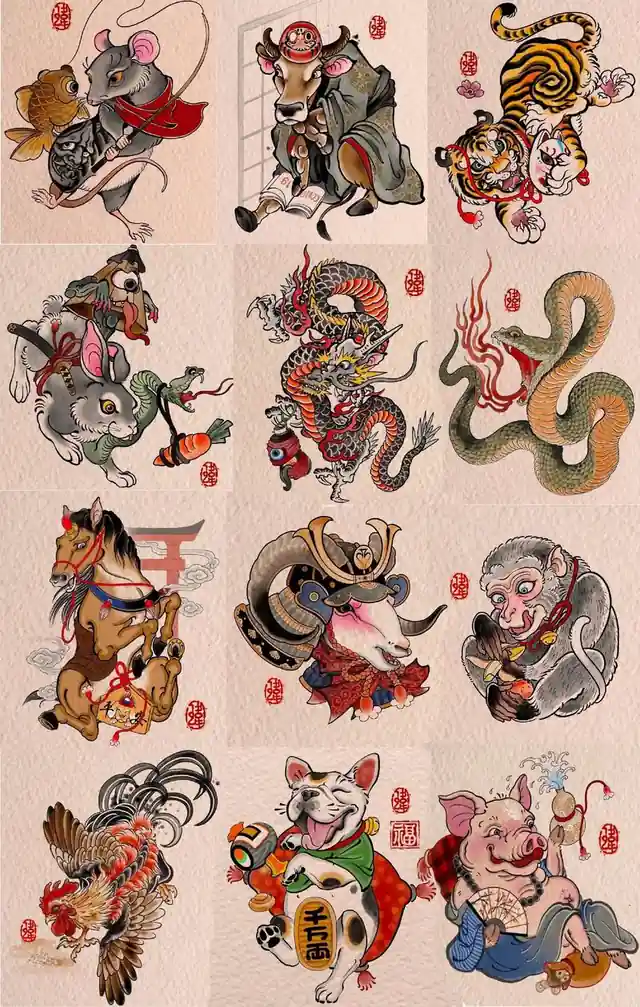
Since ancient times, the Chinese nation has paired the Dragon and Tiger together. As two complementary cultural concepts that balance hardness with softness and harmonize Yin and Yang, the Dragon and Tiger have long permeated various aspects of Chinese politics, military affairs, medicine, and art. There are both differences and connections between the Dragon and Tiger, and their pairing reflects the profound origins of the Dragon and Tiger culture within the Chinese nation.
Many Chinese idioms associate the dragon with the tiger, such as "tiger crouching, dragon coiled" (describing an imposing terrain), "hidden dragon, crouching tiger" (concealed talent), "dragon's pool, tiger's den" (a dangerous place), "dragon fighting, tiger battling" (fierce competition), and "lively dragon, active tiger" (full of vitality). The pairing of dragon and tiger indeed has a long history. The military classic "Six Secret Teachings" (Liutao) includes chapters on "Dragon Strategy" and "Tiger Strategy". Traditional Chinese medicine features "dragon-tiger acupuncture techniques". Calligraphy has "dragon-tiger seal script". The imperial examination results were announced on a "dragon-tiger list". In the Han Dynasty, the "Taishan Mirror Inscription" states: "Riding a intertwined dragon, soaring on floating clouds, a white tiger leads the way straight to heaven, receiving long life, enjoying ten thousand years." Here, the dragon and tiger serve as guides for ascending to immortality. Shandong Han Dynasty stone reliefs record: "Above, the dragon and tiger bring good fortune; a hundred birds together bring wealth." Thus, the dragon and tiger also became symbols of wealth. In the "Qian Hexagram" of the "Book of Changes" (Zhouyi), the dragon and tiger metaphorically represent heaven and earth, yin and yang, and male and female. The dragon soars in the sky while the tiger walks on the ground. Their combination has become a synonym for all things in the universe. Dragon and tiger culture has extensively influenced various aspects of Chinese production and daily life, gradually forming a relatively complete system of dragon-tiger culture.
Among archaeological artifacts, dragons and tigers are often presented together. The "First Dragon of China," dating back over 6,000 years, was unearthed at the Yangshao culture site in Xishuipo, Puyang, Henan Province, and it is paired with a tiger motif. This indicates that as early as ancient times, the dragon and tiger were already inseparable brothers, sharing a close and equal relationship. Furthermore, scientific research has found that the positions of the dragon and tiger images in the tomb correspond to the Big Dipper constellation formed by human leg bones placed to the north and above them, reflecting the astronomical concepts and religious beliefs of the people at that time. The emergence of the "Four Symbols" in astronomy (Azure Dragon of the East, White Tiger of the West, Vermilion Bird of the South, and Black Tortoise of the North) can also be traced through the fusion of the dragon and tiger: the tiger totem worship of western ethnic groups, through ethnic and cultural integration and dissemination, merged into Chinese culture, pairing with the Azure Dragon of the East to become the White Tiger Deity of the West in the celestial system. The Vermilion Bird of the South and the Black Tortoise of the North subsequently developed from these two. The White Tiger Deity later evolved into the autumn god Rushou, who withers all things and brings desolation, opposed to the spring god Goumang, which also provided a basis for the ancient calendar that divided the year into two seasons, spring and autumn.
However, the Dragon and the Tiger were originally totems of different ethnic groups. The Tiger was originally the totemic emblem of the ancient Rong Di (ancient Qiang people), a western ethnic group in ancient China. Today, most descendants of the ancient Qiang people are distributed in regions such as Sichuan and Yunnan, and ethnic groups including the Yi, Bai, Tujia, Naxi, Lahu, and Lisu still retain varying degrees of tiger-worshipping beliefs and customs. The Tiger clan was a major group in history, with their traces not only found in the Jianghuai region but also in Hunan and Sichuan. During the Shang and Zhou dynasties (c. 1600-256 BCE), the dominant decorative motif on bronze vessels was the tiger-head pattern, while dragon patterns and Kui-phoenix patterns were often used as complementary elements, forming a layout where the tiger was prominent and the dragon receded. Later, with ethnic migrations and integration, the western ethnic culture represented by the Tiger and the Chinese national culture represented by the Dragon interwove with each other. Over time, a unified Chinese nation was formed, and Tiger culture became an important part of Chinese culture.
The status between the dragon and the tiger has changed over the course of history. After all, the tiger is a real animal on earth, and people's fear of it is more than sufficient, but their sense of mystery is insufficient. In contrast, the elusive and unfathomable dragon inspires greater awe because people cannot understand it, to the extent that unexplainable natural phenomena (such as thunder, lightning, and violent storms) are attributed to the dragon's divine power. Moreover, since the dragon soars in the sky, riding clouds and mist, its position appears more sacred, and its power seems limitless. To add a sacred aura to themselves, emperors throughout history needed to borrow the dragon's divine authority. Thus, successive rulers connected their lineage with the celestial dragon, claiming that they were ordained by heaven and possessed supreme authority. Starting from Qin Shi Huang, emperors styled themselves as "True Dragon Sons of Heaven," and their descendants became "Dragon Sons and Dragon Grandsons." The imperial seal, which used a dragon and tiger knob during the Qin Dynasty, changed to a dragon-shaped knob in the Han Dynasty. The dragon and tiger that served as guardian deities on the lintels of imperial palaces were gradually replaced by paired dragons after the Tang Dynasty. The emperor's accession to the throne was called "Dragon Soaring," while subjects kneeling before the monarch was termed "Tiger Prostration." These facts indicate that the tiger, which was not adorned with brilliant colors or claimed as kin by emperors, gradually parted ways with the dragon that had ascended into the imperial family, falling below the supreme dragon symbolizing imperial authority. It eventually moved into the folk realm and became a folk auspicious symbol.
Through thousands of years of folk wisdom and creative reinterpretation, the image of the Tiger has gradually shed its ferocious and violent aspects, becoming lively, adorable, and full of vitality, ultimately transforming into a good companion and dear friend of the people.
Further Reading
Both the Dragon and the Tiger serve as guardian deities of heaven and earth.
Ancient people often regarded the North Star (Polaris) as the dwelling place of the Heavenly Emperor, while the constellations of Dragon and Tiger were seen as the Emperor's guardian deities. This understanding was emulated and utilized by earthly rulers. In the "Records of the Grand Historian: Basic Annals of Xiang Yu," Fan Zeng remarked to Xiang Yu about Liu Bang: "I have had someone observe his vital energy (qi); it manifests as dragon and tiger forms in five colors — this is the aura of a Son of Heaven." In the "History of the Southern Dynasties: Basic Annals of Emperor Wu of Liang," Xiao Yan (Emperor Wu) said: "Your steps are like a dragon's stride and a tiger's gait; your physiognomy is beyond words. The world is in chaos, and the one who can bring peace to it is surely you!" It is said that when Daoists refined the Great Elixir of Dragon and Tiger (a metaphor for inner alchemy), they required the presence of Dragon and Tiger guardians, hence the saying: "When Dragon and Tiger unite, the Great Elixir is achieved." To this day, Dragon and Tiger remain protective deities in Daoism.