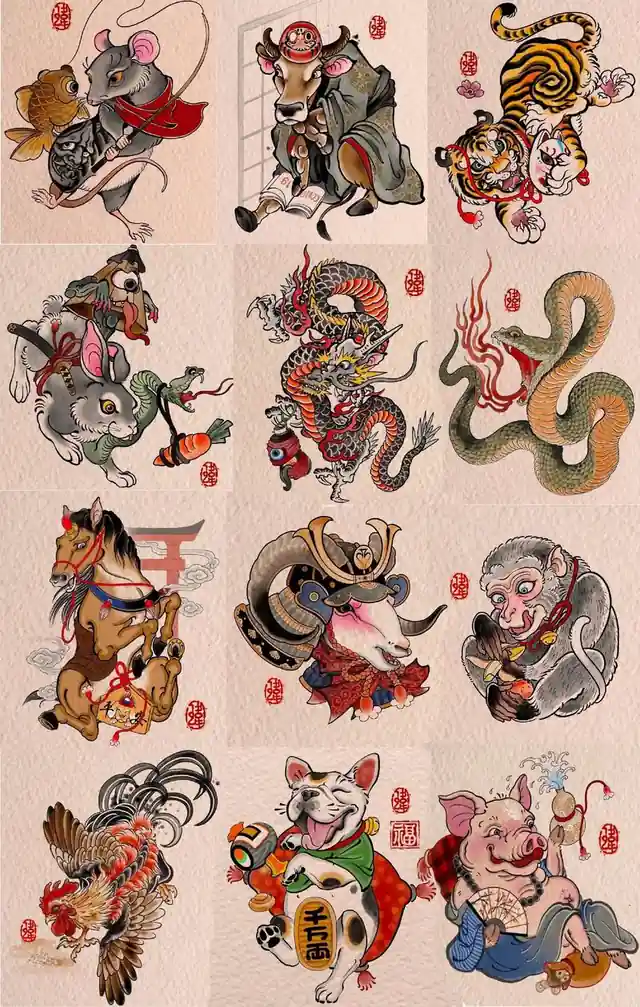
From the initial contact between humans and tigers, to both hatred and admiration for them, and then to regarding the tiger as an all-powerful mountain deity and the ancestor of humanity, eventually forming a rich and diverse tiger culture—these are all important aspects of the zodiac Tiger culture.
Human beings have long held a primitive totemic worship of the tiger. On pottery unearthed from the Nantuo Datang site in Changsha City, dating back seven thousand years, there is already a "long-fanged human face pattern" featuring a human face with a tiger's head. In a primitive tomb from six thousand five hundred years ago at Xishuipo in Puyang City, Henan Province, a tiger image made of clam shells was placed opposite a dragon, with the dragon on the right and the tiger on the left. According to the ancient custom of prioritizing the left, the tiger held a higher status than the dragon at that time.
In ancient times, the Longdong region of Gansu and Shaanxi Province were long-term settlement areas for western tribes and also served as departure points for their eastward migration. Relevant scholars believe that the ancient Qiang tribe (also known as the ancient Rongdi tribe), which originated in the Gansu and Qinghai regions of western China, was the first tribe to worship the tiger. Later, these tribes gradually migrated eastward from the west, entering the Shaanxi and Shanxi regions, and eventually moving into central China.
In the competition among tribes, the ancient Qiang people gradually became an important force in integrating other tribes within China. Their original totems, led by the ancient Qiang, were either the bear or the tiger. As the ancient Qiang system expanded, their totems also gradually evolved, though most still belonged to the bear-tiger category. Politically, they became increasingly separate from the Chinese central government, and their power grew stronger over time, with some even able to contend with Chinese regimes. The later Xiongnu were one of the more powerful branches among the Rong and Di tribes.
During the Spring and Autumn Period (770-476 BCE), most of eastern Gansu and western Shaanxi became active areas for various Rong and Di tribes. The Lintong region in Guanzhong was inhabited by the Ji-surnamed Li Rong tribe, the eastern part of Guanzhong by the Dali Rong tribe, and northern Shaanxi by the Bai Di tribe. Although Shanxi had many feudal states of the Western Zhou Dynasty (1046-771 BCE), southeastern Shanxi was home to the Chi Di and Bai Di tribes, southern Shanxi to the Chang Di tribe, the Taiyuan area in central Shanxi to the Da Rong tribe, and northern Shanxi to the Lin Rong and Shan Rong tribes. Northern Hebei was inhabited by the Shan Rong and Wu Zhong Rong tribes, western Hebei by the Bai Di Zhongshan state, and southern Hebei by the Bai Di Fei and Gu states. Henan had the western tribal states of Shen, Zeng, and Lu Rong, while the Luoyang area was also scattered with tribes like the Lu Hun Rong. Although the eastern regions of northern Jiangsu and northern Anhui did not belong to the western tribes, tribes such as the Xu Yi and Huai Yi also had customs of tiger worship. Hubei and Hunan were home to the tiger-worshipping Ba people, while Sichuan and Yunnan were inhabited by descendants of the ancient Qiang people, including the tiger-worshipping Yi, Bai, and Naxi ethnic groups.
The Western Zhou Dynasty's royal surname "Zhou Ji" (indicating descent from the Zhou clan) was also descended from western tribal groups, and half of its more than forty vassal states remained among the Rong and Di peoples (non-Chinese ethnic groups to the north and west). During the Western Zhou period, although some western tribes revered sheep or oxen, the tiger-revering tribes still held the greatest power. In several major upheavals throughout Chinese history, such as Wang Mang's rebellion at the end of the Western Han Dynasty, the Yongjia Rebellion of the Western Jin Dynasty, the An Lushan Rebellion of the Tang Dynasty, and the fall of Bianjing (Kaifeng) during the Northern Song Dynasty, these conflicts forced large numbers of Chinese people to migrate southward to the Jiangsu-Zhejiang region and the provinces of Fujian, Jiangxi, Guangdong, Guangxi, and others. They brought not only Chinese culture but also tiger culture with them. Of course, the upheavals at the end of the Yuan Dynasty and the Jingnan Campaign of the Ming Dynasty also caused cultural destruction in most regions. However, Shanxi Province, where many original ethnic minorities had gathered, suffered less from the ravages of war, thus preserving more traditional culture. The migration of Ming Dynasty residents from Shanxi to provinces such as Beijing, Hebei, Shandong, Henan, Anhui, and Shaanxi not only helped restore agricultural production in these areas but also played a role in reviving traditional culture, while simultaneously carrying forward their traditional tiger culture.
The tiger culture in western Inner Mongolia during modern times was brought to the region by migrants from Gansu, Shaanxi, and Shanxi who traveled west through the passes during the late Qing Dynasty, while migrants from Shandong and Hebei who ventured northeast into Manchuria brought tiger culture to the three northeastern provinces.
Horizontally speaking, Shanxi Province and Shaanxi Province are the regions where tiger culture is most richly preserved, followed by Shandong, northern Jiangsu, and Hubei. The tiger culture in Sichuan, western Hubei, western Hunan, and Yunnan is also the result of the tiger culture of the ancient Qiang and ancient Ba peoples being inherited by their descendant ethnic groups. Vertically speaking, since the tiger god descended from the altar during the Eastern Han Dynasty (25-220 CE), it has gradually permeated folk culture. The immigrants who migrated southward multiple times due to wars in Chinese history, as well as the immigrants of the Ming and Qing dynasties (1368-1912), played a significant role in spreading and developing tiger culture within folk customs.
Further Reading
Legend of the Tiger as Human Ancestor
The relationship between humans and tigers can be traced back millions of years. According to scientific research, early humans initially lived like animals on grasslands or in forests within nature, but their ability to hunt for food was not particularly strong, and they sometimes had to rely on scavenging carcasses to survive, which often led to malnutrition and slow evolution. Later, humans began to follow tigers, and after a tiger had consumed the meat of its prey, people would use stone tools to break open the leftover bones, extracting the marrow for nourishment. This practice provided them with rich nutrients, gradually strengthening their bodies and significantly enhancing their intelligence, which eventually allowed humans to gain an advantage in the struggle for survival in nature. Therefore, people came to believe that the tiger brought new life to humanity and regarded the tiger as an ancestor of the human race. In essence, this perspective is a product of matrilineal clan society and a transformation of maternal worship.