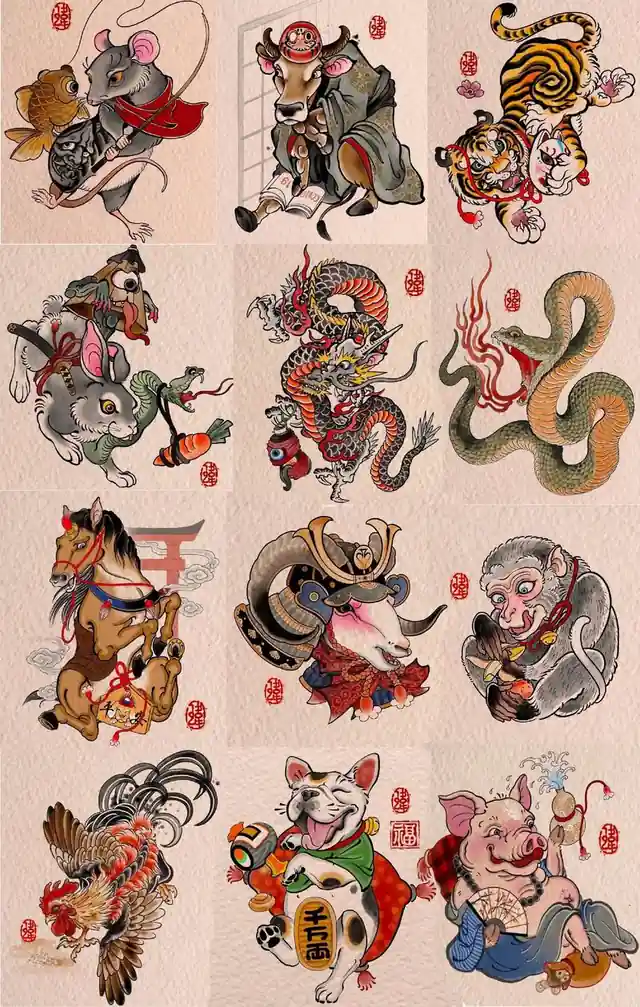
Due to the unique image and characteristics of the tiger, people often regard it as their ancestor, which is reflected in legends and the traditions of some ethnic minorities. Worshipping the tiger as an ancestor not only embodies people's desire for the tiger's protection but also reflects their fear and reverence toward it.
Where do humans come from? Can life continue forever? If so, by what means? These questions have likely troubled humanity since ancient times. Through observing and contemplating nature, the ancients offered various answers, and the Tiger is one of them. In the eyes of the ancients, life and death were merely different forms of the life process, and the transformation from life to death and back to life had to occur through some medium. The Tiger, fierce and skilled in killing, seemed well-suited for this role. Based on ancient tombs, unearthed artifacts, myths, legends, and folk customs across various regions, the Tiger has a very close relationship with the birth of life and the mutual transformation between life and death, and the Tiger is even considered the ancestor of humanity.
The Mother Tiger Goddess Queen Mother of the West (Xiwangmu)
This relationship between the tiger and life and death is most vividly embodied in the goddess Queen Mother of the West (Xiwangmu). In ancient Chinese mythology and legend, Xiwangmu was a great deity who resided on the northern side of Kunlun Mountain. In the minds of ancient people, Kunlun Mountain was filled with mystery and sanctity, serving as both a mountain of death and a mountain of rebirth. Kunlun is a homophone for "hulun" (whole) or "hulu" (gourd), referring to the chaotic state before the separation of heaven and earth. Its outer roundness and hollow interior symbolize the womb that nurtures all things. According to the Classic of Mountains and Seas (Shanhaijing), Xiwangmu was the "Kaiming Beast" guarding the nine gates of Kunlun Mountain, essentially the goddess of the mother tiger. Besides presiding over life, the Classic of Mountains and Seas also records that Xiwangmu governed death, "overseeing the heavens' plagues and the Five Remnants (Wucan)." "Li" refers to malaria, while "Five Remnants," also known as the "Five Pointed Star," foretold ruin from all directions and the slaughter of officials upon its appearance.
Some experts believe that Queen Mother of the West (Xiwangmu) was merely the title of a tribal leader or clan that worshipped feline animals such as tigers and leopards in ancient times. On one hand, the tiger is associated with wind, earth, and the yin principle, and its shape resembles a gourd, similar to the pregnant female body. It is therefore reasonable to regard the tiger as a symbol of femininity, and the concept of the tiger as the ancestor of humanity emerged during the matriarchal clan society period. On the other hand, the tiger also possesses a fierce and cruel nature, which shares similarities with the character of the goddess Queen Mother of the West.
From this, it can be seen that people's feelings toward the tiger are quite complex. On one hand, they have a clear understanding of the tiger's fierce natural instincts. On the other hand, they psychologically and emotionally draw the tiger closer to humans, reflecting a contradictory attitude toward this animal.
In the Ming Dynasty (1368-1644), Li Changqing's "Songxia Guan Zhuiyan (Supplementary Discourses from the Pine Cloud Studio)" contains a passage that elaborates on the relationship between the Tiger and human life: "Humans are born under the Yin (the third Earthly Branch), and where there is birth, there is also killing. The one who kills is the Tiger. Moreover, Yin also signifies fear, and nothing is more fearsome than the Tiger, thus Yin corresponds to the Tiger." This is not merely a reference to the Tiger's act of devouring or killing humans, but rather expresses the ancient people's understanding of the interdependent nature of life and death and the transformative process of dying and being reborn.
Some ethnic minorities worship the tiger as their ancestor.
The ancient Ba people believed that Lin Jun transformed into a tiger after his death, with his soul residing within the animal. According to the "Book of the Later Han: Records of the Southern and Southwestern Barbarians," it states: "After Lin Jun died, his soul became a white tiger for generations. Because the Ba people believed that tigers drank human blood, they used human sacrifices to worship them." According to legend, Lin Jun was the tribal leader of five clans in ancient times, and the Tujia people, who are considered descendants of the ancient Ba people and Lin Jun, still maintain the belief that the tiger is their ancestor and that their forefather Lin Jun's soul turned into a tiger after death. They refer to Lin Jun as the Tiger Lord and worship him as their ancestral deity. Temples dedicated to this worship have been established in places such as Changyang, Enshi, Jianshi, Badong, and Wufeng in western Hubei.
The Yi ethnic group developed from the Fuxi tribe, which revered the tiger as its totem, and the Yi people have a profound, inexpressible affection for tigers. Those living in the Weishan and Nanjian areas of Yunnan Province even call themselves the tiger clan. They refer to men as "Luopo" and women as "Luoluomo," which are their respective terms for male and female tigers. Additionally, their calendar begins with the tiger, and some place names are also named after the tiger.
The Naxi people of Yunnan regard "The History of the Tiger" from the ancient pictographic Dongba scriptures as the history of their own ethnic group. They view the tiger as a symbol of virtue and believe that traveling must be done on a Tiger Day to receive the protection of the Tiger God. Children born on a Tiger Day are also given special attention. The Naxi people also use the tiger as a door god to ensure the auspiciousness and safety of the entire family.
The Bai people of Yunnan also revere the tiger as their ancestor, calling themselves tiger men and tiger women, and they worship the White Tiger as a deity, even believing that being eaten by a tiger can lead to immortality. The Tujia people, distributed across Hubei, Hunan, and Sichuan, also hold a special preference for the White Tiger. Their mythology includes the legend of the ancestor god Tiger'erwa (Tiger Child) as well as tales of the White Tiger Star Lord deity. They further believe there are two types of white tigers: one is the "Walking Hall White Tiger," a fierce and malevolent spirit that breaks through doors and must be driven away; the other is the "Sitting Hall White Tiger," which resides in the center of the main hall and must be honored with respect.
Among the Lisu people of Yunnan, there is a legend about a human marrying a tiger
From the above text, it can be seen that the identification between humans and tigers is based on the premise that the tiger is the ancestor of humans, humans and tigers share the same ancestor, and there is a blood relationship between humans and tigers.
Further Reading
The "Tiger Calendar" in the Chinese Calendar System
The Tiger ranks third among the twelve zodiac animals. In the Xia calendar, which has been used in China for over 4,000 years, the Tiger month occupies the position of "the beginning of the year," historically known as "Xia established Yin." In some ethnic minority regions of China, the Tiger is often regarded as an ancestral deity in their cultural heritage, with the Yi people having the most prominent relationship with the Tiger among them. The Yi people's "Tiger Calendar" has a long history, originating as a symbolic system built upon the ancient Qiang-Rong "Tiger Calendar." This "Tiger Calendar" is a ten-month calendar system, and the twelve zodiac animals used to mark days also prioritize the Tiger as the most esteemed, hence the name "Tiger Calendar." The prominent depiction of the Tiger in the "Tiger Calendar" fully reflects the important position the Tiger occupies in people's lives.