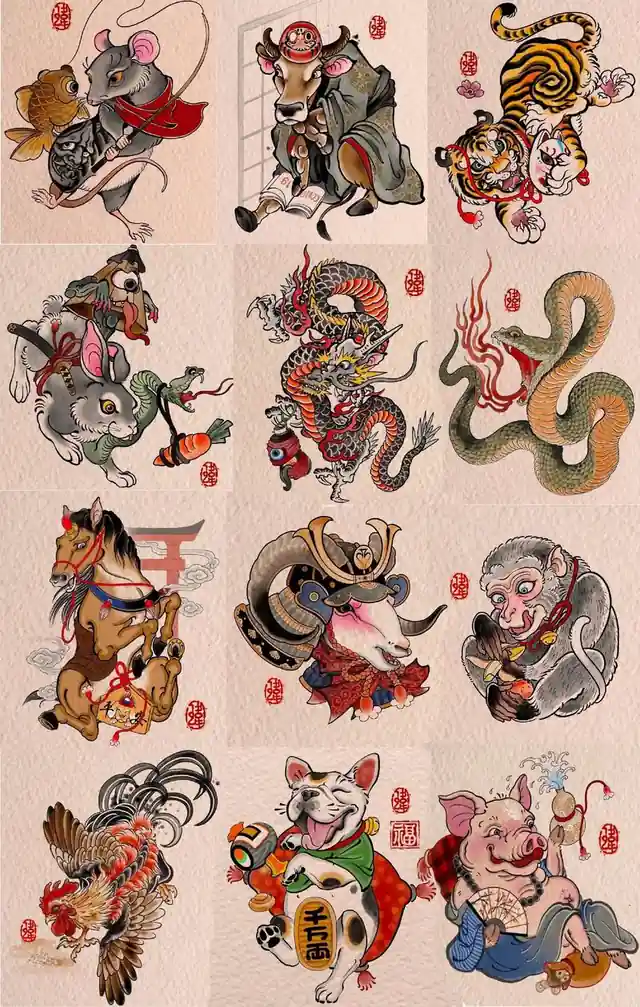
In ancient times, people believed that imitating the object of their worship would grant them great power and protection from that revered entity. Consequently, the original worship of the Tiger as a zodiac animal underwent long-term development and transformation, giving rise to a Tiger dance culture imbued with profound historical and cultural significance.
Tiger dance is an ancient tradition of the Chinese nation that still exists in various places across China today, with the most representative being the Hakka tiger dance. According to the Hakka "Tu Clan Genealogy" records: "On the beams of the ancestral hall, there is a tiger roaring painting that appears majestic and powerful from a distance. During the New Year celebrations... elders of the clan wear ceremonial hats and new clothes to welcome the New Year tiger dance. Firecrackers lead the way, guiding the tiger to the ancestral hall, where the tiger head dances and the tiger skin wraps around the body."
The Hakka people were originally Han Chinese from the Heluo region of ancient China, who migrated south to areas such as Fujian, Jiangxi, and Guangdong to escape the frequent wars in China. In the book "The Southern Migration of the Gu Clan," there is a passage describing the Tiger Dance: "Our ancestors migrated south from China, crossed the South China Sea to enter Guangxi, enduring countless hardships—who knows how difficult it was? Traveling a thousand miles, with food and supplies exhausted, the only heirloom was the wooden tiger head, weathered by rain and sun. Following the crowd over mountains and through valleys, they performed the Tiger Dance to seek food and competed in tiger-fighting arenas—who could distinguish truth from illusion?" This record, less than a hundred characters long, is deeply moving. One can imagine that during the wars of that time, amidst bloodshed and fire, the people suffered immense devastation, and their homes and belongings were reduced to ashes. To seek refuge, people from cities and villages, carrying the elderly and the young, left their homeland and flocked southward. Along the way, they climbed mountains, endured wind and rain, suffered from lack of clothing and food, and relied on begging. Yet they still carried the heirloom wooden tiger head on their backs, performing the Tiger Dance to survive. This reveals both their hardships and the Chinese people's deep trust in tiger culture.
In Shangkeng Village, Liujiang County, Guangxi, there is an ancient temple with a mural depicting tiger dancers on its stone wall, still faintly visible to this day. In Shakeng Town, a large 2-meter-long, 0.5-meter-wide painting of a tiger dance was also discovered, showing one person grasping the tiger's head while another supports its tail, with the tiger's head held high; this painting is said to be over 400 years old. In Nanshangcheng Village, Daqiao Township, Qingjiang County, Jiangxi Province, the ancestors of the Cheng family migrated from Song County, Henan Province at the end of the Northern Song Dynasty (960-1127), and every year on the eighth day of the first lunar month, the village holds a tiger parade festival where people joyfully perform the tiger dance.
During the Western Han Dynasty (206 BCE – 9 CE), there were folk activities involving tiger dances, and legend has it that the mount of Zhang Tianshi (the Celestial Master of Daoism) was a tiger. In Nanshangcheng Village, Taotangyu Town, Huozhou City, Shanxi Province, the custom of tiger dancing is still preserved to this day. During the performance, two people dress up as a tiger. The tiger head is carved from camphor wood, the tiger skin is made from cloth dyed with gardenia fruit, and the tiger tail is made from bamboo strips. One person plays the role of Shegong (the Earth God), wearing a mask, a robe, straw sandals, and holding a folding fan. During the dance, Shegong leads, and the tiger follows behind, moving and dancing to the rhythm of the fan opening and closing. The tiger sometimes leaps, sometimes rolls, and sometimes crouches, all accompanied by the percussion of gongs, drums, and cymbals. Its appearance is sometimes ferocious, and at other times it shrinks its head and tucks in its limbs... When passing by homes of newlyweds or families with newborns, the tiger rushes into the house and scatters stones and sand on the bed to symbolize good luck. The Cheng clan of Nanshangcheng Village migrated from western Henan at the end of the Northern Song Dynasty (960-1127), a history of over 800 years, indicating that the folk custom of tiger dancing still existed during the Song Dynasty.
Qingjiang County in Jiangxi Province also preserves the tradition of the Tiger Dance, which has a certain connection with Daoism. Traditional Chinese Daoism flourished in Jiangxi Province, and the Longhu Mountain (Dragon Tiger Mountain) in Guixi County within the province is a sacred site of Daoism. The Hezao Mountain in Qingjiang County, located in the middle reaches of the Gan River, is the thirty-sixth blessed land (dongtian fudi) of Daoism, a place believed to be "where immortals dwell" and "where the Supreme Lord appoints perfected beings to govern, and where many attain the Dao."
In fact, the Hakka tiger dance is not always associated with Taoism. For example, in Guangxi, the Tu family paints images of roaring tigers on the beams of their ancestral halls. During the New Year, elders of the clan welcome the tiger dance performers who come to offer greetings, and the dance is even performed inside the ancestral hall. This tradition extends to painting tiger motifs in ancient temples. Such practices demonstrate the Chinese people's steadfast devotion to their ancient national cultural heritage, much like their reverent worship of ancestors, preserving the traditional tiger culture.
The people of Taiwan and the mainland share the same ancestry and a common national culture. The development of Taiwan was the result of generations of mainland people crossing the sea to start new ventures, and these mainland immigrants also brought tiger culture to Taiwan. For example, when a new temple was completed in Lugang, a celebration ceremony was held where someone wore a mask to play the role of Tudigong (the Earth God), and another wore a tiger-head mask to play the role of a tiger. According to legend, Tudigong is a mountain god who tamed the tigers in the mountains as his mount. This performance form is similar to the Hakka tiger dance in Qingjiang Bridge Township, Jiangxi, except that in Qingjiang it is called Shegong (the God of the Soil), while in Lugang it is called Tudigong.
During the celebration of Mazu's birthday in Beigang, Taiwan, there is a grand procession and parade. The procession is led by the Tiger God (Hu Ye), who sits in a sedan chair carried by bearers wearing tiger-skin clothing, creating a "tiger carrying tiger" spectacle. Amid the sound of firecrackers, this enhances the majesty and power of the Tiger God.
Further Reading
The "Tiger Fights Ox" tradition in Dongying, Shandong.
"Tiger Fighting Ox" is a traditional folk custom in Dongying City, Shandong Province that has been passed down for over a hundred years and enjoys considerable fame in the Yellow River Estuary region. It has been recorded in the Chinese Folk Dance · Shandong Volume and selected for the first batch of Dongying's intangible cultural heritage list. According to records, the original form of "Tiger Fighting Ox" was simply two people wearing tiger heads and tiger costumes fighting in the streets. Through continuous improvements by performers, it evolved into a folk dance with the main storyline of a plow ox saving its master, and was officially named "Tiger Fighting Ox." It is understood that the "Tiger Fighting Ox" dance consists of four parts: "Hungry Tiger Searching for Food," "Tiger and Monkey Playing," "Cowherd Herding Cattle," and "Plow Ox Saving Its Master." The performance lasts approximately 40 minutes and typically requires eight actors. The dance portrays the ferocity and might of the tiger, as well as the steadiness and bravery of the plow ox, expressing the theme of defying violence and resisting oppression. To this day, during traditional festivals, "Tiger Fighting Ox" remains very popular locally. As soon as people hear the distinctive sound of gongs and drums associated with it, they gather around eagerly to watch.