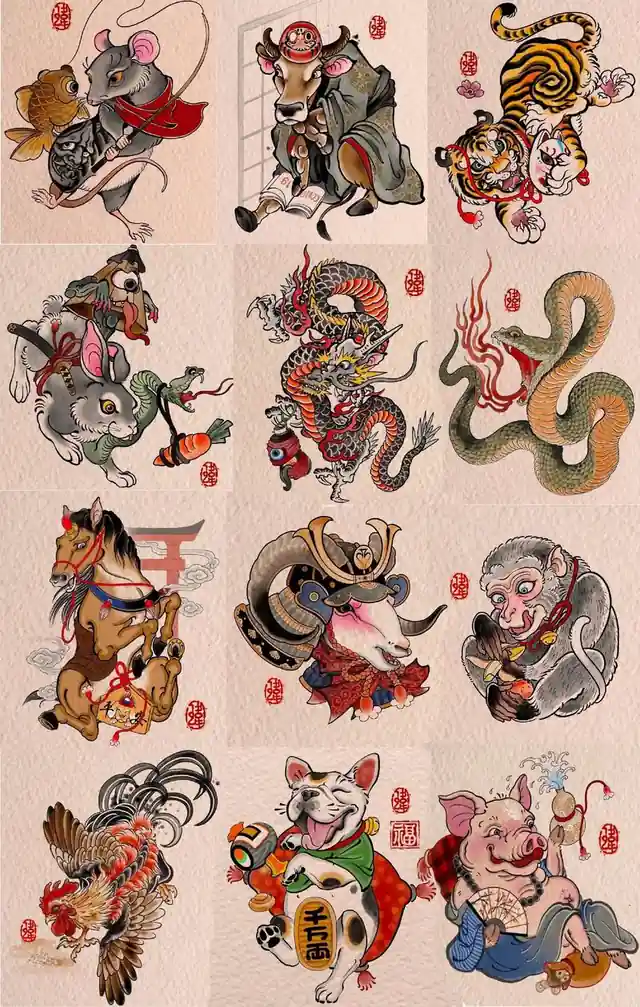
In the minds of Chinese people, the Tiger naturally possesses a kingly demeanor and is the most ferocious animal among the twelve zodiac signs. Although the Tiger sometimes symbolizes tyranny, people also praise its majestic, composed, and commanding image as it dominates the mountain forests, based on the zodiac Tiger's characteristics and folk legends.
A poem praises the tiger by saying: "Clad in tiger armor with a divine bow on the back, who could ever pluck the overlord's golden crown?" Novels also contain descriptions like: "Wearing a tiger-skin coat and leopard-pattern boots, he exudes an imposing and fierce aura." The tiger symbolizes overwhelming and invincible power, as well as authority, passion, and boldness. Since ancient times, the Chinese people have loved the tiger, which represents strength and might, and is also an auspicious beast symbolizing good fortune and peace. At the same time, as the king of all beasts, the tiger embodies dignity, power, and glory.
A symbol of might and masculine vigor.
The Tiger ranks third among the twelve zodiac animals and is paired with the Earthly Branch "Yin" (the third of the twelve Earthly Branches). The earliest oracle bone script character for "Yin" resembles an arrow. According to Shuowen Jiezi (Explaining Simple and Analyzing Compound Characters), the character "Yin" signifies that spring is approaching and yang energy (the positive, active life force in Chinese philosophy) is rising. Although frozen soil may still cover the ground, new life will inevitably break through. The pairing of "Yin" with the Tiger precisely reflects the Tiger's fierce and masculine energy, which cannot be subdued.
People have long recognized the tiger's might and ferocity. As Li Shizhen recorded in Bencao Gangmu (本草纲目, Compendium of Materia Medica), the tiger at night "emits light from one eye while the other sees, its roar is like thunder, wind rises with it, and all beasts tremble in fear." The tiger is the king of beasts, incomparably strong and exceptionally ferocious. When it roars, mountains echo in response; when it runs, fierce winds arise, embodying the majesty of a ruler. The stripes on a tiger's forehead resemble the character "王" (king), as if its status as the king of beasts is ordained by heaven, making its authority unquestionable. In ancient times, primitive humans, through prolonged life-and-death struggles with tigers in the wild, recognized the tiger as an invincible force. Out of awe and fear, they developed worship, hoping to be tigers or descendants of tigers to receive the protection of the tiger ancestor. Thus, the tiger naturally became one of the totems of ancient ancestors.
Due to the tiger's might and power, it is often regarded by the people as a symbol of masculinity. People believe that the tiger represents the pure yang force that devours ghosts and monsters, possessing the ability to suppress and eliminate evil spirits, thus ensuring peace and safety. Therefore, the tiger is commonly used in folk culture as a door god to ward off evil or as a guardian deity for the home, and it is also employed as a protective spirit for tombs. Tiger motifs are frequently applied in ancient burial offerings, such as the stone reliefs and brick carvings in Han Dynasty tombs, which often feature images of galloping tigers or two tigers contending for a jade bi disc. On stone coffin carvings, themes like tiger heads or a tiger devouring a person are common. Folk beliefs also hold that drinking tiger skin soup can rid one of ghostly entanglements, wearing tiger claws can ward off evil, and different parts of the tiger's body can serve as protective talismans against disease. Drawing the character "王" (wang, meaning king) on a child's forehead with realgar wine is thought to borrow the tiger's power to fend off evil and ensure safety. These folk customs actually originate from ancient tiger totem worship.
In the Shanhaijing (Classic of Mountains and Seas), there are many deities resembling tigers: the Kaiming beast guarding the Kunlun Ruins, which is "as large as a tiger" with nine heads and a human face; Luwu, the overseer of the Yellow Emperor's lower capital palace, is described as "having a tiger's body with nine tails, a human face, and tiger claws"; and Yingzhao, the deity managing the Heavenly Emperor's garden at Huaijiang Mountain, is "with a horse's body and a human face, tiger stripes and bird wings, restricted to the four seas." In the illustrations of the Shanhaijing, the god Yingzhao is depicted as a tiger with wings. The tiger culture phenomena manifested in folk customs contain the profound connotation of ancient tiger totem worship.
A symbol of intelligence and wisdom.
The tiger is able to reign supreme in the mountains and forests not only by relying on its ferocity but also on its wisdom. According to folk legend, a bear once fought with a tiger to compete for the throne of the forest king. Initially, they were evenly matched, but as the bear grew braver and stronger in the fight, the tiger became exhausted and proposed a truce. The bear, wanting to show its magnanimity, immediately agreed. The tiger went to hunt and eat, then lay down in the grass to rest and regain its strength. The bear, immensely powerful and somewhat contemptuous of the tiger, saw the tiger leave and, having nothing else to do, began uprooting nearby large trees to clear the fighting arena. After the tiger had eaten its fill and slept well, it returned to fight again. The bear calmly faced the challenge and fought even more fiercely, but before long, the tiger again felt hungry and weak, so it proposed another truce. The bear, still unconcerned, agreed. The tiger then went to eat and rest once more, while the bear continued relentlessly uprooting trees. This pattern repeated until the bear was finally exhausted, while the tiger, well-fed and well-rested, was full of energy. In the end, the bear suffered a crushing defeat at the tiger's paws.
According to legend, when a tigress gives birth to three cubs, one of them will inevitably be a "biao" (a ferocious variant cub). The biao is the most vicious among tiger cubs and will even devour its own siblings. Therefore, the mother tiger takes every precaution against the biao to prevent it from eating the other cubs. When crossing a river, the mother tiger will first carry the biao to the opposite bank, then return to carry another cub across. After setting that cub down on the far shore, she will bring the biao back with her and then carry another cub across. Finally, she will carry the biao across once more, ensuring that the biao never has the chance to be alone with the other cubs. This is known as "the mother tiger guarding against the biao," demonstrating that tigers are highly intelligent animals.
Further Reading
The Cat as the Tiger's Teacher
The tiger is known as the "King of the Forest," and it is said that all of the tiger's skills were taught by the cat. The tiger studied under the cat, who taught it everything about pouncing, jumping, and clawing. However, the tiger harbored malicious intentions, thinking to itself: "If I get rid of the cat, I can become the supreme ruler of the world." So, when the cat was not paying attention, the tiger suddenly lunged at it. But the cat had been cautious, holding back one trick — the ability to climb trees — and never taught it to the tiger. Seeing the tiger's ingratitude and betrayal, the cat dodged the attack and swiftly climbed a tall and sturdy tree. Unable to climb the tree, the tiger had no choice but to return to the wild and claim its kingship there.