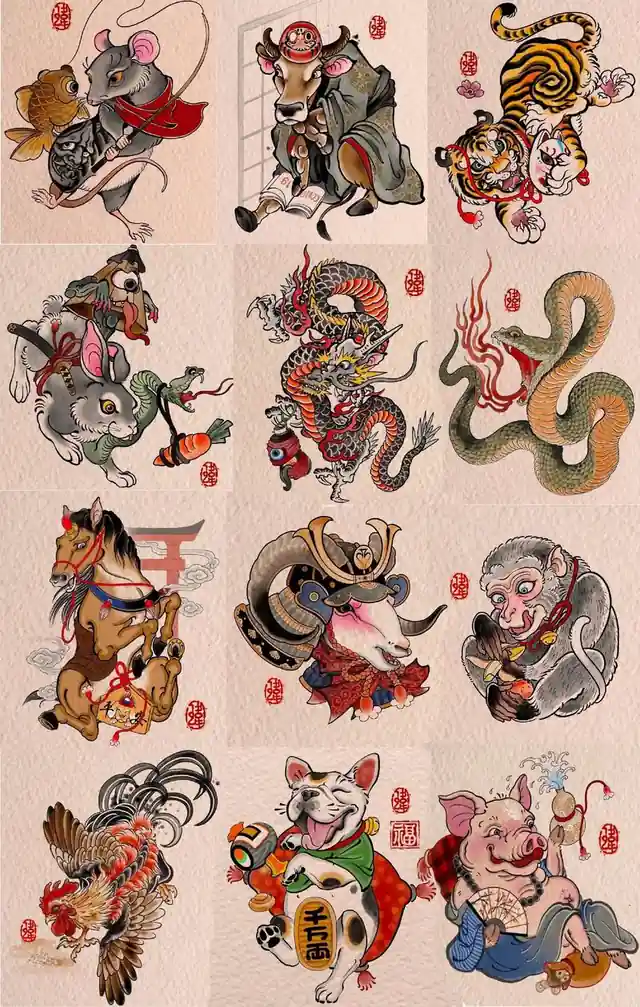
Although tigers are fierce and fearsome by nature, their appearance holds a deep attraction for humans and is truly adorable. As people's production and lifestyles have changed, opportunities to encounter tigers in nature have become increasingly rare. Over time, people's fear of tigers has gradually diminished. The culture of the Tiger zodiac is rich and diverse, having permeated various aspects of people's leisure, entertainment, and daily customs.
During the Han Dynasty (206 BCE - 220 CE) in China, there was already a custom of painting tigers on doors during Chinese New Year's Eve. Later, the folk tradition of painting tigers to ward off evil and protect the home became an established practice. After a long passage of time and rich cultural accumulation, the tiger's image was simplified and symbolized: it came to represent both warding off evil and praying for blessings, which is the folk connotation of the tiger image. Ancient people often decorated utensils with the tiger's beast-face pattern, and the common people regarded the tiger as a protective deity for children. They would dress children in tiger-head shoes and hats and let them sleep on tiger-head pillows. The tiger's image was crafted to be both majestic and endearingly clumsy, symbolizing the hope that children would grow up strong, lively, and healthy.
The practice of performers imitating tigers in combat against humans.
In ancient times, there was a performance activity where a human impersonating a tiger would fight with a real tiger. This type of entertainment was already very common during the Han Dynasty, as reflected in the murals of Han Dynasty tombs: the human performer wore a ferocious mask, appearing fierce and menacing, while the tiger was a real animal, leaping and bounding as it engaged in a life-and-death struggle with the human. According to the "Shangshu" (Book of Documents), the practice of humans imitating animals had already appeared during the time of Emperor Shun of the Yu period, about 4,000 years ago, and was then called "Baishou Lüewu" (the hundred beasts dancing in unison). During the Qin and Han Dynasties, masked performers had already entered the variety shows known as "Baixi" (hundred entertainments). As recorded in "Xijing Fu" (Western Capital Rhapsody) by Zhang Heng of the Eastern Han Dynasty, masked performers, wearing masks, would playfully dance with tigers and leopards to the stirring sounds of drums, zithers, and long songs.
After the Tang Dynasty (618-907), the practice of performers imitating human-tiger combat was gradually replaced by lion dance. However, in the Hakka-inhabited regions of southern China, the custom of tiger dance, which evolved from human-tiger combat performances, has been preserved. In Taiwan, China, tiger dance performances are also held to celebrate the completion of temples or the birthday of Mazu (Goddess of the Sea). Other folk performances, such as the "Dance of the Great Insect" and "Tiger Lantern Dance," are all developments and continuations of the traditional human-tiger combat dances.
Door God Tiger
People believe that the tiger's might is feared by all evil beings and malicious spirits, so they often use the tiger as a door god to guard the entrance and ward off evil. On New Year's Eve, people would write the names of Shenshu and Yulei, the tiger deities, on peach wood boards, or paint a tiger head to hang outside the door, signifying that the divine guardians are stationed there to suppress evil spirits, preventing any demons or malevolent forces from entering. During the Spring Festival, northern China, especially the Huabei region, favors hanging the "Town House Divine Tiger Painting" in the main hall of the home. This painting often features a poem that reads: "The divine tiger descends from high mountains, vanquishing demons in the mortal world. Good families who acquire it will enjoy peace and safety all year round." Another verse says: "The tiger is the king of beasts, descending to the mortal realm to expel evil. If your esteemed household invites it in, all affairs will prosper and be auspicious." These customs express people's heartfelt wish to receive the protection of the tiger deity.
Tiger Clothing and Tiger Toys
In folk tradition, the fifth month of the lunar calendar is often regarded as a poisonous, evil, and inauspicious month, as it coincides with heavy rainfall when epidemics spread and venomous creatures emerge, making it a season of gathered malevolence that poses particular harm to humans, especially vulnerable young children. The tiger, being the king of all beasts, is believed to repel all insects, demons, and evil spirits. Therefore, during the fifth month, women would make various tiger-themed protective items for their children, such as tiger bellybands, tiger-head caps, and tiger-head shoes. The tiger bellybands are often embroidered with the "Five Poisons" pattern, with a ferocious wide-eyed tiger stitched in the center, exuding great authority. The toe of the tiger-head shoes is embroidered with a tiger face, prominently featuring the "king" character (Wang, symbolizing the tiger's royal status). Folk belief holds that these items can embolden children, ward off evil, promote healthy growth, and symbolize longevity. The tiger-head caps are similar in design to the tiger-head shoes. When children wear tiger-head shoes and tiger-head caps, their entire being radiates vitality, causing all diseases and harms to keep away. These tiger-shaped garments not only embody the mother's love and affection for her child but also convey her heartfelt wish for the child's healthy growth.
During the Dragon Boat Festival, it was also popular among the people to make cloth tigers for children. These cloth tigers come in various forms, including single-headed tigers, double-headed tigers, four-headed tigers, mother-and-child tigers, and pillow tigers. The design of cloth tigers often features a large head, big eyes, wide mouth, and small body, highlighting the tiger's brave and majestic demeanor. At the same time, the disproportionate tiger shape can display a childlike innocence and naivety, which is very appealing to children. Parents make these cloth tigers hoping that their children will be as brave and strong as tigers, and they also pray that the tiger will become their child's guardian spirit, protecting the child's health and safety.
Further Reading
The custom of raising children under the Tiger zodiac sign.
Many parenting customs among the Han Chinese are associated with the tiger. For example, newborn babies are bathed in water infused with tiger bones, which is believed to ensure a lifetime of good health. Children also wear tiger-head shoes to pray for happiness, health, and longevity. In the Xifu region of Shaanxi Province and other areas, there is a custom of giving cloth tigers as gifts for child-rearing. When a baby reaches its first month, the maternal uncle's family presents a small tiger made of yellow cloth, wishing the child to grow up as strong and mighty as a tiger. Upon entering the door, a piece of the cloth tiger's tail is broken off and discarded outside, symbolizing the wish for the child to have a life free from disasters and difficulties. In various parts of Shanxi Province, the tradition of giving tiger-head pillows is popular. Whenever a child celebrates a birthday, the maternal uncle's family gives a pair of tiger-head pillows, which can be used for sleeping or as toys, while also conveying auspicious blessings.