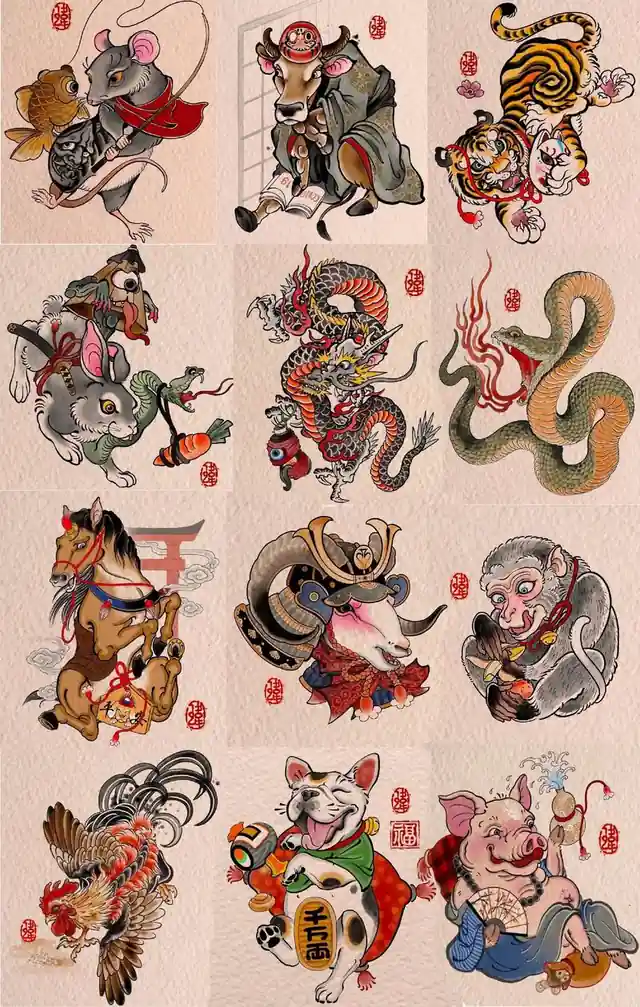
The tiger's dual nature as a deity overseeing fertility, a symbol of happiness, and an omen of evil and ferocity is also reflected in folktales and literary works. On one hand, the tiger is a joyful god associated with happiness, marriage, and childbirth, bringing joy to people. On the other hand, the tiger is a malevolent deity that may attack livestock or even cause human casualties when hungry, which has led to the emergence of many tiger-slaying heroes.
The Chinese have long revered tiger culture, viewing the tiger as a spirit animal and mythical beast, endowing it with many magical qualities. According to "Sanfu Huangtu" (Illustrated Records of the Three Districts of the Capital), "The Azure Dragon, White Tiger, Vermilion Bird, and Black Tortoise are the four celestial guardians that govern the four cardinal directions." Naturally, ancient people also created and passed down a wealth of stories and legends about tigers.
Legend of the Tiger Transforming into a Human
In ancient legends, there is a story about a tiger transforming into a wife. During the Kaiyuan reign period of the Tang Dynasty (713-741), a scholar surnamed Cui was traveling to the capital for the imperial examination. When he passed by the Wolfo Temple (Crouching Buddha Temple) in Xiangyang, it was getting dark, so he had to stay overnight at the temple. Anxious about the examination, Scholar Cui could not fall asleep at night, so he walked outside to enjoy the moonlight and observe the stars. Suddenly, a tiger leaped into the temple. Scholar Cui was greatly startled but dared not shout, so he quietly hid in the shadows. The tiger shed its skin and transformed into a beautiful woman. After Scholar Cui returned to his room, the beautiful woman came knocking on his door, explaining her origins and offering to become his wife. Scholar Cui pretended to agree, coaxed the woman to sleep, then went outside and found the discarded tiger skin by the well platform, throwing it into the well. When the woman woke up, she rushed out of the room searching for the tiger skin but could not find it anywhere. Without the tiger skin, she could not transform back into a tiger, so she had no choice but to follow Scholar Cui. Scholar Cui went to the capital for the examination, passed with honors, and was appointed as a county magistrate, later promoted to a district magistrate. Scholar Cui lived with the beautiful woman for six years, and she bore him two children. After completing his term as district magistrate, Scholar Cui took his wife and children back home, passing by the Wolfo Temple in Xiangyang once again. He thought that since the woman had been with him for six years and had children, she would no longer have any ulterior motives, so he told her the story of how she transformed from a tiger into a human years ago. Upon learning that the tiger skin had been thrown into the well, the woman was overjoyed and asked Scholar Cui to retrieve it.
She saw that the tiger skin, though slightly damaged, was still largely intact, so she took it and draped it over herself, transforming into a tiger. Letting out a loud roar, she turned back to look at her two children, then leaped over the wall and disappeared in an instant.
The association of tigers with beautiful women is indeed a bold imagination from a modern perspective. In Chinese folklore, there are many stories of men marrying fairies or fox spirits, yet tales of marrying a tiger are rare. However, legends inevitably reflect certain beliefs. Both mythology and folk customs regard the tiger as the female ancestor of humanity and the joyful deity in charge of fertility. When Cui Sheng slept beside a tiger, the tiger in his mind might have embodied this very image.
Hero legends of fighting with tigers.
Beyond symbolizing happiness and overseeing fertility, the tiger also has a fierce, brutal side that slaughters living beings, with numerous historical records in ancient texts documenting "tiger calamities" and "tiger disasters." Since ancient times, the relationship between humans and tigers has often been highly tense, giving rise to many tragic stories of human-tiger battles and producing a considerable number of tiger-slaying heroes. The Book of Han (Hanshu) records the story of "Li Guang shooting the tiger": "Li Guang went hunting and saw a rock in the grass, mistaking it for a tiger and shooting it. The arrow struck the rock and embedded itself up to the arrowhead. When he looked, it was a rock. Another day he shot again, but could never penetrate it again. In the commandery where Li Guang lived, whenever he heard of a tiger, he would personally shoot it. Later, when he was stationed at Youbeiping, he shot a tiger that leaped and wounded him, but Li Guang also killed it." Of course, the most celebrated tiger-slaying hero is Wu Song. As recorded in Water Margin (Shuihu Zhuan), while traveling home to visit his brother, Wu Song passed through Jingyang Ridge. After drinking eighteen bowls of strong wine at the foot of the mountain, he ascended the ridge at night and, with his bare hands, killed a ferocious white-fronted, striped-eyed tiger, ridding the people of a menace.
In the classic novel Water Margin (also known as Outlaws of the Marsh), there is a story called "Li Kui Kills the Tigers." Li Kui returned home to visit his elderly mother and intended to take her back to Mount Liang. On the way through the mountains, his mother became thirsty. Li Kui temporarily settled her in a mountain temple and went to fetch water from a stream. When he returned, his mother was gone, and the ground was covered with blood. Following the trail of blood, Li Kui traced it to a tiger's den, where he found three cubs devouring his mother's remains. He raised his axe and killed all three cubs. Then he hid inside the den. When the mother tiger returned, he struck her down. After that, he left the den and ambushed the father tiger in the shadows, killing it as well. In total, Li Kui killed five tigers of various sizes, thus avenging his mother's death.
In ancient times, tigers were strong while humans were weak, so it was considered a heroic feat for people to fight tigers to protect themselves and eliminate harm. Today, humans have gained the upper hand in their struggle with tigers, hunting them in large numbers for profit or entertainment, pushing the once majestic and awe-inspiring tigers to the brink of extinction. If the tiger, as a symbol of might and masculine spirit, no longer exists in nature, people will only be able to recall the regal demeanor of the zodiac tiger through ancient texts, calligraphy, and paintings.
Further Reading
"Tiger Marquis" Xu Chu saves Cao Cao.
In "Romance of the Three Kingdoms," Ma Chao from Xiliang fought a great battle against Cao Cao, defeating Cao's troops at Tong Pass, forcing Cao Cao to flee for his life by cutting his beard and abandoning his robe. When Cao Cao was leading his army to cross the Wei River, news suddenly arrived that Ma Chao was in pursuit. Cao Cao was terrified, and his subordinates scrambled to escape by boat. Cao Cao's general Xu Chu carried Cao Cao onto a boat and displayed extraordinary bravery, "using both legs to steer the rudder, one hand to pole the boat, and the other hand to hold up a saddle to shield Cao Cao." After returning to camp, Ma Chao met Han Sui and said, "I almost captured Cao Cao! There was a general who bravely carried him onto a boat and escaped. Who was that person?" Han Sui told Ma Chao that Cao Cao's personal guards were called the "Tiger Guard Army," led by the fierce generals Dian Wei and Xu Chu. Dian Wei had already died, so the one who saved Cao Cao must have been Xu Chu, a man of unrivaled bravery, commonly known as the "Tiger Fool." Ma Chao was deeply impressed by the title "Tiger Fool" and held it in awe. Later, when Ma Chao faced Xu Chu in battle, he addressed him as "Tiger Marquis." From then on, Cao Cao's camp also referred to Xu Chu as "Tiger Marquis." The titles "Tiger Marquis" and "Tiger Fool" embodied the majesty and martial prowess of this man.