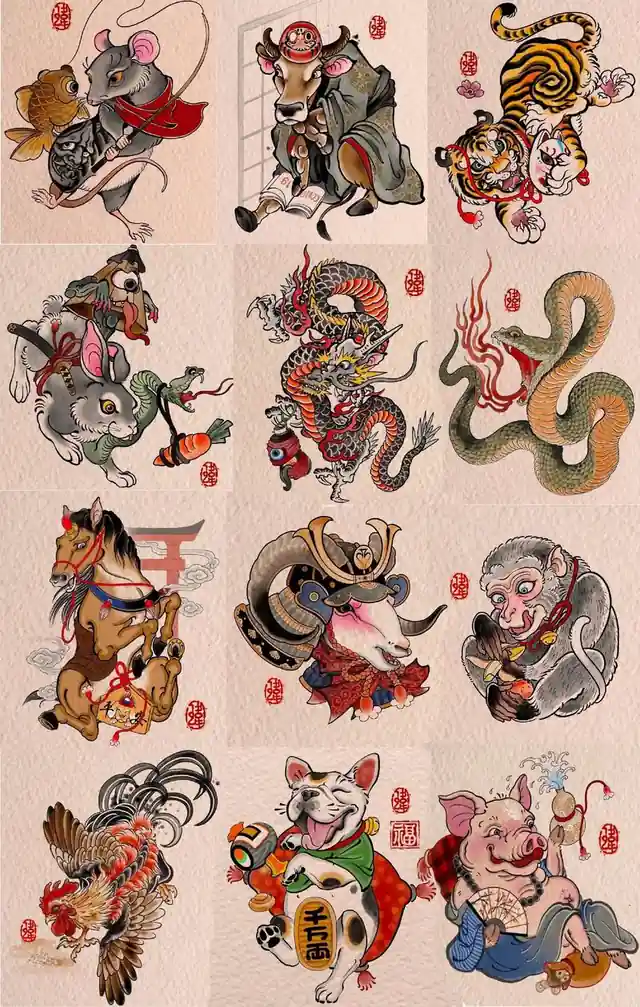
Using animals from the Chinese zodiac as names for a region or a specific scenic spot is a very common phenomenon. From these zodiac-named places, we can see traces of people's worship of the zodiac animals, and it also reflects the profound historical and cultural heritage of the region.
In ancient times, totem worship had a deeply ingrained influence on people. They not only painted zodiac animal patterns, which were regarded as sacred objects, on their clothing and created them in various forms such as headdresses, banners, and murals, but even used the names of zodiac animals to name certain regions. Among these, there are many interesting examples.
The legend of Baoji and Zhi County
The "Lie Yi Zhuan" (Records of Strange Matters), compiled by Emperor Wen of Wei, Cao Pi, records a legend: During the reign of Duke Mu of Qin, someone in the area of Chencang (in present-day southern Shaanxi) unearthed a strange creature that resembled a goat but was not a goat, and looked like a pig but was not a pig. The man then led the monster to present it to Duke Mu of Qin in hopes of receiving land and a reward. On the way, he encountered two children, who told him, "This monster is called Ao. It specializes in eating the heads of the dead underground. To kill it, you can strike its head with a cypress branch." Unexpectedly, the Ao, whose secret had been exposed by the two children, also spoke: "These two children are called Ji Bao (Chicken Treasures). One is male, the other female. Whoever obtains the male will become a king, and whoever obtains the female will become a hegemon." The man from Chencang, upon hearing this, abandoned the monster Ao and focused entirely on capturing the two children called Ji Bao. At that moment, the two children transformed into two pheasants and flew into the forest. The man from Chencang reported this to Duke Mu of Qin, who organized a large-scale military search. They indeed found the female Ji Bao in the forest, but it had already turned into stone. Duke Mu of Qin placed it between the Jing and Wei Rivers, and he later indeed became one of the Five Hegemons of the Spring and Autumn period.
This story is also recorded in Gan Bao's "Sou Shen Ji" (In Search of the Supernatural) from the Qin Dynasty. Perhaps due to the circulation of this tale, during the Tang Dynasty (618-907), Chencang County of the Qin period was renamed Baoji (Precious Rooster), while the precious rooster itself flew to the Henan region. It is said that Zhi County, established in the Han Dynasty (206 BCE-220 CE), was the place where it landed. Later historians likely regarded the legend of the precious rooster as an auspicious omen, foretelling the rise of the Qin state and even the unification of the world under the Qin Dynasty. Therefore, in the "Annals of Qin," "Fengshan Shu" (Treatise on the Feng and Shan Sacrifices) in the "Records of the Grand Historian" (Shiji), and the "Treatise on Suburban Sacrifices" in the "Book of Han" (Hanshu), this story was given ample artistic embellishment and dramatic emphasis, with a thick and prominent record.
Beijing water dragons and architectural dragons.
In October 1987, geological experts and scholars in China, using satellite remote sensing technology combined with historical data, discovered that the entire layout of Beijing City harbors two giant dragons: a Water Dragon and an Architectural Dragon. The Water Dragon takes the South Sea (Nanhai) as its head, the Central Sea (Zhonghai) and North Sea (Beihai) as its body, and Shichahai Lake as its tail. The Architectural Dragon uses Tiananmen (the Gate of Heavenly Peace) as its head, the Palace Museum (the Forbidden City) as its body, and the Bell and Drum Towers as its tail, with Jingshan Hill (Coal Hill) serving as the dragon's spine, the East and West Chang'an Avenues as its whiskers, and the Imperial Ancestral Temple (Taimiao) and the Altar of Land and Grain (Shejitan) positioned exactly at the dragon's eyes. The Water Dragon can be discerned from a map of Beijing, while the Architectural Dragon can be fully viewed from atop Jingshan Hill. With two dragons coiled here, it is no wonder that successive dynasties chose Beijing as their capital!
Fuzhou's Twelve Zodiac Place Names
In Fuzhou, located in southern China, the use of twelve zodiac animals as place names has reached an unparalleled extent, encompassing every single zodiac sign: for the Rat, there is Laoshushan (Rat Mountain); for the Ox, there are Niuxiangshan (Ox Neck Mountain), Niumianshan (Sleeping Ox Mountain), Chunniuting (Spring Ox Pavilion), Jinniushan (Golden Ox Mountain), Niujinjie (Oxford Street), Niutouxiang (Ox Head Lane), Shiniushan (Stone Ox Mountain), Niudaoshan (Ox Path Mountain), and Niugongjie (Ox Bow Street); for the Tiger, there are Xianghuzhai (Tiger Subduing Stockade), Hupogong (Tiger Lady Temple), Hujielu (Tiger Festival Road), Wuhujiao (Five Tiger Reefs), and Hushao (Tiger Whistle); for the Rabbit, there is Tuershan (Rabbit Ear Mountain); for the Dragon, there are Longtanlu (Dragon Pool Road, historically known as Longtanku, commonly called Longtanjiao), Longjinjie (Dragon Ford Street), Longtingjing (Dragon Court Area), Longyaoqi (Dragon Waist Ridge), Longlingding (Dragon Peak Summit), Longshanxiang (Dragon Mountain Lane), Longfengli (Dragon Peak Neighborhood), Longjinxiang (Dragon Ford Lane), Bailonglu (White Dragon Road), Qiulongxiang (Autumn Dragon Lane), Denglongqiao (Dragon Ascending Bridge), Panlongdao (Dragon Climbing Path), and Wulongjiang (Black Dragon River); for the Snake, there is Sheshan (Snake Mountain); for the Horse, there are Mafangxiang (Horse Stable Lane), Madaojie (Horse Path Street), Mazudao (Mazu Path), Machangjie (Horse Yard Street), Baimalu (White Horse Road), Xiamaxiang (Dismount Lane), Macaodao (Horse Grass Path), and Zoumashan (Galloping Horse Mountain); for the Goat, there is Yangroulong (Mutton Alley); for the Monkey, there is Baihouyu (White Monkey Islet); for the Rooster, there are Jinjishan (Golden Rooster Mountain), Jinjisi (Golden Rooster Temple), Jigongling (Rooster Ridge), Dujikou (Chicken Crossing), Maijilong (Chicken Selling Alley), and Jijiaolong (Chicken Horn Alley); for the Dog, there is Baiquandao (White Dog Island); and for the Pig, there are Zhutiting (Pig Hoof Pavilion), Zaizhulong (Pig Slaughtering Alley), and Hezhulong (He Pig Alley).
China has a vast territory with numerous place names, and those named after the zodiac animals are too numerous to list individually. Zodiac place names are not only simple and easy to remember, leaving a deep impression on people, but they also reflect the wisdom of our ancestors, showcasing their immense love and reverence for the twelve zodiac animals.
Further Reading
Dragon-themed landscapes across China
Beyond China's capital Beijing, known as the "City of Dragons," various "dragon sights" can be found throughout the country. Examples include the "Coiled Dragon Stone Carving" on Zhaozhou Bridge in Hebei Province, the "Nine-Dragon Wall" in Datong, Shanxi Province, the "Coiled Dragon Pillar" at the White Pagoda in Hohhot, Inner Mongolia, the "Coiled Dragon Wall" at Fuling Tomb in Shenyang, Liaoning Province, the "Dragon Sand Sunset" in Nanchang, Jiangxi Province, the "Black Dragon Pool" on Mount Tai in Shandong Province, the "Dragon Palace" in Kaifeng, Henan Province, the "Dragon Head Corner Beams" at Yellow Crane Tower in Hubei Province, the "Dongting Dragon Palace" at Liujing Well in Hunan Province, the "Dragon Carved Iron Base" of the East and West Iron Pagodas in Guangzhou, Guangdong Province, the "Great Dragon Pool" in Liuzhou, Guangxi Province, the "Fulong Temple" (Temple of the Subdued Dragon) at Dujiangyan in Sichuan Province, the "Jade Dragon Flying Across" at Huangguoshu Waterfall in Guizhou Province, the "Cangshan Yellow Dragon Pool" in Dali, Yunnan Province, and the "Longshan Temple" in Taipei, Taiwan. These countless dragon-related sites are scattered across China's vast landscape, with hidden dragons and crouching tigers everywhere, truly earning the country its reputation as a "Kingdom of Dragons."