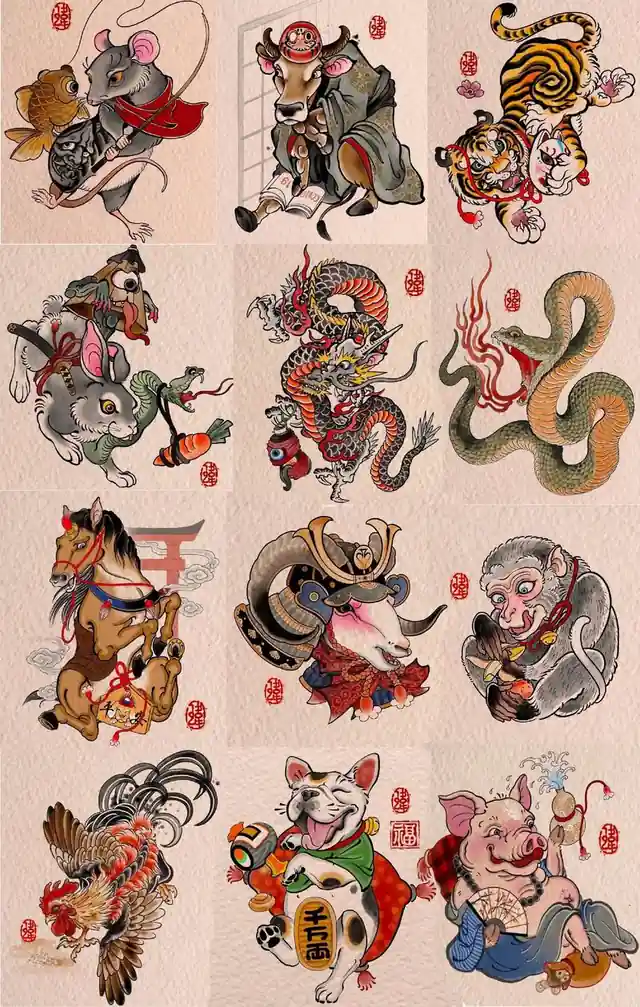
The traditional Chinese calendar system known as the Ganzhi (Heavenly Stems and Earthly Branches) method of year recording has a long and profound history, and its integration with the zodiac animal year system has had a significant impact both historically and in the present day.
Nowadays, the Gregorian calendar is commonly used, but we are not unfamiliar with the Ganzhi (Heavenly Stems and Earthly Branches) calendar system. For example, well-known historical events such as the "Jiawu War" (First Sino-Japanese War, 1894-1895), the "Wuxu Reform" (Hundred Days' Reform, 1898), and the "Xinhai Revolution" (1911 Revolution) all adopted the Ganzhi calendar method. In most people's impression, the zodiac calendar is also closely integrated with the Ganzhi system. Therefore, to discuss zodiac culture, one should understand the Ganzhi calendar.
China's traditional calendar, the Lunar Calendar, was already well-established over 3,000 years ago during the Xia Dynasty, which is why it is also called the "Xia Calendar." The Xia Calendar employs the Ganzhi (Heavenly Stems and Earthly Branches) system for year numbering. This system uses the pairing of the Ten Heavenly Stems and the Twelve Earthly Branches in sequence. The Ten Heavenly Stems are: Jia, Yi, Bing, Ding, Wu, Ji, Geng, Xin, Ren, and Gui. The Twelve Earthly Branches are: Zi, Chou, Yin, Mao, Chen, Si, Wu, Wei, Shen, You, Xu, and Hai. Since the pairing of the Ten Heavenly Stems with the Twelve Earthly Branches produces only 60 unique combinations, and combining them with the Twelve Zodiac Animals can distinguish different years within the same zodiac sign, ancient people combined all three for year naming. The Tibetan calendar and the calendars of the Western Xia and Yuan dynasties in Chinese history are typical examples of the application of zodiac-based year numbering.
In the Tibetan calendar system, the twelve zodiac animals—Rat, Ox, Tiger, Rabbit, and so on—not only correspond sequentially to the five elements of Wood, Fire, Metal, Water, and Earth, but also combine with Yin and Yang. The method of pairing follows a corresponding relationship with the ten Heavenly Stems: Jia and Yi correspond to Wood, Bing and Ding to Fire, Wu and Ji to Earth, Geng and Xin to Metal, and Ren and Gui to Water. Within these five pairs, the former is Yang and the latter is Yin. Although the Tibetan calendar does not explicitly mark the Heavenly Stems and Earthly Branches, it implicitly contains their sequential order. The zodiac calendar system in Tibetan regions is of great importance and serves as one of the methods for locating the reincarnated soul-child of the Panchen Lama.
The Xixia (Western Xia) Kingdom in history was established by the Dangxiang tribe, a branch of the Qiang people. From the time Li Yuanhao officially declared himself emperor (1038 CE), it existed for nearly 200 years. Both the Xixia government and common people used the Chinese zodiac for dating. According to relevant sources, in the 7th year of the Qianyou era of Emperor Renzong of Xixia (1176 CE), the Chinese inscription on the Ganzhou Heishui Bridge Stele was dated as "the year of bingshen (the 33rd year of the sexagenary cycle), the 7th year of the Qianshi era," while the Tibetan inscription was dated as "the year of the Yang Fire Monkey." This clearly reflects that the Xixia zodiac dating system was influenced by Tibetan calendrical methods.
The Yuan Dynasty was established by the Mongol people, who used the twelve zodiac animals to mark their years. Their calendar began with the Tiger year, followed by the order: Tiger, Rabbit, Dragon, Snake, Horse, Goat, Monkey, Rooster, Dog, Pig, Rat, and Ox. In Yuan Dynasty chronology, the characters "er" (meaning "child") and "nian" (meaning "year") were often added after the zodiac animal name, resulting in terms like "Rat-er Year" or "Ox-er Year." This practice is reflected in the "Treatise on the Five Elements" of the "History of Yuan," which records: "In the first year of the Zhizheng reign (1341 CE), a children's rhyme circulated in the Huai-Chu region, saying: 'Let not the rich build towers, nor the poor build houses; only when the Goat-er Year comes will Wu's garden be restored.'"
In the late Yuan Dynasty, social conflicts intensified and popular resentment boiled over, leading to a succession of peasant uprisings of varying scales across the country. This nursery rhyme recorded in the "History of Yuan" predicted that the Yuan Dynasty would be overthrown in 1355. The rhyme did not refer to the year Yiwei (the 32nd year of the Sexagenary Cycle) but directly called it the Year of the Goat. At the Fayuan Temple in Beijing, one can still find a Yuan Dynasty imperial edict stele inscribed with the date "the 13th day of the 2nd month in the Year of the Snake."
The combination of the Heavenly Stems and Earthly Branches with the twelve zodiac animals to mark the years is a result of ancient Chinese calendrical research and a crystallization of the wisdom of ancient Chinese people. At the same time, it serves as a lifeline running through traditional Chinese zodiac culture.
Further Reading
What is the "Sixty-Year Cycle" (Liushi Jiazi)
The Ten Heavenly Stems and Twelve Earthly Branches are paired in sequence, from Jiazi to Guihai, forming sixty combinations known as the Sixty Jiazi, also called the Sixty Huajia. The sequence is as follows: Jiazi, Yichou, Bingyin, Dingmao, Wuchen, Jisi, Gengwu, Xinwei, Renshen, Guiyou, Jiaxu, Yihai, Bingzi, Dingchou, Wuyin, Jimao, Gengchen, Xinsi, Renwu, Guiwei, Jiashen, Yiyou, Bingxu, Dinghai, Wuzi, Jichou, Gengyin, Xinmao, Renchen, Guisi, Jiawu, Yiwei, Bingshen, Dingyou, Wuxu, Jihai, Gengzi, Xinchou, Renyin, Guimao, Jiachen, Yisi, Bingwu, Dingwei, Wushen, Jiyou, Gengxu, Xinhai, Renzi, Guichou, Jiayin, Yimao, Bingchen, Dingsi, Wuwu, Jiwei, Gengshen, Xinyou, Renxu, Guihai.