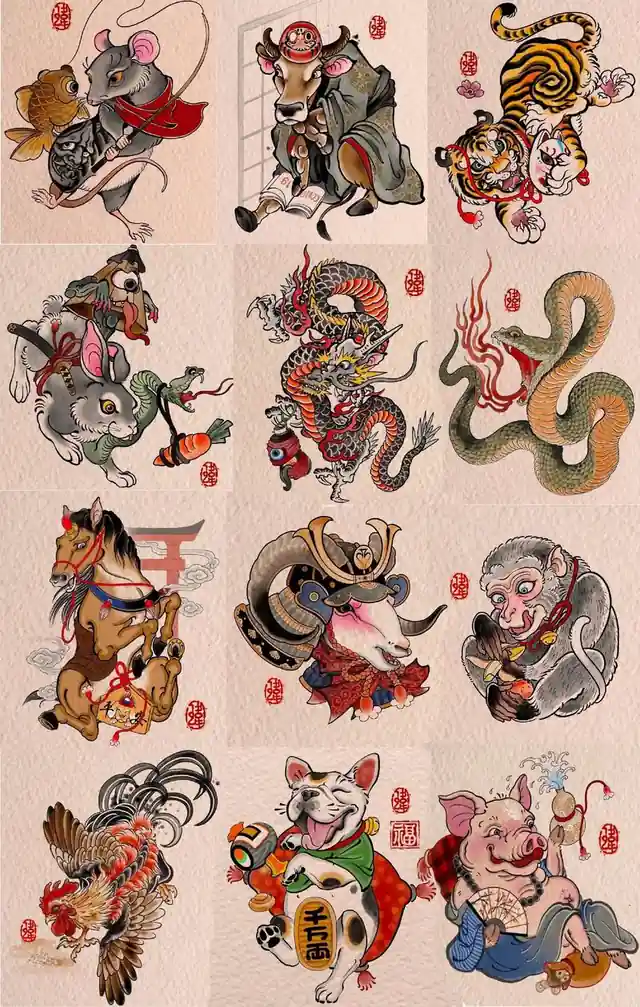
The vivid and adorable images of the twelve zodiac animals make them a favorite among children, as traces of zodiac culture can be found in nursery rhymes, children's games, and even in certain customs related to children in some regions.
The culture of the Chinese zodiac also has an accessible and enjoyable side suitable for all ages. Zodiac animals are not only objects of worship and veneration but are also frequently used as living textbooks for educating children. When children first learn to recognize things, adults teach them: this is a Rat, that is an Ox, the one with stripes all over its body is a Tiger, and the one with a three-part lip and long ears is a Rabbit.
In the Taiwan region of China, a children's rhyme has been passed down: "First Rat, the thief's name; Second Ox, the plowing brother. Third Tiger, climbing the mountain ridge; Fourth Rabbit, touring Tokyo. Fifth Dragon, the emperor's fate; Sixth Snake, causing people's fright. Seventh Horse, running through the military camp; Eighth Goat, grazing on the grassy ridge. Ninth Monkey, climbing tree tops; Tenth Rooster, crowing three times. Eleventh Dog, barking at guests; Twelfth Pig, destined for the butcher's knife." This rhyme is catchy and rhymes well, teaching children to count while helping them remember the order of the zodiac animals and learn small stories about them. It is simple, clear, and easy for children to memorize.
In addition to nursery rhymes, there was also a game called "Acting Out the Twelve Zodiac Animals" that was especially popular: the children participating in the game would take turns imitating each of the twelve zodiac animals, starting with "Rat, rat, eats oil." The child playing the Rat would squat on the ground, pretending to steal lamp oil, bowing their body forward and back, while the other children would step over them with one foot. If anyone accidentally touched the "Rat's" body, they would have to take over and play the next animal. The second act was "Ox, ox, crosses the stream," where one child played the Ox, squatting on the ground, and the other children jumped over them one by one. Before jumping, they would ask, "Are you a dead ox or a live ox?" If the child playing the Ox answered "dead ox," the jumper could give them a slap on the bottom. If they answered "live ox," the jumper would say, "Alright, I'll give you grass to eat, but you have to carry me across the stream." Then they would jump over the "Ox's" back. Whoever failed to jump over would then play the next animal. The third act was "Tiger, tiger, climbs the wall," where the child playing the Tiger squatted on the ground, scratching wildly with both hands as if climbing a wall. The others, standing on one foot, would step over the "Tiger's" head; if caught by the "Tiger," they would then play the next animal. After that, the sequence continued with "Rabbit, rabbit, gazes at the moon," "Dragon, dragon, stirs the water," "Snake, snake, sheds its skin," "Horse, horse, kicks the sand," "Goat, goat, grows its horns," "Monkey, monkey, washes its feet," "Rooster, rooster, flaps its wings," "Dog, dog, digs a hole," and "Pig, pig, eats the swill." This game not only helped children remember the order of the twelve zodiac animals but also enhanced their imitation skills and provided physical exercise, achieving multiple benefits at once.
In some areas of Zhejiang, there is a custom called "Reciting the Zodiac." If a child suffers from indigestion or stomach discomfort, an adult will tightly wrap a cup filled with rice in cloth, then invert the cup onto the child's belly while reciting: "Rat returns to rat, Ox returns to ox, Tiger returns to tiger..." After reciting all twelve zodiac animals once, they say: "Child, they are helping you eat, and your pain will go away soon..." In the Hehuang region of Qinghai, if a child is ill for a long time without recovery, elderly people believe the child has encountered a "Pass Barrier" (Guan Sha, a superstitious obstacle). To cure the illness, one must pass through these barriers. The ritual involves inviting a person born in the Year of the Dragon or Tiger to hold a hay cutter with the blade facing downward, placed horizontally above the door. The father or mother then carries the child through the doorway, while others nearby ask: "Has the Green Dragon passed the barrier?" The person holding the cutter replies: "Passed!" This is followed by barriers such as the White Tiger, the Phoenix, and the Vermilion Bird. People believe that after this ritual of passing through the barriers, the child's illness will be cured.
Regardless of whether these methods are actually effective, from another perspective, they all reflect parents' sincere wish for their children to grow up healthy and happy.
In addition, in certain rural areas of China, after a child is born, parents will cut out a paper silhouette of the child's zodiac animal and paste it at the head of the bed. For example, if the child is born in the Year of the Tiger, a tiger silhouette is cut and posted; if in the Year of the Ox, an ox is cut. Through this practice, parents hope their child will grow up as robust and vigorous as the zodiac animal. In the Suzhou area of China, there is also a custom known as "Jiming" (entrusting one's name). For instance, if a child's birth date and time (Bazi) conflict with the Tiger, the parents will find a person whose name contains the character "Tiger" to serve as the child's "godfather." If the child's Bazi conflicts with the Horse, they will find someone surnamed Ma (the character for "Horse"), and so on.
Further Reading
The "Longevity Lock" (Changming Suo) features zodiac animal motifs.
The "Longevity Lock" is a talisman hung around a child's neck, typically consisting of two sides: one side features the child's zodiac animal carved accordingly, while the other side bears inscriptions such as "Longevity of a Hundred Years," "Blessings, Fortune, and Peace," or "A Lifetime of Safety." The most refined type of longevity lock is the "Hundred Families Lock," which is made by the child's family members going from house to house begging, collecting just one coin from each household, and then pooling the money to forge a silver lock, symbolizing the wish to "beg for blessings from a hundred families." In the Jiangnan region of China, to assemble a "Hundred Families Lock," one must first wrap seven grains of white rice and seven tea leaves in red paper, preparing two to three hundred such packets to distribute to relatives and friends. When collecting the packets, each household must contribute a monetary gift, which can be of any amount, to fund the purchase of the lock. People believe that by putting this "Hundred Families Lock" around the child's neck, the twelve zodiac guardian deities carved on it will protect the child's healthy growth.