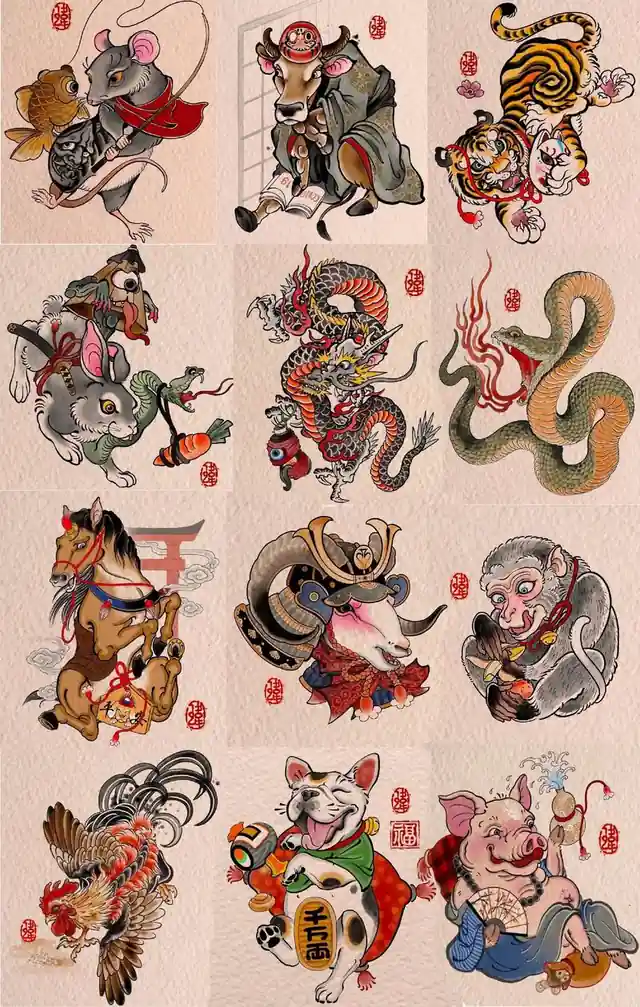
The concept of Ben Ming Nian (one's zodiac year of birth) is closely connected to the twelve zodiac animals. During a person's Ben Ming Nian, various folk customs have been passed down from ancient times to the present day, which have also had a significant impact on people's daily lives.
In folk tradition, people use "xun" (a twelve-year cycle) as a unit for marking years, with each zodiac sign recurring every twelve years in a cycle known as one xun, repeating endlessly. When the zodiac animal of a given year cycles back to match a person's own birth year animal—that is, the zodiac sign corresponding to the year of their birth—that year becomes their Ben Ming Nian (Zodiac Year of Birth). In simple terms, if a person was born in a certain year of the Chinese lunar calendar, then every subsequent year with the same zodiac animal is their Ben Ming Nian. For example, someone born in a Zi year (Year of the Rat) has the Rat as their zodiac sign, and when another Zi year occurs twelve years later, that becomes their Ben Ming Nian. Therefore, every twelve years, a person encounters their own Ben Ming Nian. As a result, a person's Ben Ming Nian occurs when they are 12, 24, 36, 48, 60 years old, and so on. From this, it can be seen that Ben Ming Nian is calculated based on the twelve zodiac animals, and it is inseparably connected to the Chinese zodiac.
People often place great importance on their zodiac sign, and generally, whatever animal they are born under, they develop a special fondness and preference for that zodiac creature. This is especially true during their Ben Ming Nian (the year of their zodiac sign), when zodiac toys, zodiac paintings, and similar items become their favorites.
According to traditional folk customs, Ben Ming Nian (the zodiac year of one's birth) is considered an unlucky year. It is believed that "offending Tai Sui (Grand Duke Jupiter) in one's zodiac year brings misfortune, and when Tai Sui sits overhead, there will be either no joy or only disaster." Therefore, people often refer to this year as the "threshold year," implying that surviving it is like stepping over a difficult obstacle. People believe that one must pray for blessings and ward off evil through "ritual exorcism" to dispel calamities, thereby attracting good fortune and avoiding misfortune, turning danger into safety during this inauspicious year. Thus, according to tradition, when entering one's zodiac year, both adults and children must wear a red belt, known as "tying red," while children also wear red vests and red underpants, and some even dress entirely in red, believing this will bring good luck and ward off disasters. This custom of "tying red" remains very popular across various regions today. During the Spring Festival, red and yellow ribbons of all kinds can be seen everywhere in the market, and those in their zodiac year tie them around their waists or wrists, believing this can eliminate calamities and bring good fortune.
The concept of red as a means to ward off evil spirits and bring good fortune has existed since the era of primitive society. However, this psychological preference for red has remained unchanged through the changing times. During the New Year, people paste red couplets, and in wedding customs, red wedding dresses, red veils, and red candles are used. Regardless of time or place, people employ red to create a festive atmosphere, especially believing that red has the power to dispel evil and protect the body. Therefore, on New Year's Eve, people put on red underwear early, or tie a red belt around their waist, and some even attach their accessories with red silk cords to welcome their Ben Ming Nian (Zodiac Year of Birth).
In the eastern region of Inner Mongolia, special importance is placed on a boy's 12th birthday. On this day, the child must "wear red" (zha hong), parents prepare a banquet, and relatives and friends give the boy gifts of money and silk as a blessing. An elderly person's 60th birthday is called "Hua Jia" (Flower Age or Cycle of Sixty Years) and is highly valued by many Chinese ethnic groups. Hua Jia marks the sixth Ben Ming Nian (Zodiac Year of Birth) in a person's life and also represents a full cycle of the Ganzhi (Sexagenary) Calendar System, carrying special significance. Children host a "Huan Jia Banquet" (Changing Age Feast) for their parents to express wishes for health, longevity, and good fortune.
In some Chinese local customs, individuals observing their Ben Ming Nian (Zodiac Year of Birth, believed to be an unlucky year) are advised to avoid going out on the evening of Chinese New Year's Eve (the 30th day of the 12th lunar month). From sunset until the next day's sunrise, adults or children in their Ben Ming Nian stay indoors, with married men accompanied by their wives. This practice is believed to help ward off potential misfortune.
From this, it can be seen that the zodiac culture has long been deeply integrated into people's lives, becoming a very important component of folk culture. Although it contains some superstitious elements, this should not negate its positive aspects.
Further Reading
The Relationship Between Ben Ming Nian and Taoism
The ten Heavenly Stems and twelve Earthly Branches combine to form the sixty-year cycle known as the Sexagenary Cycle (Jiazi). Taoism venerates the sixty Jiazi deities, which are sixty star gods. These sixty Jiazi deities are also called Tai Sui (Grand Duke Jupiter), such as Jiazi Tai Sui Jin Bian and Yichou Tai Sui Chen Cai. In folk tradition, the star god of one's birth year is referred to as Ben Ming Yuan Chen (Original Star of the Birth Year). In essence, Ben Ming Nian (the zodiac year of birth) is the colloquial term for Ben Ming Yuan Chen. The White Cloud Temple (Baiyun Guan), a famous Taoist temple in Beijing, houses the Hall of Yuan Chen, a place for worshipping the Ben Ming Yuan Chen star gods. On the seventh and eighth days of the first lunar month each year, people flock to the Hall of Yuan Chen in the White Cloud Temple to "sacrifice to the stars," burning incense and bowing to their respective birth year stars, praying for a life of safety and peace. This worship ritual is also called "Shun Xing" (Harmonizing with the Stars), meaning that even in an unfavorable year, through prayer, one can receive protection from the corresponding star, thereby turning misfortune into fortune.