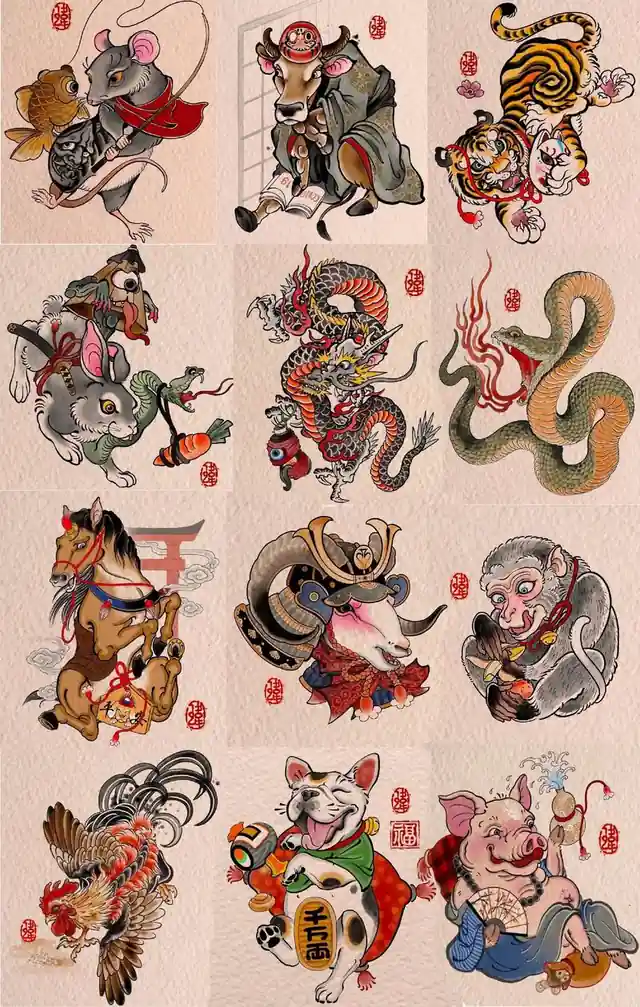
Naming based on the Chinese zodiac is a very common phenomenon. Whether among Han Chinese or ethnic minorities, and whether in ancient times or the present day, naming by zodiac sign has always been a part of people's lives.
In our daily lives, we often observe a common phenomenon: even before a child is born, their closest relatives, especially the soon-to-be parents and the already-experienced grandparents, most enjoy holding a thick dictionary to search for auspicious characters, aiming to give the child a meaningful and extraordinary name.
Many people consider their child's zodiac sign when choosing a name and selecting appropriate characters. This practice of naming based on one's birth year zodiac animal has existed since ancient times. Tang Yin, who styled himself as the "Number One Romantic Talent South of the Yangtze River" during the Ming Dynasty (1368-1644), was born in 1470, which was the Gengyin Year of the Tiger according to the Ganzhi calendar system. Tang Yin, with his given name Yin and courtesy name Bohu, had his name and courtesy name both derived from and echoing his birth year.
Speaking of names, in addition to formal names and courtesy names, people usually also have a childhood name, also known as a pet name or infant name. In traditional customs, choosing a childhood name for a child was a matter that could not be taken lightly. In old customs, the naming of a childhood name was very solemn. In some places, the biological father would bring sugar, cakes, or other gifts to ask an elder in the village or a respected member of the clan to name the child. The name had to avoid taboo characters used by the names of elder relatives, and auspicious characters were often chosen, such as "Gui'er (Precious Child)," "Xiang'er (Auspicious Child)," or "Xiaolong (Little Dragon)." In folk traditions, especially in rural areas, the custom of using humble names was very common. Whether in the north or south, whether in suburbs or remote villages, many people used characters like "Dog," "Ox," "Donkey," or even "Urine" and "Dung" to name their children, hoping that their offspring would grow up humbly and live a safe life. For example, Sima Xiangru's childhood name was "Quanzi (Puppy)," Gu Kaizhi's was "Hutou (Tiger Head)," Tao Yuanming's was "Xigou (Stream Dog)," and Wang Anshi's was "Huanlang (Badger Boy)." Auspicious childhood names include "Xiaolong (Little Dragon)" and "Huzai (Tiger Cub)," while humble names include "Xiaogouzi (Little Doggy)" and "Xiaoniu (Little Ox)." These names are often closely related to the child's zodiac sign. Using the zodiac as a basis for a childhood name is also a very common practice, and to this day, this custom is still preserved in many places.
Taking the name "Dog" (or names with a similar meaning) as an example, a great many people—from princes, generals, and scholars, down to commoners and peddlers—have used it as their personal name. The Qing Dynasty work Gaiyu Congkao (Collected Examinations from the Thatched Cottage), in its forty-second volume under the entry "Strange and Unusual Naming Practices," records some fascinating examples: "According to the Nanshi (History of the Southern Dynasties), Zhang Jing'er was originally named Dog'er, and his younger brother was named Pig'er. Emperor Ming of Qi changed their names to Jing'er and Gong'er. In the Songshi (History of the Song Dynasty), Liu Jiyuan's son was named Three Pigs. The Jin Shi (History of the Jin Dynasty), in the 'Annals of Hailing,' records a Ministry of Justice official named Sea Dog; the 'Annals of Xuanzong' mentions Li Lv Donkey and Tanggua Dog'er; and the 'Annals of Aizong' includes Wanyan Pig'er. Furthermore, Wuzhu's grandson was named Sheep Hoof, and Hushaha's son was named Pig Dung, who was enfeoffed as Prince of Pu. Others, such as Heishilie Pig Dog and Wanyan Dog'er, appear in the 'Biographies of Xixia.' Yelü Red Dog'er is found in the 'Biography of Lu Yanlun.' The Jin Shi states that the Jin people valued simplicity, so they followed old customs without change. The Yuan Shi (History of the Yuan Dynasty) also records names like Shimo Dog Dog and Ning Pig Dog. ... This was an ancient custom. It is not at all surprising that many personal names from the Jin and Yuan periods were ugly or crude." During the Jin and Yuan dynasties, it was extremely common for personal names to include zodiac animals, and among the northern ethnic minorities of that time, years were even directly referred to as "Dog Year" or "Pig Year." Using zodiac animals as personal names was likely influenced by the social and cultural life of the era.
In the past, there were various superstitious beliefs about "suitable and forbidden" elements when naming based on the Chinese zodiac. Those who adhered to these superstitions were quite particular about zodiac factors in naming. When giving a name to someone of a specific zodiac sign, certain radical characters were considered auspicious to use, while others were deemed unsuitable. They believed that only a name matching the zodiac sign could bring good fortune and positive energy to the person.
Of course, names are essentially just labels. Naming based on the zodiac is merely a way to express people's good wishes and aspirations, and it does not have any practical effect. Happiness is created by ourselves and cannot be determined by the quality of a name. However, the love and hopes that elders hold for their children, embedded in the tradition of naming, are certainly worthy of recognition.
Further Reading
Lao She's Childhood Name
Master Lao She, a luminary of Chinese literature, had a rather ordinary and even vulgar childhood nickname: Little Dog's Tail. In this regard, Shu Yi, Lao She's son, wrote in his biography "Lao She": Lao She was born on February 3, 1899. His aunt gave him a very unpleasant nickname: Little Dog's Tail. Being born in the Year of the Dog, like those born in the Years of the Pig, Rooster, or Rabbit, carries no distinction of high or low, nor any dishonor. However, "Dog's Tail," and especially "Little Dog's Tail," was truly hard to accept. Therefore, when he was young, Lao She always claimed he was born on the day when people make malt sugar sacrifices to the Kitchen God. Being born at the hour of the Kitchen God's ascension to heaven—wasn't that far more glorious and impressive than being called "Little Dog's Tail"? His aunt gave him this name, "Little Dog's Tail," as an expression of her deep affection and boundless blessings. "Little Dog's Tail" also carries the meaning of the end of the year, encompassing not only his zodiac sign but also the month of his birth, the twelfth lunar month, within the nickname. From this perspective, the name is truly quite grand.