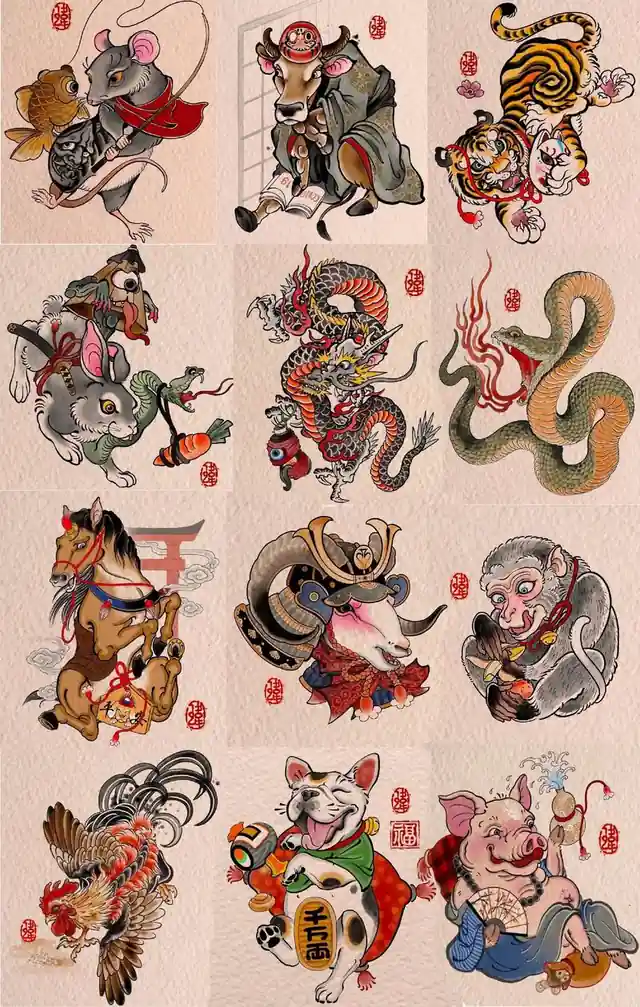
The Chinese zodiac is a highly representative cultural form within a region or an ethnic group, functioning as an implicit ethnic language. In traditional Chinese zodiac culture, the image of the Dragon serves as a symbol of the Chinese nation, while some ethnic minorities also adopt zodiac animals as symbols of their own people.
Among traditional Chinese festivals, there are not only culturally significant ones like the Spring Festival, Lantern Festival, Dragon Boat Festival, and Mid-Autumn Festival, but also the most distinctive Chinese zodiac year passed down by our ancestors. Through countless dynastic changes, with their rises and falls, the tradition of celebrating the zodiac year has never changed among the Chinese people. The zodiac year has transcended the scope of traditional festivals and evolved into a unique cultural complex. It has become a brilliant highlight of Chinese culture and shines brightly within the world's cultural forest.
In traditional Chinese culture, the dragon is a mythical creature symbolizing auspiciousness and majesty, a deity revered by all ethnic groups. Through long-term development, the dragon gradually became an exclusive term for the supreme ruler. During the feudal era, emperors wore dragon robes, sat on dragon thrones, slept in dragon beds, and even their bodies were revered by the common people as dragon bodies. The births and appearances of legendary figures such as the Yan Emperor, the Yellow Emperor, Yao, Shun, and Liu Bang, the founding emperor of the Han Dynasty, were also embellished and processed by later generations, linking them to the dragon. They were considered "dragon seeds," meaning they were born to be emperors, and even their children were called "dragon sons." Today, we often hear phrases like "descendants of the dragon" and "offspring of the dragon." This expression goes beyond the scope of ancient totem worship, representing instead a shared cultural psychology of the nation, an inherent cultural phenomenon common to the entire people.
Besides the dragon totem, other ethnic groups also regard other animals from the Chinese zodiac as their clan ancestors and worship them with great reverence.
The Huang clan of the Yao ethnic group in Nandan County, Guangxi, regards the female monkey as their founding ancestor. According to local legend, there were once ten suns and ten moons in the sky, making the days too hot and the nights too cold. Because the founding ancestress of the Huang clan was born from a female monkey, and the offspring of that female monkey possessed great strength, the founding ancestress was no exception. Thus, people asked her to go up to the heavens to strike down the suns and moons. After she shot down nine suns and nine moons, the people were deeply grateful and revered the female monkey as a deity. To this day, in areas inhabited by the Yao people, the custom of prohibiting the hunting and killing of monkeys is still preserved.
Among the Bai ethnic group in most areas of Yunnan, there is a distinction between the Tiger Clan and the Rooster Clan. The Tiger Clan believes their ancestor is a male white tiger, which they consider majestic and powerful, and it never harms members of their own people. When they plan to travel far from home, they choose a day corresponding to the Tiger in the Chinese zodiac (the Yin day), believing that only then will their endeavors be blessed by the Tiger God. When members of the Tiger Clan return from afar, they also calculate the auspicious date, entering their home only on a Tiger day for good fortune. The Rooster Clan, on the other hand, tells a legend that their ancestors hatched from the eggs of a Golden Rooster, and they believe that roosters can discern good and bad omens, thus protecting them. During migrations, they place a rooster in a basket carried on their backs. After arriving at a new settlement, wherever the rooster crows, they establish their home there. In their view, the place where a rooster crows is the most auspicious and suitable for settlement. Additionally, other Chinese ethnic groups such as the Yi, Buyi, and Tujia also regard the tiger as their ancestor.
Today, as Western culture permeates traditional Chinese culture, the zodiac culture, as one of China's national identifiers, has also been impacted to a certain extent. We should fundamentally value China's traditional zodiac culture, viewing it as an indispensable and important aspect of the Chinese nation's standing among the nations of the world. Starting from ourselves, we must root the traditional zodiac culture in the hearts and minds of every Chinese descendant, elevating it to the height of a national identifier. Only then can we better promote and disseminate zodiac culture, and only then can it be conducive to the further development of zodiac culture.
Further Reading
Tianshui Snake God
In the Tianshui region of Gansu Province, there are customs of reverence and taboo toward snakes. If a snake appears in a home, it is believed that evil energy is present and the family cannot live peacefully; the head of the household should burn incense, kowtow, and worship to exorcise the spirits. If people see snakes mating, they must avoid them and not speak of it to others, because the image of mating snakes closely resembles the ancient depictions of Fuxi and Nüwa with human heads and snake bodies. They believe snakes possess spiritual power; when crafting statues of deities, they often place small snakes inside the clay head or abdomen to enhance the divine efficacy. One should avoid snakes and help them when they are in danger. Locals most fear harming snakes, and countless stories circulate in Tianshui about the retribution suffered by those who strike snakes. The reverence and worship of snakes in the Tianshui region are essentially a continuation of ancient totem worship.