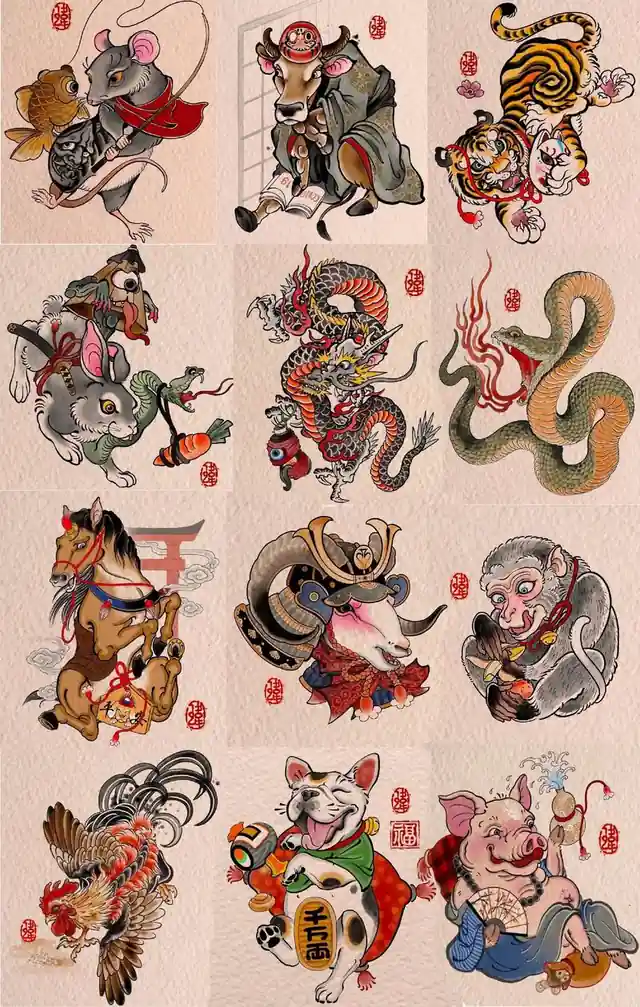
The culture of the Chinese zodiac has long permeated every aspect of people's lives, and even dietary culture has certain connections with the zodiac. The parts of dietary culture related to the zodiac naturally carry their own unique cultural significance.
Pork and chicken are used in cooking, while delicacies include beef brisket and snake soup. Undoubtedly, these are all aspects of food culture that greatly enrich it. However, who can claim that this is eating the zodiac? Beyond eating, there are many cultural intersections between the zodiac and food.
Diet and the Twelve Zodiac Animals in "Yueling Wenda" (Questions and Answers on the Monthly Ordinances)
In ancient China, the third month of each season was called the Ji Month (seasonal month), such as the third month being Ji Chun (late spring), the sixth month being Ji Xia (late summer), the ninth month being Ji Qiu (late autumn), and the twelfth month being Ji Dong (late winter). The Five Elements (Wood, Fire, Earth, Metal, Water) were matched with the four seasons: spring with Wood, summer with Fire, autumn with Metal, and winter with Water, with the remaining element "Earth" assigned to the Ji Months. By combining the Five Elements with the four seasons and further associating them with the zodiac animals, the so-called "theory of what to eat in the five seasons" (wushi suo shi) emerged.
Cai Yong of the Eastern Han Dynasty wrote "Yueling Wenda (Questions and Answers on the Monthly Ordinances)," which is one of the earlier documents recording the Chinese zodiac. Cai Yong combined the zodiac with the Five Elements (Wu Xing) and connected them to dietary practices when discussing the zodiac animals: "The animals of the twelve earthly branches that are eaten during the five seasons must be those raised by families. They are only the Chou Ox, Wei Goat, Xu Dog, You Rooster, and Hai Pig. The remaining animals, from Dragon to Tiger, are not eaten. In spring, Wood is dominant, Wood overcomes Earth, and Earth is dominant in the four seasons. Among the animals of the four seasons, the Ox belongs to late summer, and the Dog belongs to late autumn, so the Wei Goat can be eaten in spring. In summer, Fire is dominant, Fire overcomes Metal, so the You Rooster can be eaten in summer. In late summer, Earth is dominant, Earth overcomes Water, so one should eat Pig but instead eats Ox. Earth is the most revered of the Five Elements, and the Ox is the greatest of the five domestic animals. The animals of the other four elements are insufficient to match the virtue of Earth, so the Ox is eaten in late summer. In autumn, Metal is dominant, Metal overcomes Wood, the Yin Tiger is not suitable for eating, and the Dog and Pig have no horns and belong to the Tiger category, so the Dog is eaten in autumn. In winter, Water is dominant. Water overcomes Fire, so one should eat Horse, but ritual does not permit the Horse as a sacrificial animal, so because of its category, the Pig is eaten." Cai Yong believed that spring belongs to Wood, Wood overcomes Earth, and the zodiac animals belonging to Earth are the Chou Ox, Wei Goat, and Xu Dog. Because "the Ox belongs to late summer and the Dog belongs to late autumn," "the Wei Goat can be eaten in spring." Summer belongs to Fire, Fire can overcome Metal, and "the You Rooster belongs to Metal," making it the food of summer. Late summer belongs to Earth, Earth can overcome Water, the Pig belongs to Water, and the Ox belongs to Earth. Why is only the Ox eaten and not the Pig? Cai Yong believed that Earth is the most revered among the Five Elements, and the Ox is the foremost among the five domestic animals. The animals matched with the other four elements "are insufficient to match the virtue of Earth," so "the Chou Ox can be eaten in summer." Autumn belongs to Metal, Metal overcomes Wood, the Tiger belongs to Wood, but the Yin Tiger is inconvenient for eating, so it is replaced by the Xu Dog. Winter belongs to Water, Water can overcome Fire, the Horse belongs to Fire, but "ritual does not permit the Horse as a sacrificial animal, so because of its category, the Pig is eaten." Cai Yong's conclusion derived from combining the Five Elements theory is somewhat far-fetched and does not align with reality.
In "Strange Tales from a Chinese Studio" (Liaozhai Zhiyi), there is a story about dragon meat.
In the first collection of classical Chinese short stories, Strange Tales from a Chinese Studio (Liaozhai Zhiyi), there is a piece titled "Dragon Meat" (Long Rou): "Imperial Diarist Jiang Yuxuan once said, 'Beneath the Dragon Mounds, if you dig a few feet deep, you will find dragon meat packed within, which anyone may cut and take, but do not speak the word 'dragon' (Long). If someone says, 'This is dragon meat,' then a thunderbolt will strike and kill the person.' The diarist had actually eaten such meat, and it was indeed true." Of course, dragons do not exist; they are merely a mythical animal imagined by people. If there are no dragons, how could there be dragon meat? It seems that the ancients were obsessed with the desire to eat dragon meat, believing that doing so would grant immortality.
The Hani people of China have a custom known as "sacrificing dragon meat," but what they offer is not actual dragon meat; instead, it is pork and pork liver. People believe that pork bought casually at the market cannot compare to this "dragon meat," which has been "consecrated" under the dragon tree. After the dragon meat is cooked, the elders first make an offering to their ancestors, and then the entire family eats it in order, starting with the eldest and then the youngest, with women before men. Each person must take at least two bites. People believe that the dragon meat is a gift from the dragon, and that being able to eat it every year ensures peace and good fortune, no matter where they are.
In fact, what is suitable or unsuitable to eat is determined by the properties of the food and the nutritional balance within the human body. Of course, people's preferences and taboos in food culture contain deep cultural connotations and customs. The choices and freedoms of every individual and every ethnic group should be respected.
Further Reading
The mixed-consumption "Twelve Animals"
Literally, "Shi Er Xiang" (Twelve Symbols) means a stew of all twelve zodiac animals, from Rat to Pig, encompassing every type of creature. In reality, it referred to a mixed meat dish containing pork, beef, and mutton. As the term evolved, the "hundred-family meal" scraped together by the poor and beggars from various households was also jokingly called "Shi Er Xiang," emphasizing its miscellaneous nature. The writer Li Jieren, in his novel "Dead Water Stagnant Waves" (Sishui Weilan), which records the life of the lower classes at the time, described "Shi Er Xiang" as follows: "If you can't even beg twenty coins in a day, then you can still afford meat! At the four city gates, 'Shi Er Xiang' is sold for five coins for two large bowls. Could you get that in the countryside?" In this context, "Shi Er Xiang" was no longer the original delicacy.