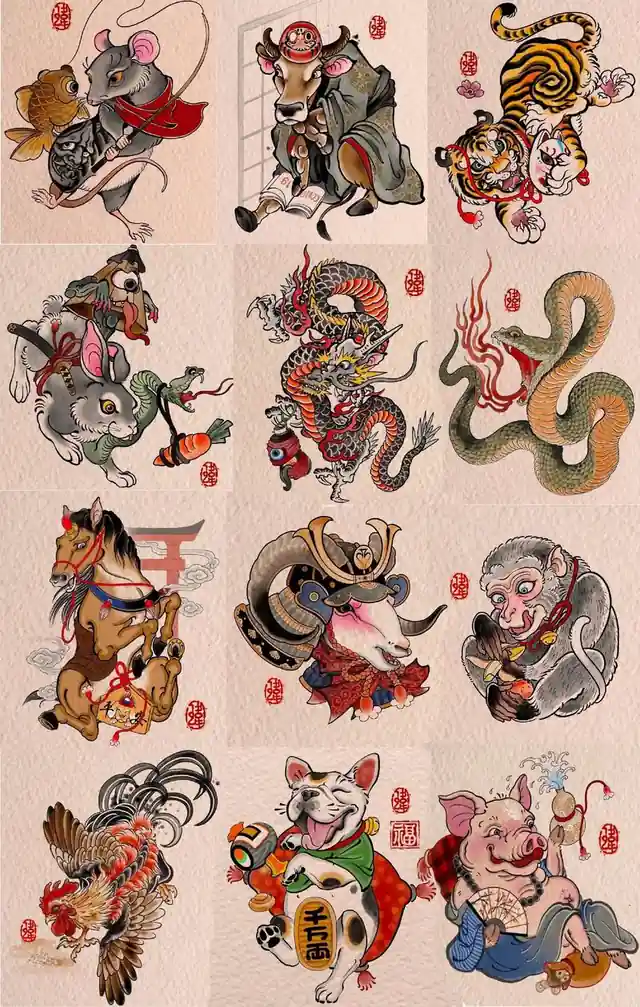
As an ancient folk cultural phenomenon, the origin of the Chinese zodiac has always been a subject of much debate. From ordinary people to scholars and experts, from local communities to formal academic institutions, everyone has attempted to explore the origins of the zodiac in their own ways. This has led to theories such as human imitation, totemic origins, and the use of zodiac animals for chronological purposes.
China's zodiac culture has a long and profound history, and the origin of the zodiac has always been a subject of great interest. Zhu Xi, a prominent Neo-Confucian scholar of the Southern Song Dynasty (1127-1279), once asked his senior disciple Cai Yuanding, "When did the twelve zodiac animals originate, and in which book were they first recorded?" Cai Yuanding was left speechless, unable to answer. Even today, the origin of the zodiac remains a topic of diverse opinions.
The theory of human imitation suggests that the twelve zodiac animals were selected based on human observation and imitation of nature.
Long ago, ancient people discovered that Jupiter takes twelve years to orbit the sun, and they believed that different periods of Jupiter's orbit had varying effects on the growth of living organisms on Earth. According to records in "Yuhan Shanfang Jiyi Shu" (Collected Lost Books from Yuhan Mountain Studio), during Jupiter's twelve-year orbit around the sun, there would be three years of good harvest, three years of flooding, three years of bountiful harvest, and three years of drought. At the same time, people also found that within each twelve-year cycle, one particular year was especially suitable for the growth of a specific animal. Thus, people began to learn from the animal with the strongest survival ability during that year, in order to enhance their own resilience and adapt to Earth's complex and changing environment. In this way, with each twelve-year cycle, the twelve zodiac animals as we know them today came into being.
The "imitation theory" reflects people's tenacious life consciousness, which was expressed through the form of ancient witchcraft. The imitation of animals by humans also reflects the fine tradition of diligence and eagerness to learn among our ancestors.
The Totem Origin Theory
Archaeologists have discovered that records of the Chinese zodiac already appeared on oracle bone inscriptions. Some believe that the zodiac may have originated during the Xia Dynasty (c. 2070-1600 BCE), and at the latest, no later than the Shang Dynasty (c. 1600-1046 BCE). However, there is no consensus on why the ancients paired the zodiac animals in this way. One explanation is that the zodiac is related to the totem worship of ancient China.
Totem means "clan," "kinship," or "marker." Totem culture is a highly unique and fascinating phenomenon in the history of human civilization, and totem worship, as one of the earliest forms of religious belief, was widespread across the world. As early as the matriarchal clan society, totems emerged to better distinguish between different clans. People in primitive clan societies often regarded animals and plants closely related to their daily lives as deities, using them as clan names and symbols for rituals and worship, strictly forbidding anyone from killing or consuming them. At that time, the ancient inhabitants of China feared animals such as tigers, snakes, and the imagined dragon, and thus worshipped them as totems. As people began to settle down, animals like the ox, rooster, and dog, which were used for livelihood, had an increasing impact on their lives, leading these animals to be selected as totems.
It is undeniable that the ancient people's worship of totems inevitably influenced the determination of the twelve zodiac animals, and there must have been some inseparable connection between the two. However, this remains merely a conjecture, as it still lacks precise scientific evidence.
The theory of the origin of the Chinese zodiac calendar system.
In ancient China, both in the north and the south, some ethnic groups used the "Twelve-Animal Calendar" to mark years, with a twelve-year cycle that repeats continuously and unceasingly. In the Ailao Mountains of Yunnan, the Twelve-Animal Calendar has been used from ancient times to the present day, and during major festivals, female shamans are invited to dress up as the twelve zodiac spirit animals and perform dances.
In fact, there is a certain connection between the "totem origin theory" and the "twelve-animal calendar theory." Ancient clans may have created the "twelve-animal calendar" based on production needs and under the influence of totem worship. Today, the calendar we use combines the Ganzhi (Heavenly Stems and Earthly Branches) system with animal year designations.
In summary, the Chinese zodiac is not a product of any single time or place. It is the result of cultural interaction and mutual influence between the Han Chinese and other ethnic groups. As a precious cultural heritage of the Chinese nation, it carries the boundless wisdom and beautiful aspirations of our ancestors.
Further Reading
The records of the twelve zodiac animals in the Qin Dynasty bamboo slip text "Rishu" (Day Book).
In 1975, bamboo slips titled "Rishu" (Day Books) were unearthed from Tomb No. 11 at Shuihudi in Yunmeng County, Hubei Province, and one chapter was entitled "Daozhe" (The Thief). It recorded: "Zi corresponds to the Rat; the thief has a pointed mouth and sparse beard... Chou corresponds to the Ox; the thief has a large nose and long neck... Yin corresponds to the Tiger; the thief has a peculiar appearance, sparse beard, and a black face. Mao corresponds to the Rabbit; the thief has a large face and head. Chen (the text is missing here); the thief is male, with a bluish-red complexion... Si corresponds to the Snake; the thief is tall, dark, and has snake-like eyes. Wu corresponds to the Deer; the thief has a long neck and small mouth, and his body is incomplete... Wei corresponds to the Horse; the thief has long beard and ears. Shen corresponds to the Ring; the thief has a round face..." Among these, the twelve zodiac animals are largely similar to modern versions. According to research, Tomb No. 11 at Shuihudi was sealed in the 30th year of Qin Shi Huang's reign (217 BCE), so the origin of the Chinese zodiac can be traced back at least to the Spring and Autumn period before the Qin Dynasty. Scholars believe this is the earliest and most systematic record of the twelve zodiac animals discovered in China to date.