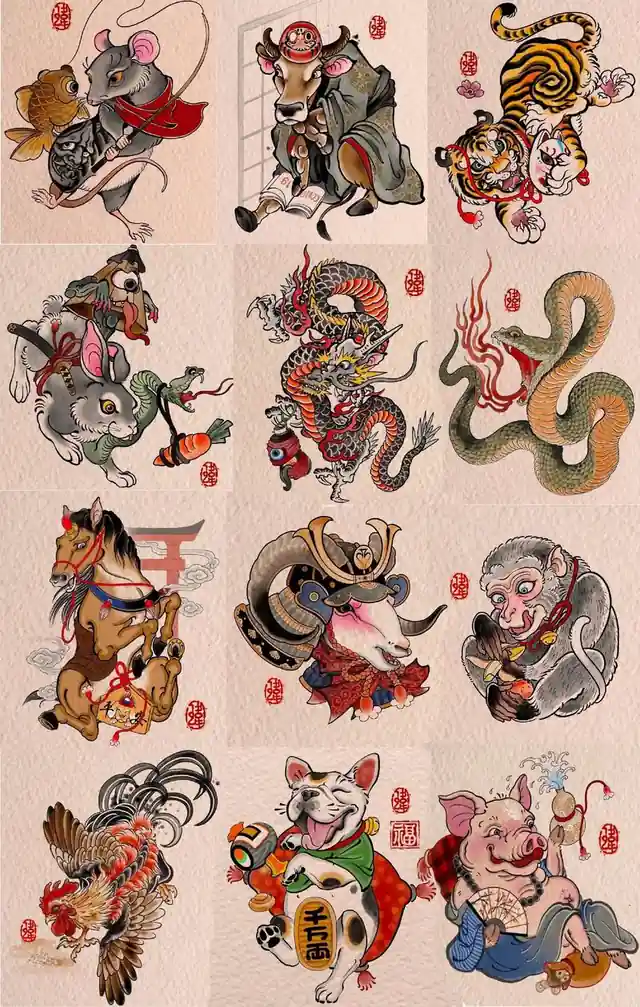
The arrangement of the twelve zodiac animals has always been an unsolved mystery in traditional Chinese culture, and since ancient times, people have spared no effort in trying to explain it, leading to various different theories regarding their order.
We are already very familiar with the order of the twelve zodiac animals, but why are they arranged in the sequence of Rat, Ox, Tiger, Rabbit, and so on?
Among the Han Chinese people, a widely circulated legend tells that the Yellow Emperor Xuanyuan wanted to select twelve animals to serve as palace guards. The cat asked the Rat to sign it up, but the Rat forgot, causing the cat to miss the deadline and fail to register. Initially, the Ox was to be ranked first, but the Rat stealthily climbed onto the Ox's back and took the lead, so the Rat became number one and the Ox number two. The Tiger and the Dragon, displeased with this outcome, were appointed as the Mountain God and Sea God respectively, placing them behind the Rat and Ox. This angered the Rabbit, who challenged the Dragon to a race and thus moved ahead of the Dragon. The Dog, dissatisfied, bit the Rabbit in a fit of rage and was punished to last place. After a series of competitions among the Snake, Horse, Goat, Monkey, and Rooster, the Pig came running in at the end, and the Dog ended up second to last again. This legend reflects people's hopeful desire to find answers.
There are two relatively scientific explanations for the arrangement of the zodiac animals.
The Theory of Hour Arrangement
Liu Xian's "Guangyang Zaji" (Miscellaneous Notes from Guangyang) from the Qing Dynasty explains the ordering of the twelve zodiac animals from the perspective of the ancient twelve two-hour periods of day and night. Liu Xian argues: "Heaven was opened at the hour of Zi, and without consumption, its qi would not open. The Rat is a creature of consumption. Thus, when the night is not yet over and the Rat is in command, the hour of Zi belongs to the Rat. Earth was opened at the hour of Chou, and the Ox is the creature that opens the earth, so the hour of Chou belongs to the Ox. Humans are born at the hour of Yin, and where there is life, there is death. The killer is the Tiger. Also, Yin means fear. Nothing is more fearsome than the Tiger, so the hour of Yin belongs to the Tiger. Mao is the hour of sunrise. The sun itself is a separate entity, but it contains the essence of the Jade Rabbit of the moon, so the hour of Mao belongs to the Rabbit. Chen is the hexagram of the third month, precisely the time when dragons bring rain, so the hour of Chen belongs to the Dragon. Si is the hexagram of the fourth month, when grass is lush and snakes find their place. Also, at the hour of Si, snakes do not take to the road, so it belongs to the Snake. Wu is when Yang reaches its extreme and Yin is just born. The Horse is extremely vigorous yet never leaves the ground, making it a Yang creature, so the hour of Wu belongs to the Horse. The Goat eats the grass of the hour of Wei and thrives, so the hour of Wei belongs to the Goat. At the hour of Shen, the sun sets and apes cry, and they stretch their arms. The qi of the arms, when about to become chaotic, makes madmen run wild, so the hour of Shen belongs to the Monkey. You is the time when the moon rises. The moon itself is a Kan body, but it contains the essence of the Golden Rooster of the sun, so the hour of You belongs to the Rooster. At the hour of Xu, night has just begun, and the dog is the creature that guards the night, so the hour of Xu belongs to the Dog. Hai is the time of heaven and earth's chaos, like all fruits containing life within their kernels. The Pig knows nothing beyond eating and drinking, so the hour of Hai belongs to the Pig."
The theory of arrangement by habits
Lang Ying of the Ming Dynasty, in his work Qixiu Leigao (七修类稿, Classified Drafts of Seven Revisions), absorbed and utilized the "Hour Arrangement Theory." He combined it with the theory of yin and yang, using the habits of each zodiac animal to provide an explanation.
The period from 11 PM to 1 AM is the Zi hour (the first Earthly Branch time period). Zi represents the extreme of yin, symbolizing concealment and obscurity, and is paired with the Rat because the Rat's characteristic is hiding, and this is the time when rats are most active.
The period from 1:00 AM to 3:00 AM is the Hour of the Ox (Chou Shi)
The period from 3:00 AM to 5:00 AM is the Yin Hour (Yinshi)
From five to seven in the morning is the Mao Hour (5-7 AM). Mao corresponds to the western direction where the moon sets, and it also contains the essence of the eastern Mao position represented by the Rabbit. Therefore, the Earthly Branch Mao is associated with the Rabbit. During this time, the moon hangs in the sky, and the Jade Rabbit is busy pounding medicine.
The period from 7 to 9 in the morning is known as the Chen hour. Chen represents the rising of yang energy and activity, and its peak is matched with the Dragon. This is precisely the auspicious time when the divine dragon brings rain, hence Chen corresponds to the Dragon.
From 9:00 AM to 11:00 AM is the Si hour. At this time, the rising yang energy is not so vigorous, resembling a snake, so Si corresponds to the Snake.
The period from 11:00 AM to 1:00 PM is the Wu Hour (noon time). Wu represents the peak of yang energy. Because the horse gallops swiftly and vigorously, it is the time when the celestial horse soars through the sky, symbolizing the ultimate yang. Therefore, Wu corresponds to the Horse.
The period from 1:00 PM to 3:00 PM is the Hour of Wei (Wei Shi)
From 3:00 PM to 5:00 PM is the Shen hour
The period from 5:00 to 7:00 PM is the You hour (the tenth of the twelve two-hour periods in the traditional Chinese timekeeping system)
The period from 7 PM to 9 PM is the Xu Hour (the eleventh of the twelve two-hour periods in the traditional Chinese timekeeping system)
Between 9 PM and 11 PM is the Hai hour, and Hai corresponds to the Pig. At this time, all is quiet and the Pig is sound asleep, making it a perfect match.
In summary, the arrangement of the Chinese zodiac signs has deep cultural and historical origins. Its formation was not an overnight process but gradually took shape and was ultimately finalized over the long course of human history.
Further Reading
The Arrangement of the Twelve Zodiac Animals in the Mahāvaipulya Mahāsaṃghāta Sūtra (Great Collection Sutra)
The Buddhist scripture "Mahavaipulya Mahasamnipata Sutra" (Great Collection Sutra), in its twenty-third volume, contains records about the arrangement of the zodiac animals. According to the sutra, within Jambudvipa (also known as Southern Continent), one of the four great continents, there are sacred mountains and treasured lands in the four surrounding oceans. In the southern ocean's lapis lazuli mountain, named Tide Mountain, a venomous snake resides in the Multicolored Cave, a horse in the Deathless Cave, and a goat in the Virtuous Dwelling Cave. In the western ocean's crystal mountain, a monkey dwells in the Supreme Color Cave, a rooster in the Vow Cave, and a dog in the Dharma Bed Cave. In the northern ocean's silver mountain, named Bodhi Moon Mountain, a pig lives in the Vajra Cave, a rat in the Fragrant Merit Cave, and an ox in the High Merit Cave. In the eastern ocean's golden mountain, named Merit Mark Mountain, a lion resides in the Bright Star Cave, a rabbit in the Pure Path Cave, and a dragon in the Joyful Cave.