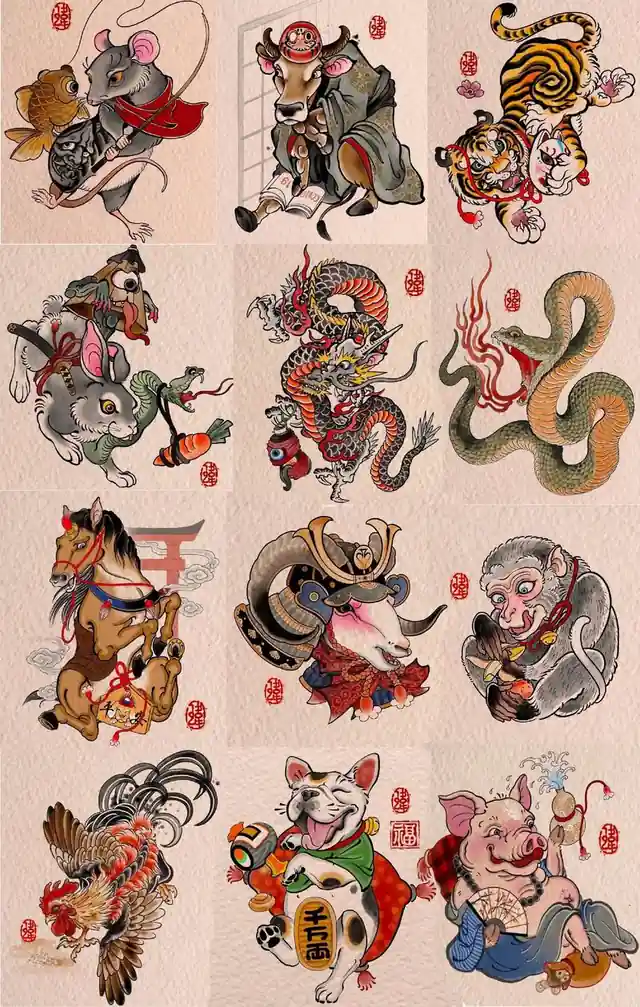
As cultural exchanges and interactions between countries around the world have increased, China's zodiac culture has gradually spread outward. During this process of dissemination beyond China's borders, some aspects of Chinese zodiac culture have retained their original form, while others have undergone various transformations due to differences in living environments and regional conditions.
China has been a land of etiquette and ritual since ancient times, and throughout history, it has mostly implemented moderately lenient ethnic and national policies. In addition to frequent cultural exchanges among China's various ethnic groups, other countries and peoples also engaged in mutual cultural exchange and absorption with China's ethnic groups. The zodiac culture is one important aspect of this.
The influence of Japanese zodiac culture.
The green pheasant (also known as the golden pheasant) is the national bird of Japan. Both China and Japan share a cultural belief in the golden rooster, yet the two nations have developed different or even contrasting cultural imprints. In China, the golden rooster is not only an auspicious omen that brings wealth but also carries deeper cultural connotations of aiding the good, rescuing the poor, upholding justice, and punishing evil and greed. In Japan, however, the value of the golden rooster has been simplified to merely symbolizing good fortune and wealth. When the Chinese belief in the golden rooster was transmitted to Japan, its moral value orientation was discarded by the Japanese. This variation in the reverence for the golden rooster in Japan also highlights the immense power of cultural confidence, self-strengthening, and reinvention in China and Japan when absorbing foreign cultures.
Additionally, Japan's zodiac signs are generally consistent with China's in both types and order. The difference is that in Japanese, when reading the twelve Earthly Branches, "Zi" is pronounced as "rat," "Chou" as "ox," and so on. It is evident that Japan has gone even further than China in integrating the Earthly Branches with the zodiac animals.
The Influence on Thai Zodiac Culture
When the culture of the Chinese zodiac was introduced to Thailand, the order of the zodiac animals underwent a certain change: Snake, Horse, Goat, Monkey, Rooster, Dog, Pig, Rat, Ox, Tiger, Rabbit, and Dragon. Thailand also adapted the Chinese Ganzhi (Heavenly Stems and Earthly Branches) and zodiac year-counting system. They refer to the twelve-year cycle of the zodiac as the Small Cycle Year-Counting Method, in contrast to the Large Cycle Year-Counting Method. The Large Cycle operates on a sixty-year period, using neither the Heavenly Stems nor the Earthly Branches; instead, it directly names the zodiac animals and pairs them with the numbers one through ten. The starting year is Snake Year One, followed by Horse Year Two, Goat Year Three, and so on, up to Ox Year Nine and Tiger Year Ten. After that comes Rabbit Year One, Dragon Year Two, Snake Year Three, Horse Year Four, and so forth. Each zodiac animal appears five times, and each number cycles six times, ultimately concluding with Rabbit Year Nine and Dragon Year Ten. After sixty years, a new Large Cycle begins again with Snake Year One. This is clearly a transformed application of the Chinese Ganzhi year-counting system.
The Influence on Vietnamese Zodiac Culture
Vietnam's twelve zodiac animals were also introduced from China and are largely the same, except that "Rabbit" was replaced with "Cat." It is said that this substitution occurred due to a translation error at the time: the Mao (卯, Earthly Branch for Rabbit) sounded similar to "Cat" in Vietnamese, so the translator misheard it, and the mistake was passed down, persisting to this day.
The influence of the Chinese zodiac on Myanmar's twelve zodiac animal culture.
Myanmar's zodiac system is unique within Southeast Asia. While absorbing Chinese zodiac culture, the Myanmar people made significant modifications and adaptations. They transformed the twelve zodiac animals into eight zodiac animals, each paired with a celestial body, arranged in order from Monday to Sunday. For example, Monday is associated with the Sun, and those born on this day are symbolized by the Tiger; Tuesday is associated with Mars, and those born on this day are symbolized by the Lion; Wednesday morning is associated with Mercury, and those born during this time are symbolized by the Double-Tusked Elephant; Wednesday afternoon is associated with Ketu, and those born during this time are symbolized by the Tuskless Elephant.
Of course, in traditional Chinese folk culture, the zodiac culture is not simply about twelve animals. Instead, it contains profound historical and cultural connotations. The twelve zodiac signs include twelve animals, but these twelve animals alone do not necessarily constitute the zodiac culture. It is precisely for this reason that zodiac culture has been able to spread and flourish worldwide. With its overseas dissemination, the Chinese zodiac has become not only a cultural heritage of the Chinese people but also a shared cultural treasure for the entire world.
Further Reading
Records of the Cambodian zodiac in ancient Chinese books
During China's ancient history, Cambodia was known as Zhenla. During the Yuanzhen era of Emperor Chengzong's reign in the Yuan Dynasty (1295-1297 CE), the scholar Zhou Daguan accompanied an envoy to Zhenla and compiled a record of local Cambodian customs and traditions titled "Zhenla Fengtu Ji" (A Record of Zhenla: The Land and Its People). This work includes an account of the Cambodian zodiac, stating: "The twelve zodiac animals are the same as in China, but their names differ. For example, the Horse is called 'Bose,' the Rooster is called 'Man,' the Pig is called 'Zhilu,' and the Ox is called 'Ge,' among others." This record reveals that Cambodian zodiac culture, while absorbing Chinese zodiac traditions, incorporated its own local characteristics. It demonstrates the enduring vitality and strong integrative power of Chinese zodiac culture, as well as its profound influence on other countries, particularly neighboring ones.