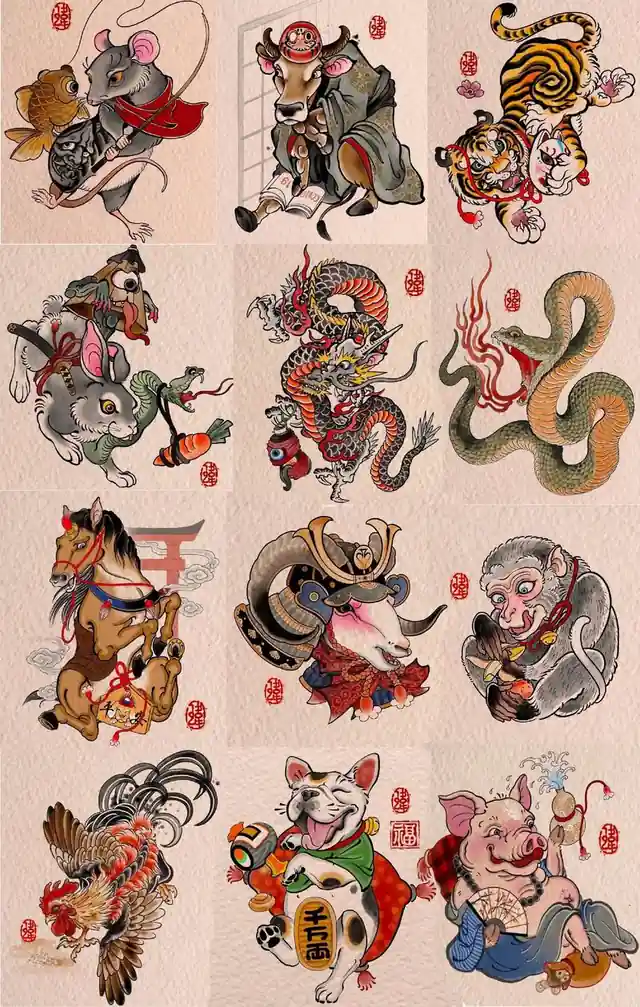
The popularity of zodiac culture lies in its widespread adoption and promotion by the Chinese people, with the role of intellectuals in fueling its spread being particularly noteworthy. Through the works of literati and scholars, the literary forms of zodiac culture have become rich and diverse, earning widespread admiration and affection, and thus becoming a valuable treasure within the tradition of zodiac culture.
The reason why zodiac culture has thrived and endured for thousands of years without decline is due to China's diverse and vibrant forms of promotion, and it is also inseparable from the literary brilliance of poets and scholars. From ancient poetry to novels, and from lantern riddles to couplets, traces of the twelve zodiac animals can be found everywhere.
Ancient Poems About the Chinese Zodiac
Ancient Chinese scholars referred to poems written with the zodiac as the theme as "zodiac-style poetry." The most famous among such "zodiac-style poems" is undoubtedly "The Twelve Animal Poems" by Hu Yan of the Ming Dynasty, collected in "Lie Chao Shi Ji" (Poetry Anthology of Successive Dynasties): "The water rat drinks from the river yet the river never dries, the Cowherd and Weaving Maid find it hard to meet year after year. With bare hands one captures a fierce tiger on Southern Mountain, while the moon-gazing rabbit roams the vast sky. The black dragon keeps a pearl and rarely sleeps, adding feet to a drawn snake only brings trouble. When has an old horse ever grown horns? A ram butting a fence only tires itself in vain. Do not mock the Chu man who wears a monkey's cap, the rooster crower grows old alone in the forest. The dog butcher of Wuyang plies his trade in Pei's market, and the pig herder of Pingjin tends his swine east of the sea." The poet skillfully weaves legends and allusions related to the twelve zodiac animals into the verses, imparting knowledge about the zodiac while filling the poem with interest and readability, truly making it a classic zodiac poem.
The zodiac is also a favorite among ordinary people, who express their love through their own "zodiac poems" in their unique way: "The rat never keeps overnight grain, the water buffalo has a single hair plucked from its body. Trying to draw a tiger but ending up with something like a dog, the rabbit does not eat the grass near its own burrow. A heavenly dragon finds it hard to defeat a local snake, one must strike a snake at its vital spot. A good horse never turns back to graze on old grass, wool comes from the sheep's own back. A green-bellied monkey cannot be taught to behave, trying to steal a chicken only to lose the bait. When beating a dog, one must consider its owner's face, a thousand-year-old wild boar always loses its food." This zodiac poem has not undergone much artistic refinement; it simply strings together familiar zodiac customs and legends in the order of the twelve zodiac animals, reflecting the popular and entertaining nature of zodiac culture.
Zodiac Novels
A truly outstanding novel is not only a reflection of the author themselves but also a kaleidoscope of a dynasty and a society, showcasing the folk culture of a particular period, and the zodiac culture is undoubtedly a very important aspect of it.
Jin Ping Mei (The Plum in the Golden Vase), one of the "Four Great Masterpieces of the Ming Dynasty," artistically reflects the daily life and customs of ordinary people during the Ming Dynasty (1368-1644). Its depictions of zodiac culture are particularly valuable resources for studying the Chinese zodiac today. In Jin Ping Mei, characters' ages are often revealed through their zodiac signs. For example, Shen Erjie says of herself, "I am an Ox, twenty-one years old," while Pan Jinlian states, "I have wasted twenty-five years, a Dragon," and so on, with countless such instances. Throughout the entire work, there are over twenty references to the zodiac, with more than one-third used solely to indicate age. Other contexts, such as fortune-telling and funeral rites, also frequently involve the zodiac.
As one of China's four great classical novels, "Dream of the Red Chamber" (Hong Lou Meng) is hailed as "an encyclopedia of Chinese feudal society," and it naturally includes depictions of zodiac culture. In the chapter "Jia Baoyu Visits the Land of Illusion," Baoyu browses the "Main Register of the Twelve Beauties of Jinling," where a poem reads: "The three springs are not equal to the early spring scene, when Tiger and Rabbit meet, the great dream ends." This line employs the taboo of the "Tiger and Rabbit meeting" from the Chinese zodiac, alluding to the tragic fate of Yuanchun among the "Four Springs."
Zodiac Lantern Riddles
In most parts of China, the Lantern Festival on the fifteenth day of the first lunar month features the tradition of displaying colorful lanterns, with lantern riddles being a highlight. Many of these riddles and their answers center on the twelve zodiac animals. In the book Guang Xiao Fu (Broad Treasury of Laughter) compiled by Feng Menglong of the Ming Dynasty (1368-1644), there is a zodiac lantern riddle that reads: "The moon hangs in the sky, a woman stands side by side, fire burns a goat's foot, a rooster stands by the water's edge." The answer is four characters: "You hao mei jiu" (meaning "there is fine wine"). Among them, the Rooster corresponds to the Earthly Branch You, so "a rooster stands by the water's edge" forms the character "jiu" (wine).
As society develops, people's cultural lives become increasingly enriched. In everyday games or various art forms such as skits and crosstalk, people often use zodiac riddles to add fun. The famous crosstalk performing artist Ma Sanli once presented a classic riddle: "Among twelve brothers, I am the seventh; push down four and six to get twenty-one." This riddle refers to his own name: among the twelve zodiac animals, the Horse ranks seventh, while "push down four and six to get twenty-one" forms the two characters "Sanli" (three and stand). The riddle is vivid and engaging, capturing people's interest.
Zodiac Couplets
Zodiac couplets are easy for viewers to remember, appealing to both refined and popular tastes, and are often talked about with great interest. The content of zodiac couplets can be written in various ways: they may feature only one zodiac animal, such as "The cowherd on the fragrant grassland awaits the auspicious year of the Ox," or embed two zodiac animals as New Year couplets marking the transition from the old to the new, like "The east wind sends the Tiger back to the mountains, while the bright moon leads the Rabbit to welcome the spring."
In traditional opera scripts and emerging song lyrics, elements of zodiac culture are also reflected to varying degrees. By embedding zodiac culture into various literary forms such as poetry and novels, it not only enriches literary themes but also endows zodiac culture with profound national cultural connotations.
Further Reading
Cleverly offering birthday wishes through zodiac couplets.
Once, the famous Southern Song Dynasty poetess Li Qingzhao and her husband Zhao Mingcheng were invited to the birthday banquet of an elderly man surnamed Wu in Qingzhou. During the feast, the guests asked the couple to compose a couplet to celebrate the old man's birthday. Zhao Mingcheng, intending to challenge his wife, wrote the first half of the upper line "The turtle is indeed surnamed Wu" and the first half of the lower line "The rat is also called old." Li Qingzhao, with her exceptional poetic talent, thought for a moment and completed the couplet: "The turtle is indeed surnamed Wu, its longevity rivals the sun and moon, with high age and virtuous glory; The rat is also called old, the peony heralds wealth and honor, with national beauty and heavenly fragrance." In the couplet, "rat aunt" (shu gu) is an alternative name for the peony flower. The upper and lower lines were ingeniously conceived and humorously witty, simultaneously wishing the birthday celebrant a long life and praising his noble character, while cleverly incorporating the character "Wu Lao" (Old Wu). Upon hearing this, the entire gathering erupted in applause and praise.