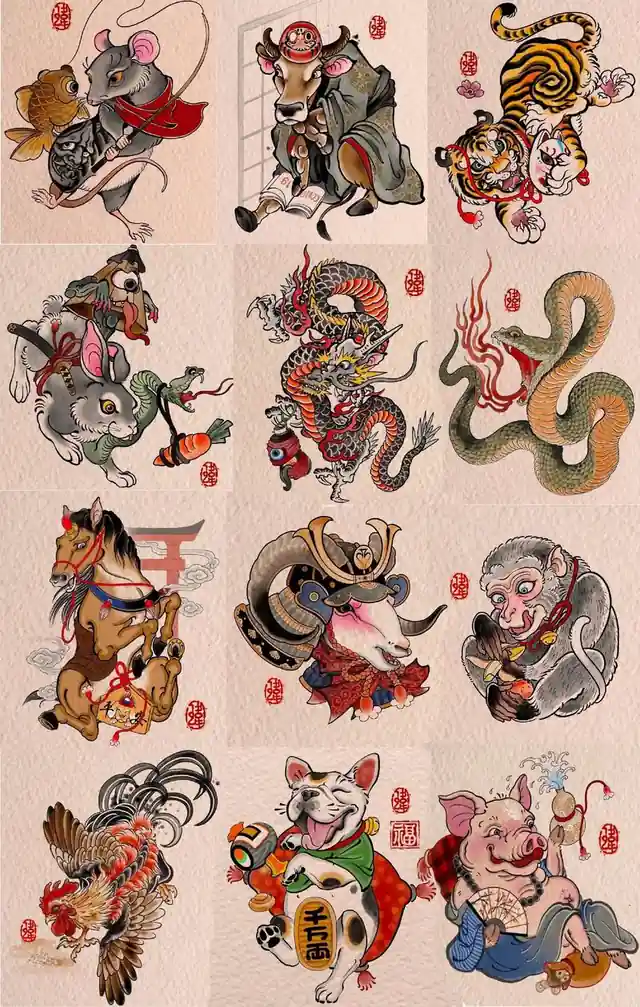
There are various theories about the origin of the Chinese zodiac, and the question of who first recorded the zodiac and in which book has naturally become a hot topic of discussion. As people's research into traditional zodiac culture has become increasingly in-depth and comprehensive, breakthrough achievements have also been made regarding the earliest recorded references to the zodiac.
Based on historical records, people during the Qing Dynasty (1644-1912) began discussing the earliest recorded origins of the Chinese zodiac. The Qing scholar Zhao Yi, in volume 34 of his work "Gaixu Congkao (Miscellaneous Examinations from the Hall of Rest)," argued that the system of twelve zodiac animals originated during the Eastern Han Dynasty (25-220). Consequently, many regard Wang Chong's "Lunheng (Discourses Weighed in the Balance)" from the Eastern Han Dynasty as the earliest document recording the twelve zodiac animals. The "Wushi (On Things and Their Forces)" chapter of Lunheng records: "Yin corresponds to wood, and its animal is the Tiger. Xu corresponds to earth, and its animal is the Dog... Wu corresponds to the Horse. Zi corresponds to the Rat. Mao corresponds to the Rabbit. Hai corresponds to the Pig..." This passage lists only eleven zodiac animals, notably missing the Dragon. Wang Chong also records in the "Yandu (On Poisons)" chapter of Lunheng: "Chen corresponds to the Dragon, Si corresponds to the Snake, and the positions of Chen and Si lie in the southeast." Zhao Ye of the Eastern Han Dynasty also recorded in his work "Wu Yue Chunqiu (Spring and Autumn Annals of Wu and Yue)": "Wu corresponds to Chen, and its animal is the Dragon." Thus, this completes the set of twelve zodiac animals, with the pairing of the Twelve Earthly Branches and the twelve zodiac animals already highly refined, differing very little from the popular version widely circulated today.
As time passed and research deepened, people's discoveries continued to increase. In 1970, archaeologists unearthed a batch of Qin Dynasty bamboo slips from Shuihudi in Yunmeng, Hubei, which contained relatively complete records of the twelve zodiac animals. Among these Qin slips were two versions of "Rishu" (Day Books), and one section titled "Daozhe" (The Thief) on the back of a certain "Rishu" recorded the twelve zodiac animals. According to research, the bamboo slips of "Rishu" were likely written before Qin Shi Huang's ascension to the throne, pushing the record back nearly 300 years earlier than that in "Lunheng" (Discourses Weighed in the Balance). In the Qin slip records, all twelve Earthly Branches were complete, except for the "Chen" branch, where the zodiac animal was omitted due to a copying error. The remaining eleven branches were marked with zodiac animals: "Zi, the Rat. Chou, the Ox. Yin, the Tiger. Mao, the Rabbit. Chen. Si, the Snake. Wu, the Deer. Wei, the Horse. Shen, the Ring. You, the Water. Xu, the Old Goat. Hai, the Pig." The five zodiac animals — Zi Rat, Chou Ox, Yin Tiger, Mao Rabbit, and Hai Pig — recorded in the Qin slips are consistent with modern ones. Meanwhile, the three items "Si, the Snake," "Shen, the Ring," and "You, the Water" are similar to Si Snake, Shen Monkey, and You Rooster. The remaining three items differ from today's zodiac. There is no consensus on this in the academic community. Regardless, after the excavation of the Qin bamboo slips from Shuihudi in Yunmeng, Hubei, the pioneering advantage of the twelve zodiac records in "Lunheng" was suddenly surpassed.
Most contemporary scholars believe that the earliest records of the Chinese zodiac are found in the "Classic of Poetry" (Shijing), China's first collection of poems. For example, the poem "Ji Ri" (Auspicious Day) includes the line: "On the auspicious day Gengwu, we harnessed my horses." The Warring States period poet Qu Yuan also begins his poem "Li Sao" (Encountering Sorrow) with: "Born on the year of Tiger (Yin) in the first month (Zou) on the day of Gengyin," indicating that his birth occurred during the Yin year, Yin month, and Yin hour. Additionally, the "Liji" (Book of Rites) in the chapter "Yueling · Jidong" (Monthly Ordinances · Last Month of Winter) records: "They brought out an earthen ox to send off the cold air."
Archaeologists have also discovered that as early as the oracle bone inscriptions of the Shang Dynasty and bronze inscriptions, there were already tables of the Heavenly Stems and Earthly Branches, as well as examples of their use. This suggests that the eras in which the Qin bamboo slips and Lunheng (Discourses Weighed in the Balance) were produced may not necessarily represent the earliest records or origins of the Chinese zodiac. It is believed that as research deepens and technology advances, new discoveries will surely emerge regarding the origins of the twelve zodiac animals and their earliest documented evidence.
Further Reading
A summary of the earliest records of the Chinese zodiac.
The renowned modern literary critic and folklorist Yang Mengshen, in his book "Shiwu Zhanggu Congtan" (Collected Discussions on the Origins of Things), compiled the earliest records related to the origin of the Chinese zodiac and provided a relatively detailed documentation and organization. These can be broadly categorized into the following types:
First, the theory of the twelve Earthly Branches paired with the twelve zodiac animals is represented by Wang Chong's Eastern Han Dynasty works Lunheng (Discourses Weighed in the Balance), specifically the chapters "Wushi" (On the Power of Things) and "Yandu Pian" (On the Poison of Words), as previously discussed.
Second, the Northern Ethnic Origin Theory first appeared in "Chunfengtang Random Notes" (Spring Breeze Hall Essays) by Lu Shen of the Ming Dynasty (1368-1644): "Among the Northern Di barbarians, each year is designated by one of the twelve zodiac animals. Terms such as 'Dog Year' and 'Goat Year' — are these not all barbarian terms?"
Third, the theory of Indian origin states in the Buddhist scripture "Mahāsaṃnipāta Sūtra" (Great Collection Sutra): "Outside Jambudvīpa, in the four seas, there are twelve animals, all of which are manifestations of bodhisattvas guiding sentient beings. When a human is first born, they correspond to the cave where a bodhisattva dwells, and thus this animal protects and benefits them. Therefore, the twelve earthly branches of the Han region follow this practice."
Fourthly, the theory of odd and even numbers of animal feet, which is already reflected in the Song Dynasty book "Jia Gong Xuan" (Family Public Selection).
Fifth, the theory of temperament first appeared in the Ming Dynasty (1368-1644) scholar Lang Ying's compiled work "Qixiu Leigao" (Classified Manuscripts of Seven Revisions).
Sixth, the theory of physical defects: Li Changqing stated in his work "Songxia Guan Zhui Yan (Supplemental Discourses from the Pine Cloud Pavilion)" that "The Rat has no incisors, the Ox has no front teeth, the Tiger has no spleen, the Rabbit has no lips, the Dragon has no ears, the Snake has no feet, the Horse has no gall bladder, the Goat has no pupils, the Monkey has no buttocks, the Rooster has no kidneys, the Dog has no intestines, and the Pig has no sinews — each of the twelve zodiac animals is inherently incomplete."