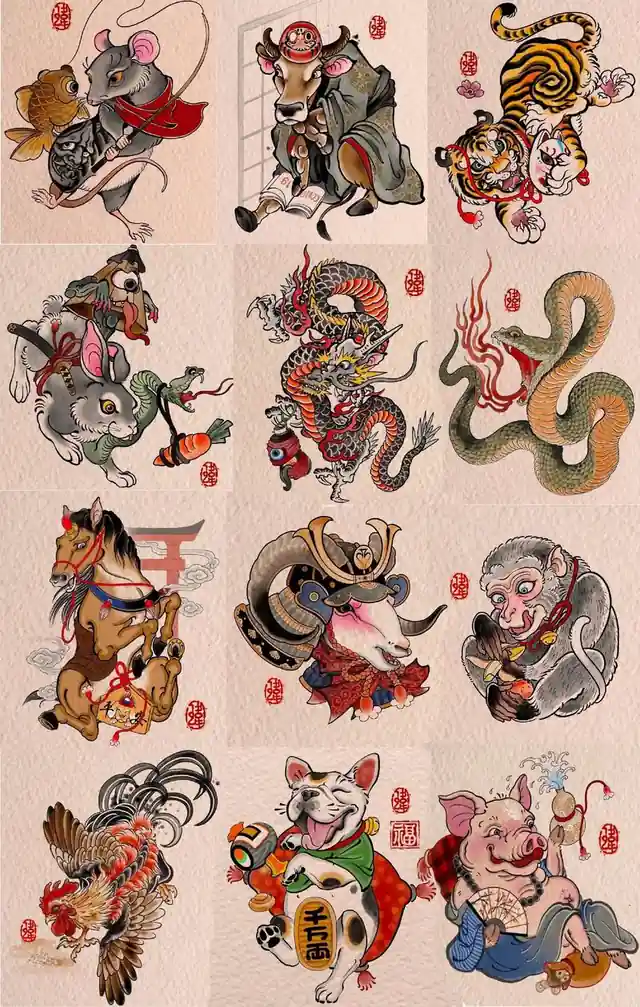
Across the vast landscape of China, the zodiac is not exclusive to the Han people; China's ethnic minorities also possess their own zodiac cultures, fully demonstrating the diversity of Chinese zodiac culture and highlighting the brilliant charm of traditional Chinese zodiac culture.
Since ancient times, China has been a country of multi-ethnic development. Each ethnic minority group has its own long history, as well as cultural customs rich in local characteristics, and the zodiac culture is no exception. The twelve zodiac signs of some ethnic minorities within China, such as the Mongolians and parts of the Yi ethnic group, have been greatly influenced by Han Chinese culture and are basically consistent with those of the Han. Due to differences in living environments and familiar species, when selecting zodiac animals, ethnic minorities often choose animals that are most closely related to their own ethnic group, thus bringing certain differences to the zodiac culture. In addition, ethnic minorities have also developed their own distinct methods of using zodiac signs to mark years and days, resulting in a rich variety of festivals and customs.
The Dai ethnic group's twelve zodiac animals.
Among the Dai ethnic group living in areas such as Xishuangbanna, the zodiac sign for Hai (the twelfth Earthly Branch) is not the Pig but the Elephant. The Dai people pair the twelve zodiac animals with the Earthly Branches, using them not only to mark years but also to mark months and days. In the Dai calendar, "bone" corresponds to the Han Chinese "year," "blood" to "month," and "skin" to "day." For example, what they call "Zi Year Rat Bone" means "Zi Year Rat Year," "First Month Rat Blood" means "First Month Rat Month," and "Shen Day Monkey Skin" means "Shen Day Monkey Day," and so on. It is evident that after the Han Chinese twelve zodiac animals were introduced to the Dai people, their application became far more extensive than among the Han Chinese.
The Li ethnic group's twelve zodiac animals include the Rat, Ox, Tiger, Rabbit, Dragon, Snake, Horse, Goat, Monkey, Rooster, Dog, and Pig.
The Li ethnic group living in Hainan Province has a unique Chinese zodiac sequence: Rooster, Dog, Pig, Rat, Ox, Insect, Rabbit, Dragon, Snake, Horse, Goat, and Monkey, starting with Rooster and substituting Insect for Tiger. Meanwhile, the Li people residing in Maodao Township, Baoting County, Hainan Province (the Maodao Li) follow a different zodiac order: Rat, Ox, Insect, Rabbit, Dragon, Fish, Meat, Human, Monkey, Rooster, Dog, and Pig.
The Yi ethnic group's twelve zodiac animals.
The Yi ethnic group living in the Liangshan region of Sichuan Province uses the twelve zodiac animals to mark years, months, and days, though the animal designated as the first month varies by location. In some areas, the Goat month is considered the first month, in others the Horse month, and in still others the Monkey month. Among the Yi people of the Ailao Mountains, the pangolin replaces the Dragon in the twelve zodiac sequence. The Yi residing in the border region of Yunnan, Guizhou, and Sichuan provinces still preserve their traditional customs. On Tiger days, they hold Tiger Street markets, and on Pig days, they hold Pig Street markets. In some places, there are temples dedicated to the twelve zodiac animals, where annual sacrificial ceremonies are held, accompanied by lively performances of the Twelve Spirit Dance.
The Tibetan Chinese Zodiac
According to legend, the Tibetan zodiac calendar system was introduced in the 7th century CE when Princess Wencheng of the Tang Dynasty brought it to Tibet upon her marriage to Songtsen Gampo. Therefore, it shares many similarities with the Chinese zodiac. The Tibetans also use a sixty-year cycle, which corresponds to the Han Chinese sexagenary cycle (Jiazi year). The first year of each sixty-year cycle is called "Huideng," meaning Wood Rat, which is the Year of the Rat. The Tibetan zodiac calendar uniquely combines the concepts of Yin and Yang, the Five Elements (Wood, Fire, Earth, Metal, Water), and the Ten Heavenly Stems: Jia and Yi correspond to Wood, Bing and Ding to Fire, Wu and Ji to Earth, Geng and Xin to Metal, and Ren and Gui to Water. In each pair, the former is Yang and the latter is Yin. Additionally, the Tibetan calendar uses male and female to represent Yin and Yang respectively. For example, the Yin Metal Ox Year is also called the Female Metal Ox Year, while the Yang Water Tiger Year is also called the Male Water Tiger Year.
The Naxi ethnic group's twelve zodiac animals.
The Naxi people living in Yunnan Province use the twelve zodiac animals to mark days and also assign directions to them, a method that is very unique. They divide the twelve months of the year into long months and short months, with each month having 30 days. On the first day of odd-numbered months, they start with the Monkey day, then follow the sequence of Monkey, Rooster, Dog, Pig, Rat, Ox, Tiger, Rabbit, Dragon, Snake, Horse, and Goat, continuing until the 29th day of the odd-numbered month, which is the Rat day. When entering an even-numbered month, they skip the first day, which is not set as the Ox day; instead, they bypass the Ox day and designate it as the Tiger day.
Further Reading
Ethnic minorities name their children after the Chinese zodiac animals.
In some ethnic minority regions, the Chinese zodiac is not only used for recording years but also for naming newborns. For example, the Hani people in Yunnan name their children based on the zodiac sign of their birth hour. If a child is born during the hour of the Ox, the name begins with the character "Niu" (ox), such as "Niushan". The Pumi people in Yunnan also incorporate zodiac animals into names. A person born in the Year of the Rooster might be called "Luoci" (male) or "Luomi" (female), where the name indicates both gender and zodiac sign. Among the Qiang people, it is common to name children after their zodiac animal. For instance, "Zemuzi" means a girl born under the sign of the Goat, "Biemuzi" means a girl born under the sign of the Pig, "Biemuji" means a boy born under the sign of the Pig, and "Hemuji" means a boy born under the sign of the Tiger. In Miao-inhabited areas, shamans typically name children according to their birth date. For example, a child born on a Chou day (associated with the Ox in the Earthly Branches) might be named "Water Buffalo" or "Field", drawing on the concept that Chou corresponds to the Ox, and the Ox plows the fields.