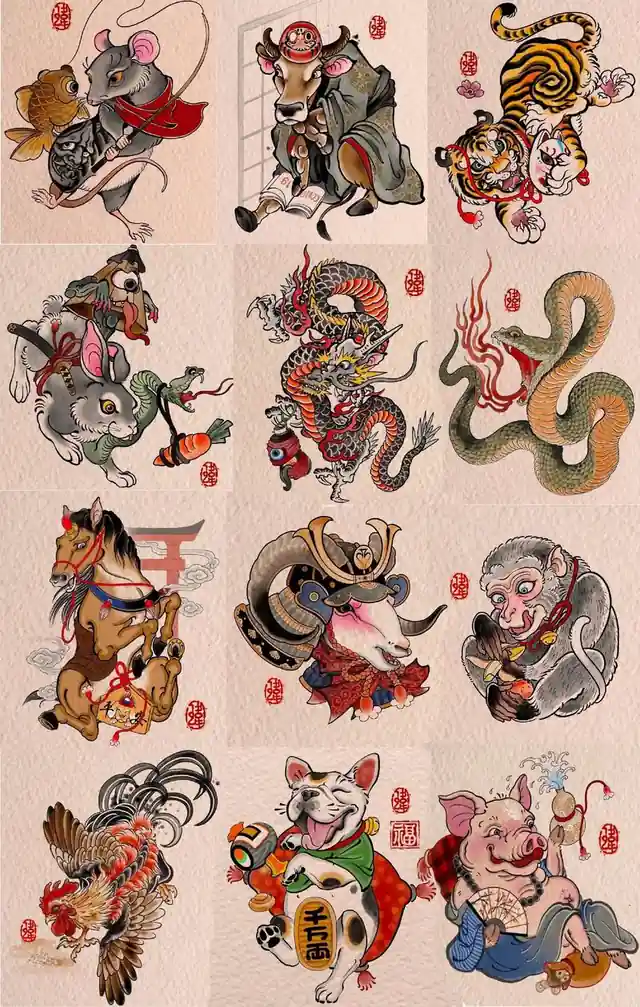
According to historical records, the Chinese zodiac has existed for two thousand years. Over the course of history, the names of the twelve zodiac animals have varied, reflecting changes in people's understanding across different historical periods as well as the unique cultural and historical backgrounds of various dynasties.
The Chinese zodiac, also known as Sheng Xiao or Shu Xiang, represents the years and a person's birth date in China. Each of the twelve zodiac signs corresponds to one year, forming a complete cycle every twelve years. The twelve zodiac animals consist of real-world creatures — Rat, Ox, Tiger, Rabbit, Snake, Horse, Goat, Monkey, Rooster, Dog, and Pig — along with the legendary Dragon.
Throughout the long history of the Chinese nation, the names of the twelve zodiac animals have continuously evolved and changed. From the various alternative names and appellations of the "Twelve Zodiac Animals" in different historical periods, we can clearly understand the history of their development and transformation, and feel the brilliance and splendor of zodiac culture.
During the Han Dynasty and most periods before it, people generally referred to animals collectively as "qin" (creatures or beasts), and virtually any animal seen in daily life could be called by this term. In the "Discussion of Creatures" chapter of Lunheng (Discourses Weighed in the Balance) by the Eastern Han scholar Wang Chong, when discussing the four symbols and the twelve zodiac animals, it states: "Using the four beasts for verification, the twelve earthly branches' creatures correspond accordingly." The "twelve earthly branches' creatures" mentioned here refer to the twelve zodiac animals.
During the Sui and Tang dynasties, political, economic, and cultural development reached a peak in Chinese feudal society, and references to the twelve zodiac animals began to increase. In the Sui Dynasty, Wang Du described the bronze mirror inscriptions featuring zodiac patterns in his work "Gu Jing Ji" (Record of the Ancient Mirror), referring to the twelve zodiac animals as the "Twelve Chen Beasts." In the Tang Dynasty, the book "Shi Shi" (Origins of Things) introduced the term "Twelve Beasts." Han Yu and Liu Zongyuan, the leading figures of the "Eight Great Prose Masters of the Tang and Song Dynasties," often referred to the twelve zodiac animals as the "Twelve Spirits" in their literary works. During most of this period, relatively lenient ethnic policies were implemented, and as cultural exchanges between the Han and other ethnic groups intensified, some zodiac traditions from minority groups gradually spread into Central China. According to the "Xin Tang Shu: Huihe Biography, Part Two" (New History of the Tang Dynasty: Uyghur Records), it is recorded: "The Xiajiasi people are from the ancient Jiankun state... They use twelve objects to mark the years, such as when the year has Yin, they call it the Tiger Year." The "twelve objects" in this context refer to the twelve zodiac animals.
During the Song Dynasty, the twelve zodiac animals were roughly referred to by two names: "Twelve Insects" and "Twelve Hours." Su Zhe, while keeping vigil on New Year's Eve, lamented the shifting of constellations and the fleeting passage of time, composing a poem titled "Shou Sui (Keeping Vigil on New Year's Eve)": "Wutu (the tiger) breaks the rope and departs, the Gu Rabbit (rabbit) chases after the Dragon and Snake. Running and scurrying, the Twelve Insects cannot be stopped by nets." The poet noted in his own annotation, "This year is Renyin (a year of the Water Tiger)." In ancient times, people of the Chu region called the tiger "Wutu," and "Wutu breaks the rope and departs" signifies the end of the Tiger year. Thus, "Twelve Insects" refers to the twelve zodiac animals. In the Song Dynasty, Li Pu referred to the twelve zodiac animals as the "Twelve Hours" in his work "Wudai Huiyao (Essential Regulations of the Five Dynasties)": "For funerals of civil and military officials and commoners, those of the third rank and above are allowed ninety funerary objects, including the Four Spirits and the Twelve Hours."
By the Qing Dynasty, the term "Twelve Earthly Branch Animal Symbols" (shier chen qin xiang) came into use. In Volume 2 of "Xingli Kaoyuan" (Investigations into the Origins of Calendrical Calculations), compiled by Li Guangdi and others by imperial decree, it states: "The Twelve Earthly Branch Animal Symbols are: Zi Rat, Chou Ox, Yin Tiger, Mao Rabbit, Chen Dragon, Si Snake, Wu Horse, Wei Goat, Shen Monkey, You Rooster, Xu Dog, and Hai Pig." Notably, during this period, the more familiar term "Twelve Corresponding Animals" (shier xiang shu) also emerged. In his work "Gaiyu Congkao" (Collected Investigations from the Retired Scholar), Zhao Yi of the Qing Dynasty includes an entry titled "The Twelve Corresponding Animals Originated in the Later Han Dynasty."
During the Republic of China period, the concept of the "Twelve Branch Spirits" (Shi'er Zhi Shen) was also proposed. The book "Chinese Mingqi" (Chinese Funerary Objects), published at that time, suggested that the Eastern Han Dynasty zodiac portrait bricks were "the origin of the later Twelve Branch Spirits in funerary objects," and the Twelve Branch Spirits are the twelve zodiac animals.
The various appellations of the twelve zodiac animals contain traces of cultural development across successive dynasties, harbor the historical transformations of folk customs, and profoundly bear the infinite mysteries of traditional zodiac culture. From the evolution of the zodiac names, one can observe the deep historical and cultural origins of zodiac culture, as well as the developmental journey of the Chinese national language.
Further Reading
Classification of the Chinese Zodiac
Based on the origins of the Chinese zodiac and their relationship with humans, the twelve zodiac animals can be broadly divided into three main categories. The first category consists of the "Six Domestic Animals" that have been domesticated by humans: the Ox, Goat, Horse, Pig, Rooster, and Dog. These animals were tamed by early humans for survival or other purposes, accounting for half of the twelve zodiac animals. In traditional Chinese thought, the "prosperity of the six domestic animals" symbolizes flourishing family lineage, good fortune, and cherished wishes. The second category includes wild animals that are well-known to people and closely related to their daily lives: the Tiger, Rabbit, Monkey, Rat, and Snake. Among these are the Tiger and Snake, which people hold in awe and fear; the Rat, which people dislike and avoid yet depends on humans for survival; and the Rabbit and Monkey, which are beloved by people. The third category is the Dragon, a traditional Chinese symbolic mascot. The Dragon is a "man-made creation" that integrates the characteristics of many animals, an imagined spiritual creature representing wealth, nobility, and good fortune.