
Fuxi is also known as Mixi, Paoxi (or Paoxishi), and Fuxi, while Xihuang, Huangxi, Taihao, and Baoxi also refer to the same figure; in the Records of the Grand Historian, the name Fuxi is used. Fuxi lived around the middle to late Neolithic period and, along with Shennong and the Yellow Emperor, is revered as one of the three primordial ancestors of the Chinese nation—the "Three Sovereigns." According to legends and historical records, Fuxi was one of the earliest kings in China, and his activities mark the beginning of Chinese civilization, earning him the title of the foremost of the Three Sovereigns. Numerous myths and legends about Fuxi have been passed down.
According to legend, Fuxi was born in a land like a paradise, and his mother was a beautiful woman named Huaxu. One day, when the weather was fine and the breeze gentle, Huaxu went out for a stroll and arrived at a vast marsh. This place was filled with exotic flowers and rare plants, with swirling mists in the middle, creating a breathtaking scene. This was the territory of the Thunder God, known as "Thunder Marsh." The Thunder God had a dragon's body and a human head, and he produced booming thunder by drumming his abdomen. Huaxu came here and was captivated by the beautiful scenery. As she walked along, she saw a huge footprint on the ground, strange in shape. She thought, since this was the Thunder God's domain, this enormous footprint must undoubtedly belong to him. Out of curiosity, Huaxu involuntarily stepped onto it. Suddenly, she felt a daze, her body grew hot, as if she were being coiled by a snake, and she could not move her feet. It was a long while before she could step out of that large footprint.
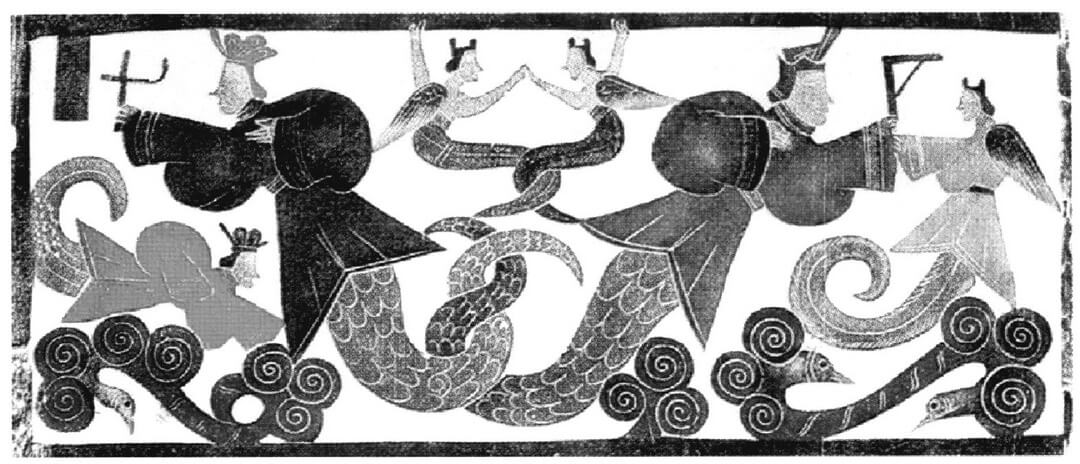
Shortly after returning, Huaxu became pregnant and later gave birth to a boy with a human head and a serpent's body. Since Huaxu conceived after stepping in the footprints of the Thunder God, and the child had a human head and a serpent's body, it was clear he was the Thunder God's son. Huaxu named him Fuxi. As a demigod born from the union of a human and a deity, Fuxi was exceptionally intelligent from a young age.
After Fuxi grew up, Huaxu passed away. At this time, Fuxi decided to leave his birthplace and travel abroad. As he journeyed eastward, he carefully observed all kinds of phenomena along the way, whether it was the movement of stars, birds, beasts, insects, or fish, without exception.
He saw fishermen catching fish with their bare hands in the water and hunters risking their lives to chase prey, yet despite all their hard work, they gained very little. Fuxi then wondered how he could improve this situation. However, he did not stop moving. He walked for a long time until he felt tired and lay down to rest under a tall tree. Soon, he fell asleep and dreamed that he had ascended to heaven, where a voice told him that both the celestial realm and the human world needed a wise and sagely person to transform them, and that he was that person. After waking up, Fuxi pondered the voice in his dream and then continued on his journey of exploration.
When he arrived in the Central Plains, seeing the people's hard life deeply moved him, and he decided to end his travels and stay to help them.
Once, Fuxi saw a spider weaving a web and was deeply inspired. He imitated the spider by tying ropes into knots to create large nets—those with wide mesh were used to catch wild animals, while those with fine mesh were used to catch fish. With these nets, the people's harvest from fishing and hunting greatly increased. When they caught more fierce beasts than they could eat, they began to pen them up, and thus people started to domesticate animals. Additionally, Fuxi invented musical instruments such as the qin and se, composed music, and brought melodies into people's lives. He also created written characters for recording events, ending the practice of keeping records by tying knots. Furthermore, he reformed marriage customs, promoting the etiquette of men proposing and women marrying, which put an end to the primitive state of group marriage.
With the help of Fuxi, people's lives became much more prosperous than before, and their quality of life greatly improved. To express their gratitude to Fuxi, the people of all tribes unanimously elected him as their common sacred leader. He thus became the first true tribal alliance leader, or the first king.
However, Fuxi's greatest contribution was inventing the Eight Trigrams based on the principles of yin and yang changes in heaven and earth, giving profound meaning to eight simple symbols to summarize the transformations of all things in the universe. According to legend, the place where Fuxi drew the Eight Trigrams is called Guatai Mountain. Under Fuxi's governance, the world enjoyed a peaceful and prosperous era, and heaven even sent auspicious signs to reward Fuxi.
One day, Fuxi received a report that a strange animal had appeared on Guatai Mountain, with a dragon's head and a horse's body, adorned with very unusual patterns. Fuxi hurried to see it, and upon arriving at Guatai Mountain, he indeed saw the dragon-horse. Fuxi had always enjoyed observing things, sometimes studying the footprints and patterns of birds and beasts. He noticed that the dragon-horse's body had many black and white spots, and upon closer inspection, these spots were arranged in a very orderly manner. The dragon-horse later leaped onto a large rock in the Wei River at the foot of Guatai Mountain, a rock shaped like the Taiji symbol, which complemented the patterns on the dragon-horse's body. Fuxi suddenly had a revelation, and after understanding it, he drew the Eight Trigrams.
The Eight Trigrams represent eight directions and symbolize the eight most representative natural phenomena: heaven, earth, water, fire, wind, thunder, mountains, and lakes. They reflect the waxing and waning of yin and yang, as well as the interdependent relationships among all things in the world, and are a hallmark of Fuxi culture. To this day, countless scholars both in China and abroad remain fascinated by them, exploring and researching their meanings. In modern times, many scientists have drawn inspiration from the trigrams, advancing scientific progress. It is said that the great German mathematician Gottfried Wilhelm Leibniz was inspired by the Eight Trigrams to invent the binary system.
Fuxi made great contributions to humanity, and to commemorate his birth, the locals renamed the place Chengji. The Book of Han records: "Chengji belonged to Hanyang Commandery, which was Tianshui Commandery. It was the birthplace of the ancient emperor Fuxi." In other words, Tianshui in Gansu is the ancient Chengji. Therefore, Tianshui, Gansu, is known as the "Hometown of Emperor Fuxi." Every year on the sixteenth day of the first lunar month, which is Fuxi's birthday, the city of Tianshui holds a Fuxi Cultural Festival.
According to legend, Fuxi had the head of a human and the body of a snake, and was the son of the Thunder God. However, throughout history, there have been many different accounts of Fuxi. Some say that in ancient times, Fuxi and Nüwa were siblings who married and gave birth to descendants, becoming the ancestors of humanity. Others claim that Fuxi was the true founder of Daoism, and that his human-headed, snake-bodied form was merely a symbol representing the "Dao," as it was the original form of the character for "Dao," and that he himself was not actually half-human, half-snake. Some scholars have also pointed out, regarding the "human head, snake body" description, that Fuxi belonged to a snake clan that revered snakes. The leaves or animal skins he wore were shaped like snake scales or patterns, serving as the clan's emblem or totem. Another theory holds that "Fuxi" was a title for outstanding leaders of the ancient Huaxia tribes, and that names like Mìxī, Páoxī, Bāoxī, Fúxì, or Xīhuáng, Huángxī, Tàihào all referred to tribal chiefs of the Fuxi lineage. These individuals lived in different eras but held the same status, so they could all be called "Fuxi."