
In the myths and legends of ancient times, Shennong is another legendary figure who made significant contributions to the Chinese nation. According to Sima Zhen's "Records of the Three Sovereigns," it is recorded: "Shennong, surnamed Jiang. His mother was named Nüdeng, a daughter of the Wawa clan... She conceived the Flame Emperor after being moved by a divine dragon, and he grew up by the Jiang River, ruling by the virtue of fire." Based on this, it is inferred that Shennong was the leader of a Jiang-surnamed tribe living in the Jiang River basin. The original meaning of the character "Jiang" is shepherd, indicating that this Jiang clan was originally a nomadic or semi-nomadic people; the "female" radical at the bottom suggests that this surname originated from the ancient matriarchal society.
According to legend, he taught people how to cultivate the five grains, invented farming tools, and passed on the techniques of pottery and weaving. Because of these remarkable achievements, he was revered as the God of Agriculture, also known as the Immortal of the Five Grains.Book of ChangesThe "Xici" records his achievements as follows: "After Baoxi passed away, Shennong arose. He carved wood to make plowshares and bent wood to make plow handles, teaching the world the benefits of plowing and weeding, drawing inspiration from the Yijing hexagram 'Yi.'" Legend has it that in ancient times, grains and weeds grew together, making it impossible to distinguish which were edible, and there was no stable yield. People had to survive by gathering grass seeds, wild fruits, and hunting birds and animals, but food sources were neither sufficient nor reliable, and people often went hungry.
The common people were suffering from hunger, and Shennong felt deeply distressed. One day, a bird covered entirely in red feathers flew down from the sky, carrying in its beak a colorful nine-eared grain stalk. As it passed over Shennong's head, the grain stalk fell to the ground. Shennong picked it up, and a few grains dropped into his hand. He put them in his mouth and chewed, finding them quite tasty. He buried the grain stalk in the soil, and before long, it grew into a small patch.
This inspired Shennong greatly: every year, plants would bear seeds, which fell to the ground and sprouted again the next year. So why not collect the seeds of edible plants, find a place to plant them, and wait for the next year's harvest to fill their stomachs? This way, year after year, people would always have food. At that time, wild grasses and grains grew together, so Shennong gathered various seeds, tasted each one, and if they were edible, he tried planting them. Through his careful selection and cultivation, he eventually discovered the five grains: rice, millet, broomcorn millet, wheat, and beans. He had people cut down trees, clear away wild grass, open up farmland, and spread the methods of planting these grains. He told them not to just wait after sowing but to work in the fields, and he invented tools like hoes and plows, teaching people how to use them. Recognizing the crucial role of water for crops, he also developed a well-irrigation system with nine interconnected wells, channeling water into fields to help crops grow better. From then on, people had agriculture, could produce food, and no longer went hungry.
The mythological legend of Shennong reflects the stage in China's primitive society when it transitioned from gathering and fishing-hunting to agricultural production. This figure introduced agriculture to primitive society and taught people farming techniques, earning him the revered title of Shennongshi. The Mencius, Liang Hui Wang I records: "Shennong... inherited the foundation of Paoxi and ruled by the virtue of fire." Ruling by the virtue of fire and naming officials after fire, another theory holds that Shennongshi is the same as the "Yan Emperor," one of the Three Sovereigns renowned for supreme virtue. In Jin Dynasty Wang Jia's Shiyi Ji, the legend of Shennong is recorded as: "During the time of Yan Emperor, a red sparrow carried a nine-eared grain stalk; where it fell to the ground, the Emperor picked it up and planted it in the fields, and those who ate it grew old without dying." Whether Shennongshi and the Yan Emperor are the same person has long been debated, and we will not delve into that, as our focus is on Shennongshi's contributions to humanity.
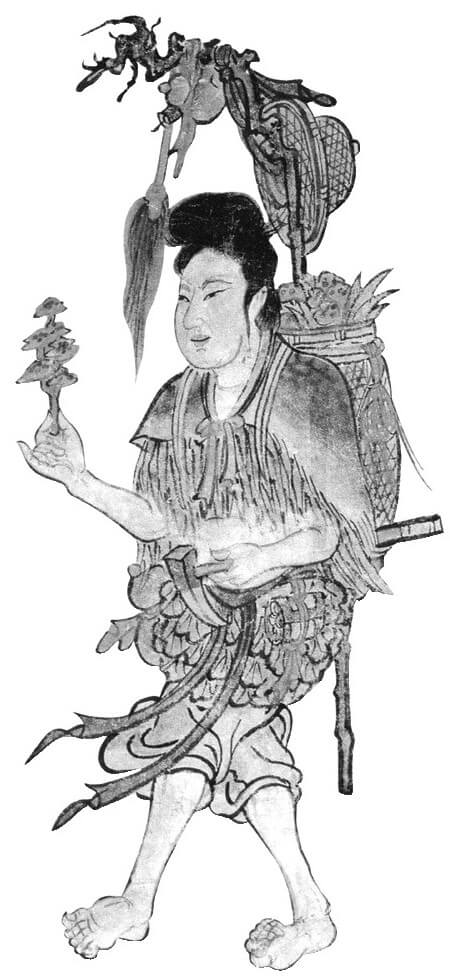
According to legend, besides inventing agricultural techniques, Shennong also tasted hundreds of herbs and invented medicine, making him the ancestor of medicine. The Records of the Grand Historian, Supplement to the Annals of the Three Sovereigns, records: "Shennong instituted the wax sacrifice, used a red whip to strike plants, tasted hundreds of herbs, and thus medicine began." The Huainanzi, Chapter on Cultivating Effort, states: "Shennong tasted the flavors of hundreds of herbs, encountering seventy poisons in a single day." The In Search of the Supernatural also writes: "Shennong used a red whip to strike hundreds of herbs, fully understanding their properties of balance, toxicity, cold, and warmth, as well as their flavors and effects, in order to sow the hundred grains." The myth of Shennong tasting hundreds of herbs has been passed down for ages and remains vibrant to this day.
Shennong selected the five grains and cultivated the land, allowing people to have enough food to eat, but some still suffered from poisoning by eating the wrong things, frequently fell ill, or got injured while fishing or hunting. When people fell sick, they had no idea how to alleviate their conditions and could only endure it—some recovered, while others died from their illnesses. Seeing his people tormented by disease, Shennong grew deeply anxious. He sought advice from many and tried various remedies, such as roasting with fire, dousing with water, and freezing, but none proved very effective, and sometimes they even worsened the illness.
Shennong set out from his hometown toward the great mountains with a few assistants and simple luggage. Traveling day and night, he finally arrived at the foot of the high mountains, his legs swollen and his feet blistered, yet he did not stop for a moment before beginning to climb. The mountains were covered with all kinds of exotic flowers and rare plants; whenever Shennong saw a plant, he would pick it, put it in his mouth to taste, and then record its characteristics, properties, the sensation in his mouth, and his body's reaction after ingestion.
Once, he had just put a blade of grass into his mouth and chewed it a couple of times when his body suddenly went numb, he lost consciousness, and collapsed to the ground. His assistant quickly helped him sit up. He knew he had eaten a highly poisonous plant, but his entire body was paralyzed, and he could not speak, so he mustered all his strength to raise his hand, pointing to a glowing red plant in front of him, then to his own mouth. The assistants quickly picked the red plant, chewed it, and fed it to him. As soon as Shennong ate this plant, the poison dissipated, his body was no longer numb, his dizziness cleared, and he could speak again. The plant Shennong used to neutralize the poison was the lingzhi mushroom, and from then on, people learned that lingzhi could revive the dying.
This time it was a close call, and although he knew that if he continued to taste, this danger would happen again, and perhaps next time he might not be so lucky, he still kept climbing over mountains and valleys, tasting every plant he came across. The mountain paths were winding and rugged, difficult to traverse, and because the vegetation was so dense that sunlight could not penetrate, many paths were covered with slippery moss, making it easy to fall into the valleys with one misstep. Moreover, deep in the mountains, besides poisonous plants, there were also venomous snakes and ferocious beasts lurking, making it extremely dangerous.
Once, deep in a mountain forest, Shennong was surrounded and severely bitten by several venomous snakes, leaving him gravely wounded, unconscious, and on the brink of death. The Queen Mother of the West in heaven, moved by his sacrifice of testing herbs to save humanity, sent a bluebird carrying her immortal elixir to the forest to detoxify him. The bluebird found Shennong and fed the elixir into his mouth, slowly reviving him. Seeing he was awake, the bird flew off to report back. Grateful for heaven's protection, Shennong loudly gave thanks. But as he opened his mouth, the elixir fell to the ground. Soon, a green herb sprouted there, topped with a red bead. Examining it closely, Shennong saw the bead was identical to the elixir, so he picked it and placed it in his mouth, instantly easing his pain and curing his poisoning. Overjoyed that he now had a remedy for snakebites, he named the herb "One Red Bead on Top," later renamed "Trillium" by pharmacologists.
In this way, he climbed one mountain after another, each time tasting all the herbs on the entire mountain before moving on to the next, identifying 365 types of medicinal herbs, recording their functions, and compiling the "Shennong's Classic of Herbal Medicine," so that when people fell ill, they could gather the appropriate herbs to treat their symptoms based on the illness. Later, while gathering herbs on a mountain, Shennong mistakenly tasted a poisonous "gut-breaking" herb and, unable to counteract its poison, died.
Shennong discovered the five grains for the people and also tested herbs on himself to invent medicine. To commemorate his great merits, various folk activities are held in many forms, including building temples for him and conducting sacrificial ceremonies from the fifth to the twentieth day of the first lunar month each year—it is said Shennong was born on the fifth day of the first lunar month, and these rituals also pray for bountiful harvests. In old times, pharmacies often enshrined a portrait of Shennong, in which he holds medicinal herbs, with thick eyebrows, big eyes, and a beaming smile.