
More than 3,000 years before the Common Era, numerous large and small primitive tribes and clans already existed across the land of China. These tribes constantly migrated in search of suitable places for production and daily life, and as a result, wars frequently broke out over the competition for wealth and natural resources.
In the Ji River basin of the northwest, a tribal leader named Huangdi led his tribe to the Central Plains region of the Yellow River basin. According to the "Records of the Grand Historian: Annals of the Five Emperors," it is recorded: "Huangdi was the son of Shaodian, his surname was Gongsun, and his given name was Xuanyuan." Thus, Huangdi is also known as Xuanyuan. The Yellow River basin had a moderate climate and abundant resources, so he settled his tribe in Zhuolu, where they began to develop agriculture and animal husbandry. With favorable natural conditions and the hard work of the tribe members, Huangdi's tribe gradually grew stronger.
At this time, the Yan Emperor's tribe, living along the Jiang River basin, began to expand toward the Yellow River region. The Yan Emperor, a descendant of Shennong, was also known as the Lieshan clan because he lived in the stone chambers of Lieshan Mountain. The Yan Emperor's tribe had long been developing in the Central Plains, but in their territory lived the Jiuli tribe led by Chiyou. The Jiuli tribe still led a nomadic hunting life and frequently clashed with the Yan Emperor's tribe over land and wealth. The Yan Emperor's tribe excelled in farming but was not skilled in warfare, while Chiyou's tribe, ancestors of the later Dongyi people, were rugged and fierce in battle. Legend has it that their leader Chiyou was immensely strong, extremely ferocious, and could summon wind and rain. When these two tribes went to war, the outcome was predictable. After the Yan Emperor's tribe was defeated, the Yan Emperor led his people eastward along the Yellow River, where they encountered the Yellow Emperor's tribe. Conflict erupted, and the Yan Emperor was again defeated by the Yellow Emperor, who then merged the two tribes. The union of the Yan Emperor and the Yellow Emperor formed the main body of the Chinese nation—the Huaxia people—which is why the Chinese people call themselves descendants of Yan and Huang.
After the two tribes merged, the Flame Emperor's tribe spread its advanced agricultural techniques, helping the Yellow Emperor's tribe develop farming. The two tribes quickly integrated into one and grew rapidly. During this process, the Yellow Emperor's tribe absorbed other smaller tribes, gradually becoming the most powerful tribe in the Central Plains region.
At that time, the Chiyou tribe of the Jiuli clan mastered copper smelting technology and excelled in manufacturing various weapons such as swords, bows, and crossbows. With their superior weapons and fierce, combative nature, they rapidly expanded through plunder and conquest, growing to encompass eighty-one tribal branches. Seeing that the Central Plains under the Yellow Emperor's rule were rich in resources, stable, and prosperous, Chiyou sought to invade and take over.
However, unlike the Flame Emperor, who excelled only in agriculture but neglected military preparedness, the Yellow Emperor continuously strengthened and perfected his military forces while annexing other tribes. Unfortunately, the Chiyou tribe was exceptionally fierce—armed with weapons and clad in armor, they fought with increasing ferocity, causing the Yellow Emperor's tribe to suffer repeated defeats and quickly retreat to Zhuolu. Zhuolu was the Yellow Emperor's tribal stronghold; if even this place were to be captured by the enemy, there would be no chance left for recovery.
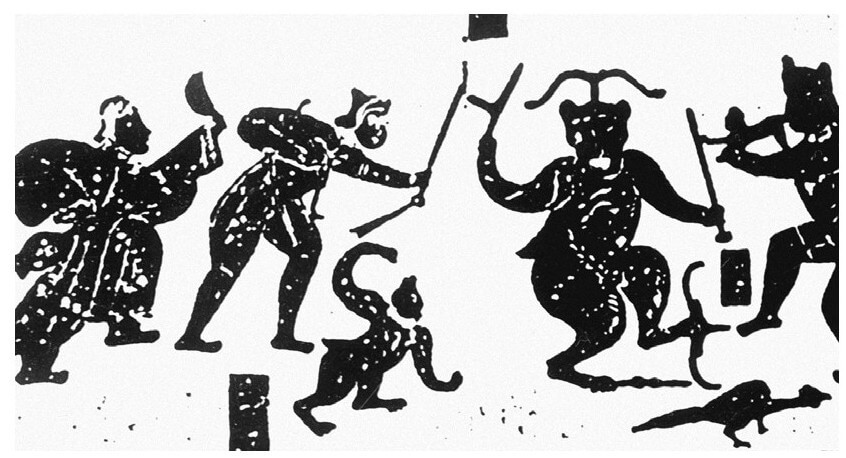
Thus, the Yellow Emperor made a last-ditch stand, summoning reinforcements from various tribal branches to engage in a decisive battle against Chi You on the fields of Zhuolu—the famous "Battle of Zhuolu."
The decisive battle began. Chi You's army charged toward the Yellow Emperor's tribe with earth-shaking war cries. The Yellow Emperor sent Yinglong to counterattack; legend has it that Yinglong could fly and summon the waters of rivers, lakes, and seas, instantly sending massive waves crashing into Chi You's forces. Chi You quickly summoned the Wind Earl and Rain Master to assist, and soon the sky darkened, thunder roared, lightning flashed, and a fierce storm broke out, making it impossible to see anything, halting the Yellow Emperor's advance. The Yellow Emperor then called upon a celestial maiden to help disperse the dark clouds, and soon the wind ceased, the rain stopped, the sun shone brightly, and the sky cleared, allowing the Yellow Emperor's army to launch a fierce assault. However, Chi You's soldiers were protected by armor that was impenetrable to swords and spears, so the Yellow Emperor's forces could not harm them. The Yellow Emperor then released various wild beasts he had trained, all fierce and massive, roaring as they charged toward Chi You's battlefield. Under the sunlight, the reflection from Chi You's soldiers' armor dazzled the beasts' eyes, enraging them, and they furiously attacked the armored Chi You soldiers. Already terrified by the sight of the wild beasts, Chi You's soldiers panicked and fled in fear when they saw the beasts charging at them like mad.
The Yellow Emperor ordered his army to pursue the fleeing enemy with full force, but Chi You summoned poisonous mists from the southern mountains and marshes, causing the emperor's troops to lose their way. Fortunately, the Yellow Emperor was prepared; having noticed that the Big Dipper in the sky always pointed north, he built a south-pointing chariot based on this principle. He deployed the chariot to guide his soldiers out of the fog. The Yellow Emperor's army swept forward with unstoppable momentum, decisively defeating Chi You's eighty-one tribal branches, capturing Chi You alive, placing him in shackles, and finally executing him.
In the Classic of Mountains and Seas, the battle between the Yellow Emperor and Chi You is recorded as follows: "Chi You raised troops to attack the Yellow Emperor, so the Yellow Emperor ordered Yinglong to attack him in the wilderness of Jizhou. Yinglong stored up water. Chi You then summoned the Wind Earl and the Rain Master to unleash a great storm. The Yellow Emperor then sent down the celestial maiden Nü Ba, who stopped the rain, and thus Chi You was killed." Gods, fierce beasts, and even various weather phenomena all took part in the battle, showing just how intense and prolonged this conflict was. After the Yellow Emperor annexed the Yan Emperor's tribe and decisively defeated the formidable Chi You tribe, his prestige soared. Many other weaker tribes voluntarily sought alliances, and soon the Yellow Emperor unified the Central Plains, becoming the founding ancestor of the Chinese nation.
The period of the Yellow Emperor's rule was also a time of many inventions and creations in cultural history, such as the cart, pottery, wells, tripods, music, bronze mirrors, and drums, all of which emerged during this era. Some people, out of admiration for the Yellow Emperor, deified him, claiming that these inventions were either made by him personally or ordered by him from his ministers. Thus, in legend, the Yellow Emperor is also portrayed as a cultural hero skilled in invention and creation.
In his poem, Mr. Lu Xun wrote, "I dedicate my blood to Xuanyuan," where "Xuanyuan" refers to the Yellow Emperor, symbolizing the Chinese nation, expressing his determination to defend it with his own blood. As the emblem of the Chinese nation, the Yellow Emperor's image has always inspired the Chinese people to unite and strive for strength.